Dia De Los Muertos

•October 26, 2011 • Leave a Comment
Celebrations honouring the dead are prevalent among many ancient cultures, sharing similar religious commonalities, sadly lacking in modern European religiosity. During a pilgrimage to Mexico I was privileged to witness and participate in the ‘Dia de los Muertos’ held November 1st –2nd each year throughout Hispanic America. Originally it would have been celebrated in the Aztec month of ‘Miccailhuitontli,’ roughly equivalent to the Gregorian months of July/August. Naturally, the colonising Spanish prohibited this festival and moved the greatly sanitised theme to November, supplanting it by their own Feasts for All Saints and All Souls. Despite the obvious Catholic overlays, this festival remains primarily Mesoamerican, revealing many indigenous celebrations of death and ancestry.
Preparations begin in early October with the cleaning and repairing of family tombs. When festivities finally get underway, the 1st of November is dedicated to ‘los angelitos’, the little angels: the souls of departed children. Flowers and candles adorn the gravesides as the family hold their evening vigil, storytelling and singing until dawn. Native Creation accounts maintain a frequency of stories relating to the first human couple as the ancestors of mankind. These are honoured today in the tales told to their descendants during the ‘Dia de los Muertos’ celebrations. As dusk falls, the 2nd of November is dedicated to ‘Los Muertos’ the dead adults to whom food, tequila and cigarettes are offered alongside ritualistic flowers of the dead –‘cempazuchitl’ (marigolds) whose perfume blends perfectly with copal, burnt upon graves and altars throughout Mexico. Mariachi bands accompany masked dancers, whose grinning skeletal faces gleefully mock death in this ceremony that celebrates our mortality as a beginning rather than an end of life. This evocative pageant to Death expresses intense devotion and veneration of Death itself whose final deliverance is deemed to come almost as a saviour from the toils of life. Fireworks and folklore drama full of sexual innuendo complete the carnival atmosphere. Children pull playfully on skeletal marionettes of death, the stark reality of which parallels every day. There is no Catholic duality here, no fear of death, just a dynamic unity in opposition.

Colour pre-dominates the scene as fire and candles illuminate the night glowing orange, the colour of the flower of death. Fruits, costumes and masks appear in abundance decorating the doorways of shops and houses everywhere. It is still believed that flowers given as sacrificial offerings are at the behest of Quetzalcoatl who instructed his people to give only these and butterflies in lieu of human flesh. Upon entering the many Cemeteries throughout Mexico,  everyone is offered steaming bowls of rich, dark hot chocolate and ‘pan de muertos’ (bread of the dead), which is a shared consumption between the living and the dead.  After blessings, these ‘dumb’ suppers are removed from ‘offrendas’ (private altars) for the public in what anthropologists recognise as the ancient tribal activity of ‘re-distributive’ feasting.
Spectacular, imposing shrines line the quadrangle of tombs, dedicated to past dignitaries and revered members of the community. Constructed of arched reeds and sheaves of corn, the shrines are adorned with garlands of tangerines and flowers. Water too is set out to slake the insatiable thirst of the dead. Immense national pride and civic prowess among competing teams guarantees a magnificent display, mindful of disqualification for the introduction of foreign elements i.e. pumpkins and cauldrons.

Candles illuminate photographs of all persons honoured and are often accompanied by ‘Calaveras,’ poignant yet satirical eulogies extolling pertinent virtues and vices of the deceased. Delicate lacy paper patterns of figures and symbols relating to death also decorate these shrines in honour and remembrance of intricate paper hats worn by ‘Mictlantecuhtli’ the Aztec Lord of death (synonymous with the Mayan ‘Ah Puch’). Marzipan and candied fruits sit among sugar and amaranth skulls, symbols of the gods of death, highlighted with red and black spots, redolent of putrefaction, convincingly depicted in decorative coloured icings. Hundreds of years ago, during the months of ‘Panquetzaliztli’ (approx November) and ‘Toxcatl’ (approx April), amaranth seeds of the ‘huala’ plant were finely ground and mixed with blood and honey to form a stiff dough. Shaped into deific skeletal figurines, primarily of ‘Tezcatlipoca,’ but also ‘Huitzilopochtli’, they were hung high upon the Xocolli tree and worshipped. Finally, they were taken down and consumed by ‘tecuelo’ (meaning quite literally – god eaten) participants, a ceremony with such a startling similarity to the Eucharist, it was suppressed by Spanish missionaries.  

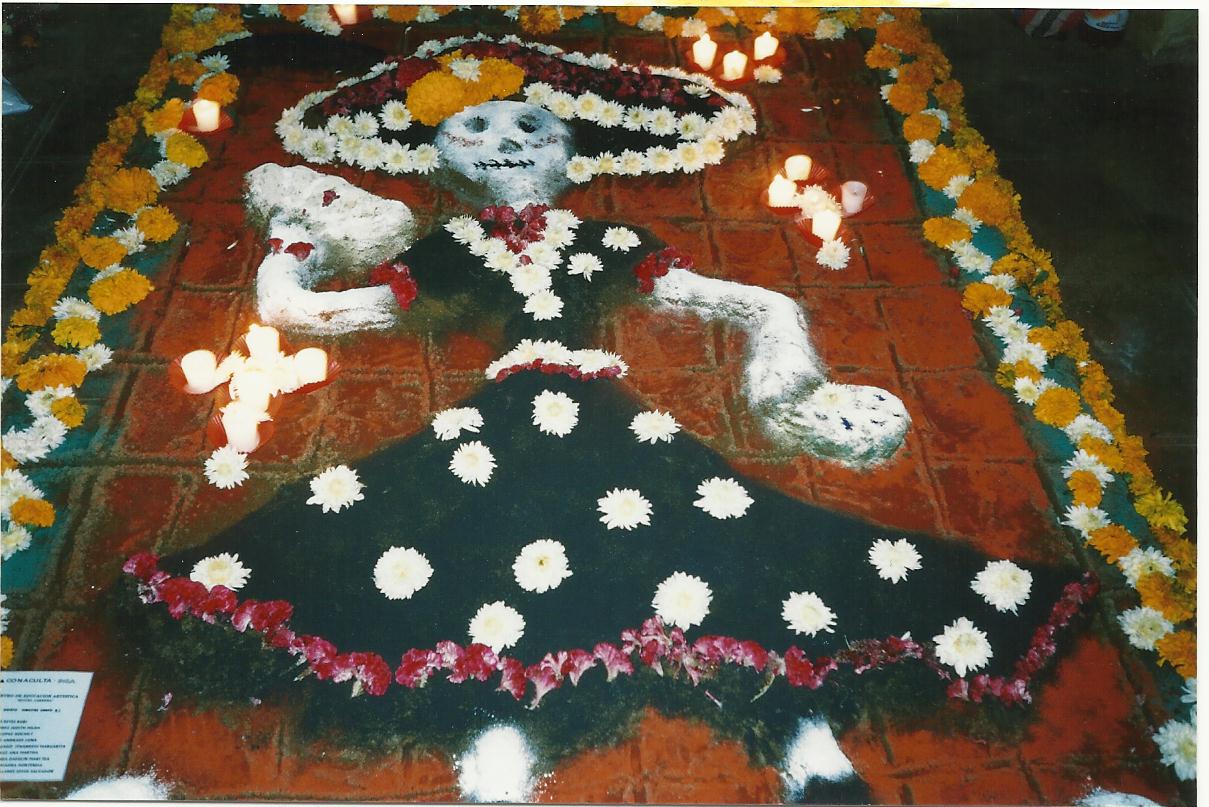
Pulque, a milky alcohol, likened to the mothers’ milk, fermented from the sap of the maguey (Agave) cactus, is still consumed as a ceremonial drink in place of ritually revered traditional hallucinogenics such as datura and morning glory. Magnificent sand ‘rugs’ decorate the stone slabs of the courtyard satirically portraying skeletal brides, bandits, dancers and musicians: death here, is a welcome inevitability. Included in these intricate designs are the images of butterflies and humming-birds, reflecting the Aztec belief in the immortal soul returning from the Underworld, now visually celebrated in the Autumnal return of the monarch butterfly in from Canada and the USA. For the Aztecs, the Underworld, though fraught with trials and tribulations was no Catholic Hell. After a harrowing journey and judgement, Mictlan was the final destination of nine levels in the Land of the Dead with many Classic funerary pyramids constructed of nine levels reflecting this.
Laying to the West, Xibalba, the Land of the Dead could also be entered through caves and bodies of water known as  ‘cenotes’, sacred water cisterns, places of ritual sacrifice to the Lord and Lady of Death – ‘Mictlantecuhtli’ and ‘Mictecacihuatl.’ Bodies were buried with grave goods of Jade beads, food and chocolate to be offered as payment upon reaching ‘Mictlan’, the final level of the wandering soul.
People reflect and embody regenerative process and so death is perceived as a cyclical symbiosis, from which life evolves. Moreover, the regenerative life cycle is connected to that of the maize, which is seen to spring from the ground nine days after the seed is planted. Mirrored in the emergence of life from the nine fleshless realms of ‘Xibalba,’ death was thus viewed as a descent into the world of spirit.
Skeletons as powerful symbols for new life are depicted in many art forms, more commonly as masks where skeletal faces are drawn back to reveal the fully fleshed life latent within. Bones, like seeds are cyclical; hence life comes from death and is not to be feared. Complex cosmologies emerged woven around the life giving maize, life from the earth and the fertilization of blood spilled upon it by the first couple and the creator gods. Ancestor worship in Meso-America is celebrated in Classic Mayan art, filled with scenes of priests and rulers offering back their blood and other sacrifices to the honoured dead.
Paralleling these ancient concepts clearly evidenced within ‘Dia de los Muertos’ celebrations is the recent rise in popularity of the ‘Cult of Santisima Muerte’ (Saint Death) who has subsumed the role of ‘Mictecacihuatl,’ the Aztec Lady of Death. As a robed female skeleton she is unashamedly called upon for all kinds of material comfort – in life. Reflecting the rise in neo-pagan/Hispanic syntheses over recent years, various commonalities prevail. Candle magic and colour correspondences dictate votive offerings for use in ‘requests’ to her; cloaks worn may for example, be black for power and vengeance, or red for affairs of the heart. Household shrines to her are lit daily with relevant flowers, food, water, tobacco and even where necessary, liquor. An evening kiss secures her good favour and fortune throughout the night. Her popularity is fast exceeding even that of the Virgin of Guadalupe in Mexico City, with thousands buying water and holy incense dedicated to her, though she is not, of course, recognised by the Catholic Church. There is even an annual ceremony for worshippers to celebrate her birthday.
Its depth and poignancy provides an insight into our real heritage as human beings, from mysteries of our creation to the power of death, reflecting a faint gnostic perspective. In a spiritually blanched society such as ours it, I think that sometimes in order to understand what we are doing here and where it is taking us, we have to remember the immortal words of Robert Cochrane that: ‘all ritual is prayer.’
Text extracted from Chpt – Dia de los Muertos: Tubelo’s Green Fire by Shani Oates.
All photos credit and copyright of Shani Oates.
The White Poppy

•October 10, 2011 • Leave a Comment
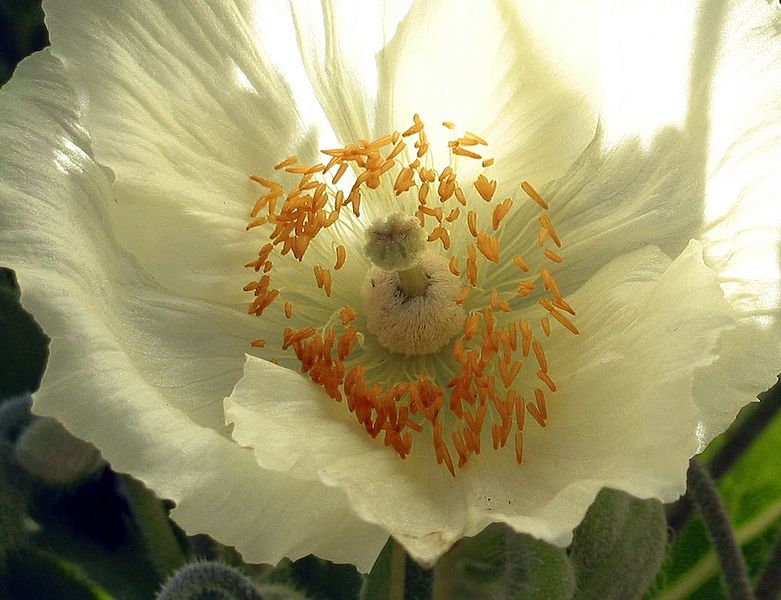
The White Poppy.
By Kenneth Grahame [1859-1932]
A riot of scarlet on gold, the red poppy of our native fields tosses
heavy tresses with gipsy abandon; her sister of the sea-shore is
golden, a yellow blossom that loves the keen salt savour of the spray.
Of another hue is the poppy of history, of romance, of the muse. White
as the stark death-shroud, pallid as the cheeks of that queen of a
silent land whose temples she languorously crowns, ghost-like beside
her fuller-blooded kin, she droops dream-laden, Papaver somniferum,
the poppy of the magic juice of oblivion. In the royal plenitude of
summer, the scarlet blooms will sometimes seem but a red cry from
earth in memory of the many dews of battle that have drenched these
acres in years gone by, for little end but that these same “bubbles
of blood” might glow to-day; the yellow flower does but hint of the
gold that has dashed a thousand wrecks at her feet around these
shores: for happier suggestion we must turn to her of the pallid
petals, our white Lady of Consolation. Fitting hue to typify the
crowning blessing of forgetfulness! Too often the sable robes of night
dissemble sleeplessness, remorse, regret, self-questioning. Let black,
then, rather stand for hideous memory: white for blessed blank
oblivion, happiest gift of the gods! For who, indeed, can say that the
record of his life is not crowded with failure and mistake, stained
with its petty cruelties of youth, its meannesses and follies of later
years, all which storm and clamour incessantly at the gates of memory,
refusing to be shut out? Leave us alone, O gods, to remember our
felicities, our successes: only aid us, ye who recall no gifts, aptly and
discreetly to forget.
Discreetly, we say; for it is a tactful forgetfulness that makes for
happiness. In the minor matter, for instance, of small money
obligations, that shortness of memory which the school of Professors
Panurge and Falstaff rashly praises, may often betray into some
unfortunate allusion or reference to the subject which shall pain the
delicate feelings of the obliger; or, if he be of coarser clay, shall
lead him in his anger to express himself with unseemliness, and
thereby to do violence to his mental tranquillity, in which alone, as
Marcus Aurelius teacheth, lieth the perfection of moral character.
This is to be a stumbling-block and an offence against the brethren.
It is better to keep just memory enough to avoid such hidden rocks and
shoals; in which thing Mr Swiveller is our great exemplar, whose
mental map of London was a chart wherein every creditor was carefully
 ‘buoyed.’
The wise man prays, we are told, for a good digestion: let us add to
the prayer — and a bad memory. Truly we are sometimes tempted to
think that we are the only ones cursed with this corroding canker. Our
friends, we can swear, have all, without exception, atrocious
memories; why is ours alone so hideously vital? Yet this isolation
must be imaginary; for even as we engage in this selfish moan for help
in our own petty case, we are moved to add a word for certain others
who, meaning no ill, unthinkingly go about to add to humanity’s
already heavy load of suffering. How much needless misery is caused in
this world by the reckless “recollections” of dramatic and other
celebrities? You gods, in lending ear to our prayer, remember too,
above all other sorts and conditions of men, these our poor
erring brothers and sisters, the sometime sommités of Mummerdom!
Moments there are, it is true, when this traitor spirit tricks you:
when some subtle scent, some broken notes of an old song, nay, even
some touch of a fresher air on your cheeks at night — a breath of
“le vent qui vient à travers la montagne” — have power to ravish,
to catch you back to the blissful days when you trod the one authentic
Paradise. Moments only, alas! Then the evil crowd rushes in again,
howls in the sacred grove, tramples down and defiles the happy garden;
and once more you cry to Our Lady of Sleep, crowned of the white
poppy. And you envy your dog who, for full discharge of a present
benefaction having wagged you a hearty, expressive tail, will then
pursue it gently round the hearth-rug till, in restful coil, half-dozen
diurnal sleeps being in truth a royal amnesty.
But whose the hand that shall reach us the herb of healing? Perdita
blesses every guest at the shearing with a handful of blossom; but
this gift is not to be asked of her whose best wish to her friends is
“grace and remembrance.” The fair Ophelia, rather: nay, for as a
nursling she hugs her grief, and for her the memory of the past is a
“sorrow’s crown of sorrow.” What flowers are these her pale hand
offers? “There’s pansies, that’s for thoughts!”For me rather, O
dear Ophelia, the white poppy of forgetfulness.


images at wikicommons

MICHAELMAS

•September 22, 2011 • 1 Comment
Michaelmas

About the time of Michael’s feast
And all his angels,
There comes a word to man and beast
By dark evangels.

Then hearing what the wild things say
To one another,
Those creatures first born of our gray
Mysterious Mother,

The greatness of the world’s unrest
Steals through our pulses;
Our own life takes a meaning guessed
From the torn dulse’s.

The draft and set of deep sea-tides
Swirling and flowing,
Bears every filmy flake that rides,
Grandly unknowing.

The sunlight listens; thin and fine
The crickets whistle;
And floating midges fill the shine
Like a seeding thistle.

The hawkbit flies his golden flag
From rocky pasture,
Bidding his legions never lag
Through morning’s vasture.

Soon we shall see the red vines ramp
Through forest borders,
And Indian summer breaking camp
To silent orders.

 The glossy chestnuts swell and burst
Their prickly houses
Agog at news which reached them first
In sap’s carouses.
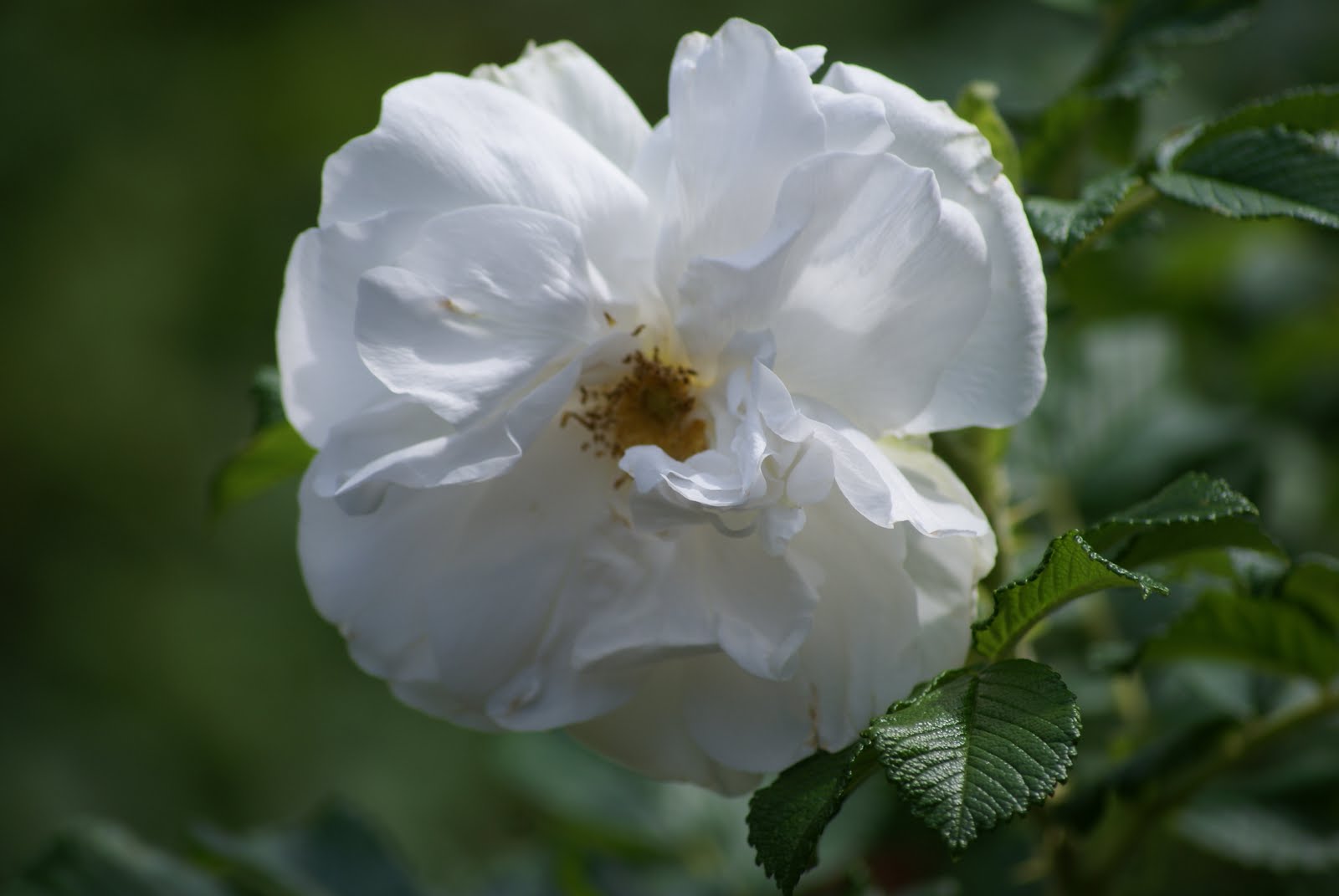
The long noons turn the ribstons red,
The pippins yellow;
The wild duck from his reedy bed
Summons his fellow.

The robins keep the underbrush
Songless and wary,
As though they feared some frostier hush
Might bid them tarry;

Perhaps in the great North they heard
Of silence falling
Upon the world without a word,
White and appalling.

The ash-tree and the lady-fern,
In russet frondage,
Proclaim ’tis time for our return
To vagabondage.

All summer idle have we kept;
But on a morning,
Where the blue hazy mountains slept,
A scarlet warning

Disturbs our day-dream with a start;
A leaf turns over;
And every earthling is at heart
Once more a rover.

All winter we shall toil and plod,
Eating and drinking;
But now’s the little time when God
Sets folk to thinking.

“Consider,” says the quiet sun,
“How far I wander;
Yet when had I not time on one
More flower to squander?”

“Consider,” says the restless tide,
“My endless labor;
Yet when was I content beside
My nearest neighbor?”

So wander-lust to wander-lure,
As seed to season,
Must rise and wend, possessed and sure
In sweet unreason.


For doorstone and repose are good,
And kind is duty;
But joy is in the solitude
With shy-heart beauty.

And Truth is one whose ways are meek
Beyond foretelling;
And far his journey who would seek
Her lowly dwelling.

She leads him by a thousand heights,
Lonelily faring,
With sunrise and with eagle flights
To mate his daring.

For her he fronts a vaster fog
Than Leif of yore did,
Voyaging for continents no log
Has yet recorded.

He travels by a polar star,
Now bright, now hidden,
For a free land, though rest be far
And roads forbidden,

Till on a day with sweet coarse bread
And wine she stays him,
Then in a cool and narrow bed
To slumber lays him.


So we are hers. And, fellows mine
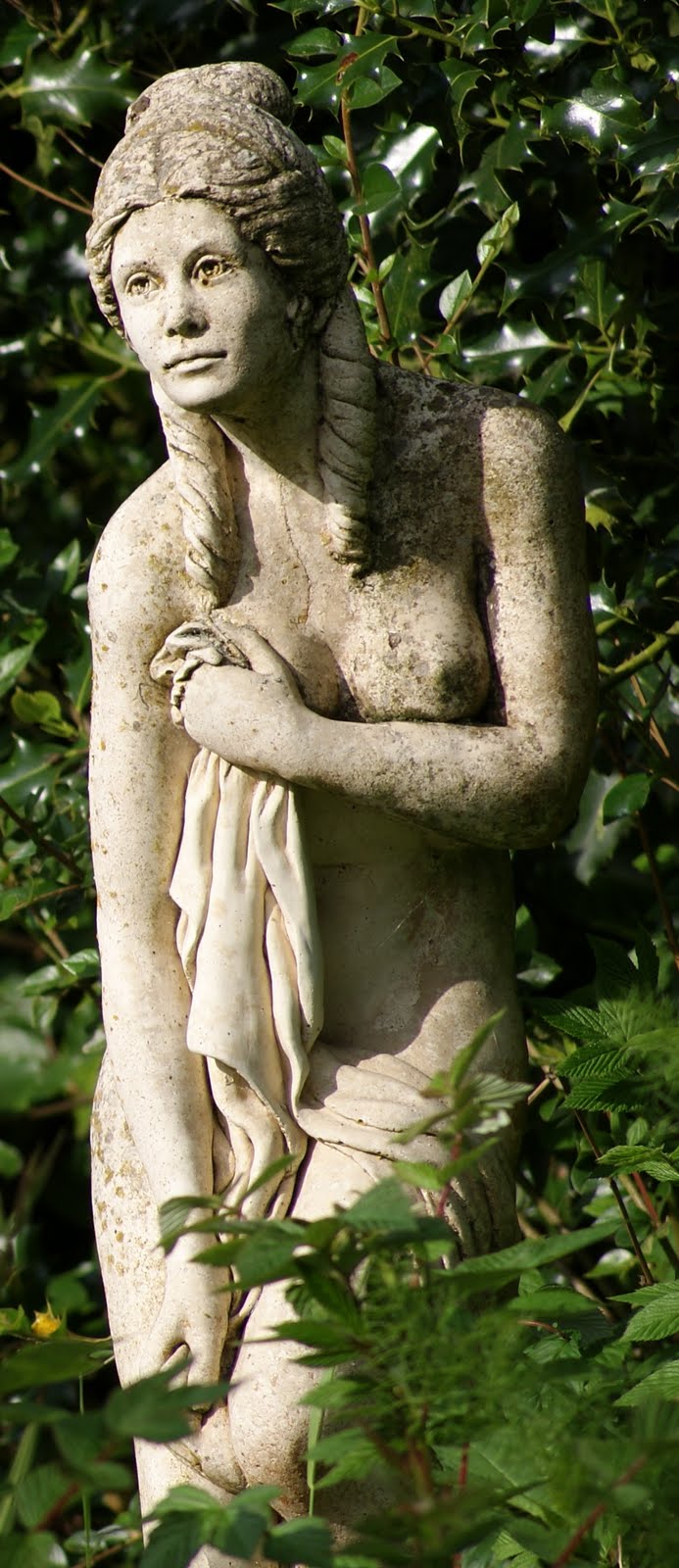
Of fin and feather,
By shady wood and shadowy brine,
When comes the weather

For migrants to be moving on,
By lost indenture
You flock and gather and are gone:
The old adventure!

I too have my unwritten date,
My gypsy presage;
And on the brink of fall I wait
The darkling message.
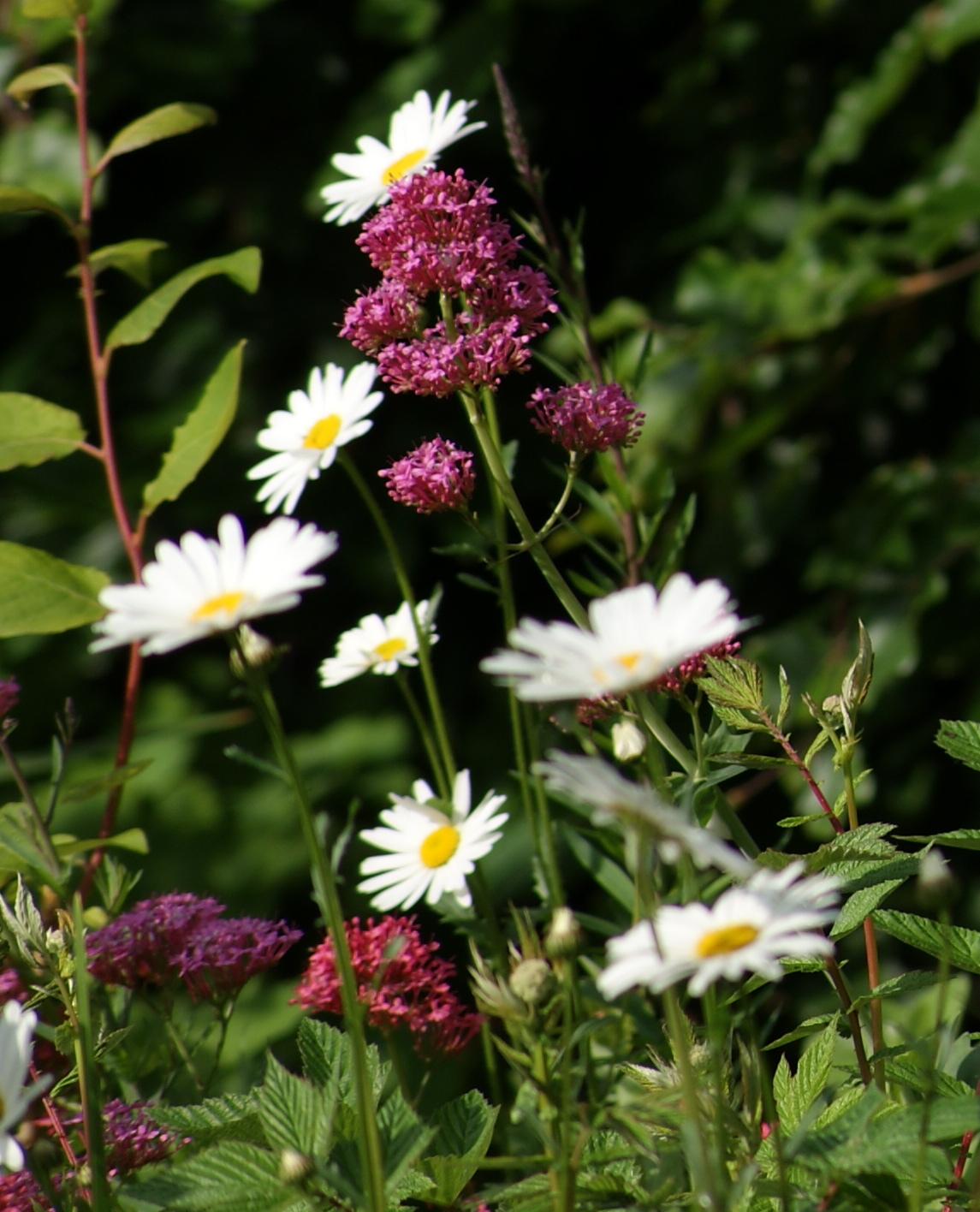
The sign, from prying eyes concealed,
Is yet how flagrant!
Here’s ragged-robin in the field,
A simple vagrant.
(April 15, 1861 – June 8, 1929
‘Canada’s poet laureate’ [http://en.wikipedia.org/wiki/Bliss_Carman]
All images courtesy of wikicommons.

Tamerlane

•September 7, 2011 • 1 Comment
Tamerlane
by Edgar Allan Poe


Kind solace in a dying hour!

      Such, father, is not (now) my theme-
      I will not madly deem that power
       Of Earth may shrive me of the sin
      Unearthly pride hath revell’d in-
      I have no time to dote or dream:
      You call it hope- that fire of fire!
      It is but agony of desire:
      If I can hope- Oh God! I can-
      Its fount is holier- more divine-
      I would not call thee fool, old man,
      But such is not a gift of thine.
        Know thou the secret of a spirit
        Bow’d from its wild pride into shame.
       O yearning heart! I did inherit
       Thy withering portion with the fame,
      The searing glory which hath shone
      Amid the jewels of my throne,
      Halo of Hell! and with a pain
      Not Hell shall make me fear again-
      O craving heart, for the lost flowers
      And sunshine of my summer hours!
      The undying voice of that dead time,
      With its interminable chime,
      Rings, in the spirit of a spell,
      Upon thy emptiness- a knell.
 
      
I have not always been as now:
      The fever’d diadem on my brow
        I claim’d and won usurpingly-
      Hath not the same fierce heirdom given
        Rome to the Caesar- this to me?
          The heritage of a kingly mind,
      And a proud spirit which hath striven
          Triumphantly with human kind.
 
 
 On mountain soil I first drew life:
        The mists of the Taglay have shed
        Nightly their dews upon my head,
      And, I believe, the winged strife
      And tumult of the headlong air
      Have nestled in my very hair.

So late from Heaven- that dew- it fell
        (Mid dreams of an unholy night)
      Upon me with the touch of Hell,
        While the red flashing of the light
        From clouds that hung, like banners, o’er
 
        Appeared to my half-closing eye
        The pageantry of monarchy,
      And the deep trumpet-thunder’s roar
        Came hurriedly upon me, telling
          Of human battle, where my voice,
      My own voice, silly child!- was swelling
          (O! how my spirit would rejoice,
      And leap within me at the cry)
      The battle-cry of Victory!
 
              The rain came down upon my head
        Unshelter’d- and the heavy wind
        Rendered me mad and deaf and blind.
      It was but man, I thought, who shed
        Laurels upon me: and the rush-
      The torrent of the chilly air
        Gurgled within my ear the crush
      Of empires- with the captive’s prayer-
      The hum of suitors- and the tone
      Of flattery ’round a sovereign’s throne.
     
       My passions, from that hapless hour,
        Usurp’d a tyranny which men
      Have deem’d, since I have reach’d to power,
          My innate nature- be it so:
        But father, there liv’d one who, then,
      Then- in my boyhood- when their fire
          Burn’d with a still intenser glow,
      (For passion must, with youth, expire)
        E’en then who knew this iron heart
        In woman’s weakness had a part.
 
     
       I have no words- alas!- to tell
      The loveliness of loving well
      Nor would I now attempt to trace
      The more than beauty of a face
      Whose lineaments, upon my mind,
      Are- shadows on th’ unstable wind:
      Thus I remember having dwelt
        Some page of early lore upon,
      With loitering eye, till I have felt
      The letters- with their meaning- melt
        To fantasies- with none.
 
      O, she was worthy of all love!
        Love- as in infancy was mine-
      ‘Twas such as angel minds above
        Might envy; her young heart the shrine
      On which my every hope and thought
       Were incense- then a goodly gift,
       For they were childish and upright-
      Pure- as her young example taught:
        Why did I leave it, and, adrift,
          Trust to the fire within, for light?
      We grew in age- and love- together,
       Roaming the forest, and the wild;
      My breast her shield in wintry weather-
      And when the friendly sunshine smil’d,
      And she would mark the opening skies,
      I saw no Heaven- but in her eyes.
 
      Young Love’s first lesson is- the heart:
        For ‘mid that sunshine, and those smiles,
      When, from our little cares apart,
        And laughing at her girlish wiles,
      I’d throw me on her throbbing breast,
        And pour my spirit out in tears-
      There was no need to speak the rest-
        No need to quiet any fears
      Of her- who ask’d no reason why,
      But turn’d on me her quiet eye!
 
      Yet more than worthy of the love
      My spirit struggled with, and strove,
      When, on the mountain peak, alone,
      Ambition lent it a new tone-
      I had no being- but in thee:
        The world, and all it did contain
      In the earth- the air- the sea-
        Its joy- its little lot of pain
      That was new pleasure- the ideal,
        Dim vanities of dreams by night-
      And dimmer nothings which were real-
        (Shadows- and a more shadowy light!)
      Parted upon their misty wings,
        And, so, confusedly, became
        Thine image, and- a name- a name!
      Two separate- yet most intimate things.


      I was ambitious- have you known
        The passion, father? You have not:
      A cottager, I mark’d a throne
      Of half the world as all my own,
        And murmur’d at such lowly lot-
      But, just like any other dream,
        Upon the vapour of the dew
      My own had past, did not the beam
        Of beauty which did while it thro’
      The minute- the hour- the day- oppress
      My mind with double loveliness.
 
      We walk’d together on the crown
      Of a high mountain which look’d down
      Afar from its proud natural towers
        Of rock and forest, on the hills-
      The dwindled hills! begirt with bowers,
        And shouting with a thousand rills.
 
      I spoke to her of power and pride,
        But mystically- in such guise
      That she might deem it nought beside
        The moment’s converse; in her eyes
      I read, perhaps too carelessly-
        A mingled feeling with my own-
      The flush on her bright cheek, to me
        Seem’d to become a queenly throne
      Too well that I should let it be
        Light in the wilderness alone.


       I wrapp’d myself in grandeur then,
        And donn’d a visionary crown-
          Yet it was not that Fantasy
          Had thrown her mantle over me-
      But that, among the rabble- men,
        Lion ambition is chained down-
      And crouches to a keeper’s hand-
      Not so in deserts where the grand-
      The wild- the terrible conspire
      With their own breath to fan his fire.
 
      Look ’round thee now on Samarcand!
        Is not she queen of Earth? her pride
      Above all cities? in her hand
        Their destinies? in all beside
      Of glory which the world hath known
      Stands she not nobly and alone?
      Falling- her veriest stepping-stone
      Shall form the pedestal of a throne-
      And who her sovereign? Timour- he
        Whom the astonished people saw
      Striding o’er empires haughtily
        A diadem’d outlaw!
 
      O, human love! thou spirit given
      On Earth, of all we hope in Heaven!
      Which fall’st into the soul like rain
      Upon the Siroc-wither’d plain,
      And, failing in thy power to bless,
      But leav’st the heart a wilderness!
      Idea! which bindest life around
      With music of so strange a sound,
      And beauty of so wild a birth-
      Farewell! for I have won the Earth.
 
     
      When Hope, the eagle that tower’d, could see
        No cliff beyond him in the sky,
      His pinions were bent droopingly-
        And homeward turn’d his soften’d eye.
      ‘Twas sunset: when the sun will part
      There comes a sullenness of heart
      To him who still would look upon
      The glory of the summer sun.
      That soul will hate the ev’ning mist,
      So often lovely, and will list
      To the sound of the coming darkness (known
      To those whose spirits hearken) as one
      Who, in a dream of night, would fly
      But cannot from a danger nigh.
 
       What tho’ the moon- the white moon
      Shed all the splendour of her noon,
      Her smile is chilly, and her beam,
      In that time of dreariness, will seem
      (So like you gather in your breath)
      A portrait taken after death.
      And boyhood is a summer sun
      Whose waning is the dreariest one-
      For all we live to know is known,
      And all we seek to keep hath flown-
      Let life, then, as the day-flower, fall
      With the noon-day beauty- which is all.
 
      I reach’d my home- my home no more
        For all had flown who made it so.
      I pass’d from out its mossy door,
        And, tho’ my tread was soft and low,
      A voice came from the threshold stone
      Of one whom I had earlier known-
        O, I defy thee, Hell, to show
        On beds of fire that burn below,
        A humbler heart- a deeper woe.
     
        Father, I firmly do believe-
        I know- for Death, who comes for me
          From regions of the blest afar,
      Where there is nothing to deceive,
          Hath left his iron gate ajar,
        And rays of truth you cannot see
        Are flashing thro’ Eternity-
      I do believe that Eblis hath
      A snare in every human path-
      Else how, when in the holy grove
      I wandered of the idol, Love,
      Who daily scents his snowy wings
      With incense of burnt offerings
      From the most unpolluted things,
      Whose pleasant bowers are yet so riven
      Above with trellis’d rays from Heaven,
     
 
      No mote may shun- no tiniest fly-
      The lightning of his eagle eye-
      How was it that Ambition crept,
       Unseen, amid the revels there,
      Till growing bold, he laughed and leapt
      In the tangles of Love’s very hair?
 
 
 photo credits copyright: shani oates

Inanna, Queen of the Heavens, Earth and the Seas

•August 24, 2011 • 1 Comment
ISHTAR’S MIDNIGHT COURTSHIP IN THE PALACE OF IZDUBAR.
As Samas’ car sank in the glowing west,
And Sin the moon-god forth had come full drest
For starry dance across the glistening skies,
The sound of work for man on earth now dies,
And all betake themselves to sweet repose.
The silver light of Sin above bright flows,
And floods the figures on the painted walls,
O’er sculptured lions, softly, lightly falls;
Like grim and silent watch-dogs at the door
They stand; in marble check their leaping roar.
The King within his chamber went his way,
Upon his golden jewelled couch he lay.
The silken scarlet canopy was hung
In graceful drapery and loosely clung
Around his couch, and purple damask cloths
Embroidered with rare skill, preserved from moths
By rich perfumes, to the carved lintel clung
In graceful folds; thus o’er the entrance hung.
Queen Ishtar softly comes, and o’er his dreams
A mystic spell she draws, until it seems
While half awake he lies, that she is yet
Close nestling in his arms, as he had met
Her in the wood, and with her there reclined,
While her soft arms around him were entwined.
Thus while he sleeps she hovers o’er his bed
With throbbing heart, and close inclines her head
Until her lips near touch the sleeping King’s,
But daring not to kiss.
                          She love thus brings,
His couch the Heavenly Queen of Love now graces,
And on his breast her glorious head she places;
Embracing him, she softly through her lips
And his, the sweetest earthly nectar sips,
While he in sleep lies murmuring of love,
And she in blissful ecstasy doth move.
Her lips to his, she wildly places there,
Until to him it seems a fond nightmare.
And thus, against his will, she fondly takes
What he her shall deny when he awakes,
The stolen kisses both the lovers thrill:
Unquenched her warm desire would kiss him still,
But his hot blood now warms him in his dream
Which is much more to him than it doth seem;
And clasping her within convulsing arms,
Receives a thrill that all his nerves alarms,
And wakes him from the dreams she had instilled.
“What means this fantasy that hath me filled,
And spirit form that o’er my pillow leans;
I wonder what this fragrant incense means?
Oh, tush! ’tis but an idle, wildering dream,
But how delightful, joyous it did seem!
Her beauteous form it had, its breath perfume;
Do spirit forms such loveliness assume?”
The goddess yet dares not her form reveal,
And quickly she herself doth now conceal
Behind the damask curtains at the door.
When he awoke, sprang to the chamber floor,
As his own maid the queen herself transforms,
Says entering in haste:
 “What wild alarms Thee, Sar?”
and then demure awaits reply,
In doubt to hear or to his bosom fly.
“My maid art thou? ‘Tis well, for I have dreamed
Of spirits, as a Zi-ru fair it seemed.”
Text: TABLET II–COLUMN I
Image 2: Photo credit copyright Shani Oates

Phanes – the Lightbringer

•July 31, 2011 • Leave a Comment
Phanes
I invoke Protogonus, of a double nature, great, wandering through the ether,
Egg-born, rejoicing in thy golden wings,
Having the countenance of a bull, the procreator of the blessed gods and mortal men,
The renowned Light, the far-celebrated Ericepæus,
Ineffable, occult, impetuous, all-glittering strength;
Who scatterest the twilight clouds of darkness from the eyes,
And roamest throughout the world upon the flight of thy wings,
Who bringest forth the pure and brilliant light, wherefore I invoke thee as Phanes,
As Priapus the king, and as dazzling fountain of splendour.
Come, then, blessed being, full of wisdom and generation, come in joy
To thy sacred, ever-varying mystery. Be present with the Priests of thy Orgies.
Chaos was generated first, and then
The wide-bosomed Earth, the ever stable seat of all
The Immortals that inhabit the snowy peaks of Olympus,
And the dark aerial Tartarus in the depths of the permeable Earth,
And Eros, the fairest of the immortal Gods,
That relaxes the strength of all, both gods and men,
And subjugates the mind and the sage will in their breasts.
From Chaos were generated Erebus and black Night,
And from Night again were generated Ether and Day,
Whom she brought forth, having conceived from the embrace of Erebus.
And Earth first produced the starry Heaven equal to herself,
That it might inclose all things around herself.
   (Theog. v. 116.)

Within the Orphic mysteries, Nyx, a black-winged spirit rose from the emptiness of the Void of Khaos to lay the silver cosmic egg containing the golden winged spirit of love – Eros, also known as Phanes the Revealer, whose radiant beauty illuminated the earth. Nyx, primal Mother Night, within her dark starry realm also birthed the Fates, the Furies, the sperids, and Nemesis. To the ancients, Phanes thus represented the bearer of ‘Light’ of gnosis drawn from the dark void of ignorance. On the physical mundane realms, this was deemed visible in the light and power of the Sun. (Shani Oates copyright – ‘Tubelo’s Green Fire’)

In short, that to the power of the Sun is to be referred the control and supremacy of all things, is indicated by the theologists, who make it evident in the mysteries by the following short invocation:

   “Oh, all-ruling Sun, Spirit of the world, Power of the world, Light of the world”

(Macrob. Sat. lib. i. c. 23.)
The Egyptian alchemist Zosimos of Panopolis interpreted Adam as Thouth:”the First Man who is Thouth among us” is named Adam, “with a name borrowed from the tongue of Angels,” by the Chaldeans….”Thus it is that the sensual Adam is named Thouth according to external patterning. As for the man who is inside Adam, the spiritual man, he has simultaneously a personal and a universal name…His Universal name is Phos (light).  

First was Chaos and Night, and black Erebus and vast Tartarus;
And there was neither Earth, nor Air, nor Heaven: but in the boundless bosoms of Erebus.
Night, with her black wings, first produced an aerial egg,
From which, at the completed time, sprang forth the lovely Eros,
Glittering with golden wings upon his back, like the swift whirlwinds.
But embracing the dark-winged Chaos in the vast Tartarus.
He begot our race (the birds),
2 and first brought us to light.
The race of the Immortals was not, till Eros mingled all things together;
But when the elements were mixed one with another, Heaven was produced, and Ocean,
And Earth, and the imperishable race of all the blessed Gods.
   
(Aristop. Aves. 698.—Suid. v. Chaos.)

First (I have sung) the vast necessity of ancient Chaos,
And Cronus, who in the boundless tracts brought forth
The Ether, and the sp lendid and glorious Eros of a two-fold nature,
The illustrious father of night, existing from eternity.
Whom men call Phanes, for he first appeared.
I have sung the birth of powerful Brimo (Hecate), and the unhallowed deeds
Of the earth-born (giants), who showered down from heaven
Their blood, the lamentable seed of generation, from when sprung
The race of mortals, who inhabit the boundless earth for ever.

  (Arg. v. 12.)

First I sung the obscurity of ancient Chaos,
How the Elements were ordered, and the Heaven reduced to bound;
And the generation of the wide-bosomed Earth, and the depth of the Sea,
And Eros (Love) the most ancient, self-perfecting, and of manifold design;
How he generated all things, and parted them from one another.
And I have sung of Cronus so miserably undone, and how the kingdom
Of the blessed Immortals descended to the thunder-loving Zeus.

   (Arg. 419.)

The theologist places around him the heads of a ram, a bull, a lion, and a dragon, and assigns him first both the male and female sex.   To him also the wings are first given.  Orpheus has the following theological speculation in allusion to Phanes. Therefore the first God bears with himself the heads of animals, many and single, of a bull, of a serpent, and of a fierce lion, and they sprung from the primeval egg in which the animal is seminally contained.

 (Proc. in Tim.)
Text:  
From: http://www.sacred-texts.com/cla/af/af10.htm      ‘orphic fragments’
 Images:
(Algris Uzdavinys)

The Garden of Eros

•July 10, 2011 • 1 Comment
The Garden Of Eros
It is full summer now, the heart of June;
Not yet the sunburnt reapers are astir
Upon the upland meadow where too soon
Rich autumn time, the season’s usurer,
Will lend his hoarded gold to all the trees,
And see his treasure scattered by the wild and spendthrift breeze.

Too soon indeed! yet here the daffodil,
That love-child of the Spring, has lingered on
To vex the rose with jealousy, and still
The harebell spreads her azure pavilion,
And like a strayed and wandering reveller
Abandoned of its brothers, whom long since June’s messenger 

 The missel-thrush has frighted from the glade,
One pale narcissus loiters fearfully
Close to a shadowy nook, where half afraid
Of their own loveliness some violets lie
That will not look the gold sun in the face
For fear of too much splendour, – ah! methinks it is a place

Which should be trodden by Persephone
When wearied of the flowerless fields of Dis!
Or danced on by the lads of Arcady!
The hidden secret of eternal bliss
Known to the Grecian here a man might find,
Ah! you and I may find it now if Love and Sleep be kind.

There are the flowers which mourning Herakles
Strewed on the tomb of Hylas, columbine,
Its white doves all a-flutter where the breeze
Kissed them too harshly, the small celandine,
That yellow-kirtled chorister of eve,
And lilac lady’s-smock, – but let them bloom alone, and leave


Yon spired hollyhock red-crocketed
To sway its silent chimes, else must the bee,
Its little bellringer, go seek instead
Some other pleasaunce; the anemone
That weeps at daybreak, like a silly girl
Before her love, and hardly lets the butterflies unfurl

Their painted wings beside it, – bid it pine
In pale virginity; the winter snow
Will suit it better than those lips of thine
Whose fires would but scorch it, rather go
And pluck that amorous flower which blooms alone,
Fed by the pander wind with dust of kisses not its own.

The trumpet-mouths of red convolvulus
So dear to maidens, creamy meadow-sweet
Whiter than Juno’s throat and odorous
As all Arabia, hyacinths the feet
Of Huntress Dian would be loth to mar
For any dappled fawn, – pluck these, and those fond flowers which
are
Fairer than what Queen Venus trod upon
Beneath the pines of Ida, eucharis,
That morning star which does not dread the sun,
And budding marjoram which but to kiss
Would sweeten Cytheraea’s lips and make
Adonis jealous, – these for thy head, – and for thy girdle take

Yon curving spray of purple clematis
Whose gorgeous dye outflames the Tyrian King,
And foxgloves with their nodding chalices,
But that one narciss which the startled Spring
Let from her kirtle fall when first she heard
In her own woods the wild tempestuous song of summer’s bird,

Ah! leave it for a subtle memory
Of those sweet tremulous days of rain and sun,
When April laughed between her tears to see
The early primrose with shy footsteps run
From the gnarled oak-tree roots till all the wold,
Spite of its brown and trampled leaves, grew bright with shimmering
gold.

 Nay, pluck it too, it is not half so sweet
As thou thyself, my soul’s idolatry!
And when thou art a-wearied at thy feet
Shall oxlips weave their brightest tapestry,
For thee the woodbine shall forget its pride
And veil its tangled whorls, and thou shalt walk on daisies pied.

And I will cut a reed by yonder spring
And make the wood-gods jealous, and old Pan
Wonder what young intruder dares to sing
In these still haunts, where never foot of man
Should tread at evening, lest he chance to spy
The marble limbs of Artemis and all her company.

And I will tell thee why the jacinth wears
Such dread embroidery of dolorous moan,
And why the hapless nightingale forbears
To sing her song at noon, but weeps alone
When the fleet swallow sleeps, and rich men feast,
And why the laurel trembles when she sees the lightening east.


And I will sing how sad Proserpina
Unto a grave and gloomy Lord was wed,
And lure the silver-breasted Helena
Back from the lotus meadows of the dead,
So shalt thou see that awful loveliness
For which two mighty Hosts met fearfully in war’s abyss!

And then I’ll pipe to thee that Grecian tale
How Cynthia loves the lad Endymion,
And hidden in a grey and misty veil
Hies to the cliffs of Latmos once the Sun
Leaps from his ocean bed in fruitless chase
Of those pale flying feet which fade away in his embrace.

And if my flute can breathe sweet melody,
We may behold Her face who long ago
Dwelt among men by the AEgean sea,
And whose sad house with pillaged portico
And friezeless wall and columns toppled down
Looms o’er the ruins of that fair and violet cinctured town.

Spirit of Beauty! tarry still awhile,
They are not dead, thine ancient votaries;
Some few there are to whom thy radiant smile
Is better than a thousand victories,
Though all the nobly slain of Waterloo
Rise up in wrath against them! tarry still, there are a few

Who for thy sake would give their manlihood
And consecrate their being; I at least
Have done so, made thy lips my daily food,
And in thy temples found a goodlier feast
Than this starved age can give me, spite of all
Its new-found creeds so sceptical and so dogmatical.

Here not Cephissos, not Ilissos flows,
The woods of white Colonos are not here,
On our bleak hills the olive never blows,
No simple priest conducts his lowing steer
Up the steep marble way, nor through the town
Do laughing maidens bear to thee the crocus-flowered gown.

Yet tarry! for the boy who loved thee best,
Whose very name should be a memory
To make thee linger, sleeps in silent rest
Beneath the Roman walls, and melody
Still mourns her sweetest lyre; none can play
The lute of Adonais: with his lips Song passed away.


Nay, when Keats died the Muses still had left
One silver voice to sing his threnody,
But ah! too soon of it we were bereft
When on that riven night and stormy sea
Panthea claimed her singer as her own,
And slew the mouth that praised her; since which time we walk
alone,

Save for that fiery heart, that morning star
Of re-arisen England, whose clear eye
Saw from our tottering throne and waste of war
The grand Greek limbs of young Democracy
Rise mightily like Hesperus and bring
The great Republic! him at least thy love hath taught to sing,

And he hath been with thee at Thessaly,
And seen white Atalanta fleet of foot
In passionless and fierce virginity
Hunting the tusked boar, his honied lute
Hath pierced the cavern of the hollow hill,
And Venus laughs to know one knee will bow before her still.

 And he hath kissed the lips of Proserpine,
And sung the Galilaean’s requiem,
That wounded forehead dashed with blood and wine
He hath discrowned, the Ancient Gods in him
Have found their last, most ardent worshipper,
And the new Sign grows grey and dim before its conqueror.

Spirit of Beauty! tarry with us still,
It is not quenched the torch of poesy,
The star that shook above the Eastern hill
Holds unassailed its argent armoury
From all the gathering gloom and fretful fight –
O tarry with us still! for through the long and common night,

Morris, our sweet and simple Chaucer’s child,
Dear heritor of Spenser’s tuneful reed,
With soft and sylvan pipe has oft beguiled
The weary soul of man in troublous need,
And from the far and flowerless fields of ice
Has brought fair flowers to make an earthly paradise.


We know them all, Gudrun the strong men’s bride,
Aslaug and Olafson we know them all,
How giant Grettir fought and Sigurd died,
And what enchantment held the king in thrall
When lonely Brynhild wrestled with the powers
That war against all passion, ah! how oft through summer hours,

Long listless summer hours when the noon
Being enamoured of a damask rose
Forgets to journey westward, till the moon
The pale usurper of its tribute grows
From a thin sickle to a silver shield
And chides its loitering car – how oft, in some cool grassy field

Far from the cricket-ground and noisy eight,
At Bagley, where the rustling bluebells come
Almost before the blackbird finds a mate
And overstay the swallow, and the hum
Of many murmuring bees flits through the leaves,
Have I lain poring on the dreamy tales his fancy weaves,

And through their unreal woes and mimic pain
Wept for myself, and so was purified,
And in their simple mirth grew glad again;
For as I sailed upon that pictured tide
The strength and splendour of the storm was mine
Without the storm’s red ruin, for the singer is divine;

The little laugh of water falling down
Is not so musical, the clammy gold
Close hoarded in the tiny waxen town
Has less of sweetness in it, and the old
Half-withered reeds that waved in Arcady
Touched by his lips break forth again to fresher harmony.

Spirit of Beauty, tarry yet awhile!
Although the cheating merchants of the mart
With iron roads profane our lovely isle,
And break on whirling wheels the limbs of Art,
Ay! though the crowded factories beget
The blindworm Ignorance that slays the soul, O tarry yet!

 For One at least there is, – He bears his name
From Dante and the seraph Gabriel, –
Whose double laurels burn with deathless flame
To light thine altar; He too loves thee well,
Who saw old Merlin lured in Vivien’s snare,
And the white feet of angels coming down the golden stair,

Loves thee so well, that all the World for him
A gorgeous-coloured vestiture must wear,
And Sorrow take a purple diadem,
Or else be no more Sorrow, and Despair
Gild its own thorns, and Pain, like Adon, be
Even in anguish beautiful; – such is the empery

Which Painters hold, and such the heritage
This gentle solemn Spirit doth possess,
Being a better mirror of his age
In all his pity, love, and weariness,
Than those who can but copy common things,
And leave the Soul unpainted with its mighty questionings.

 
But they are few, and all romance has flown,
And men can prophesy about the sun,
And lecture on his arrows – how, alone,
Through a waste void the soulless atoms run,
How from each tree its weeping nymph has fled,
And that no more ‘mid English reeds a Naiad shows her head.

Methinks these new Actaeons boast too soon
That they have spied on beauty; what if we
Have analysed the rainbow, robbed the moon
Of her most ancient, chastest mystery,
Shall I, the last Endymion, lose all hope
Because rude eyes peer at my mistress through a telescope!

What profit if this scientific age
Burst through our gates with all its retinue
Of modern miracles! Can it assuage
One lover’s breaking heart? what can it do
To make one life more beautiful, one day
More godlike in its period? but now the Age of Clay

Returns in horrid cycle, and the earth
Hath borne again a noisy progeny
Of ignorant Titans, whose ungodly birth
Hurls them against the august hierarchy
Which sat upon Olympus; to the Dust
They have appealed, and to that barren arbiter they must

Repair for judgment; let them, if they can,
From Natural Warfare and insensate Chance,
Create the new Ideal rule for man!
Methinks that was not my inheritance;
For I was nurtured otherwise, my soul
Passes from higher heights of life to a more supreme goal.

Lo! while we spake the earth did turn away
Her visage from the God, and Hecate’s boat
Rose silver-laden, till the jealous day
Blew all its torches out: I did not note
The waning hours, to young Endymions
Time’s palsied fingers count in vain his rosary of suns!

Mark how the yellow iris wearily
Leans back its throat, as though it would be kissed
By its false chamberer, the dragon-fly,
Who, like a blue vein on a girl’s white wrist,
Sleeps on that snowy primrose of the night,
Which ‘gins to flush with crimson shame, and die beneath the light.
Come let us go, against the pallid shield
Of the wan sky the almond blossoms gleam,
The corncrake nested in the unmown field
Answers its mate, across the misty stream
On fitful wing the startled curlews fly,
And in his sedgy bed the lark, for joy that Day is nigh,

Scatters the pearled dew from off the grass,
In tremulous ecstasy to greet the sun,
Who soon in gilded panoply will pass
Forth from yon orange-curtained pavilion
Hung in the burning east: see, the red rim
O’ertops the expectant hills! it is the God! for love of him

Already the shrill lark is out of sight,
Flooding with waves of song this silent dell, –
Ah! there is something more in that bird’s flight
Than could be tested in a crucible! –
But the air freshens, let us go, why soon
The woodmen will be here; how we have lived this night of June!

poem by Oscar Wilde
photo credits copyright of shani oates 
except for ‘Cupid’s Hunting Fields’ by E. Burne-Jones.

Kali-Ma

•June 27, 2011 • Leave a Comment
 KALI-MA
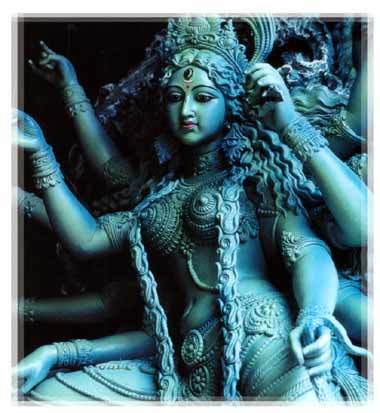
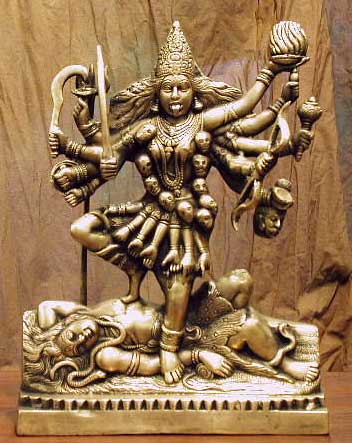
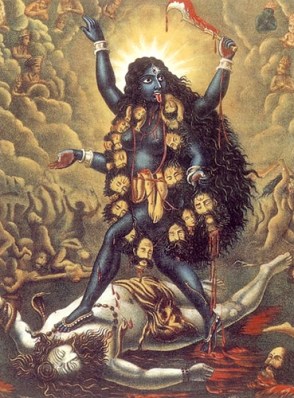
Kali  is the divine qutub; erect upon the inert corpse of Shiva, She generates the impulse of life, of the manifest moment; Mother of the gods. Consort of Lord Shiva, who dances the Universe into being. Order from Chaos.
The universe descends from the eternal void, the infernal Absu. 1


“Kali, also known as Kalika, is the Hindu goddess associated with eternal energy. The name Kali means “black” but has, by folk etymology, come to mean “force of time (kala).” Kali is today considered the goddess of time and change. Although sometimes presented as dark and violent, her earliest incarnation as a figure of annihilation still has some influence. More complex Tantric beliefs sometimes extend her role so far as to be the “ultimate reality” or Brahman. She is also revered as Bhavatarini (literally “redeemer of the universe”).”2
Why is Mother Kali so radiantly black?
Because she is so powerful,
that even mentioning her name destroys delusion.
Because she is so beautiful,
Lord Shiva, Conqueror of death,
lies blissfully vanquished,
beneath the red soled feet.
There are subtle hues of blackness,
But her bright complexion
is the mystery that is utterly black,
overwhelmingly black, wonderfully black.
When she awakens in the lotus shrine
within the heart’s secret cave,
her blackness becomes the mystic illumination
that causes the twelve petal blossom there
to glow more intensely than golden embers.
Her lovely form is the incomparable
Kali- black blacker than the King of Death.
Whoever gazes upon this radiant blackness falls eternally in love
and feels no attraction to any other,
discovering everywhere only her.
This poet sighs deeply,
“Where is this brilliant lady, this black light beyond luminosity?
Though I have never seen her, simply hearing her name,
the mind becomes absorbed completely in her astonishing reality.
Om Kali! Om Kali! Om Kali!3
O longing mind,
consecrate your being to pure love.
Turn every thought to Goddess Tara.
She will bear you tenderly across the raging sea
of separation and individuality.
Be utterly dedicated to her reality.
Cry aloud Ma Kali, Ma Kali.
Know that she can clarify
the inconceivable maze of relativity.
To hope for assistance and guidance through this world
from wealth, relatives, and religious rites
provides no profound solution.
Have you forgotten that everyone is lost?
Where are you now? Why are you travelling?
This cosmos is the strange theatre where souls act,
wearing various costumes and disguises.
This intricate play of transparent energy
is initiated, sustained, and dissolved by Kali,
who is the dream power of Absolute Reality.
At this very moment, you are resting
on the vast lap of Mother’s cosmic dream
that you misperceive
as the narrow prison of suffering.
Why abandon the kingdom of awareness
to obsession with self and disdain for others,
to hollow passion and abject clinging?
You are creating a disease without a remedy.
The brief day of your earthly life is almost over.
Meditate now on beautiful Black Tara.
She is seated upon the jewel island of essence
in the transparent sea of ultimacy.
This poet sings drunkenly:
“Tara! Tara! Tara!
Your name is ambrosia.
May all beings enter the secret sanctuary
through this name,
tasting your unique sweetness,
self-luminous awareness.”4
NOTES: 1 – shani oates
              2ferrebeekeeper.wordpress.com
            3.Ramprasad Sen 

Version by: Lex Hixon From Mother of the Universe “Visions of the Goddess and Tantric Hymns of Enlightenment”

           4. – by: Ramprasad Sen

Version: Lex Hixon from “Mother of the Universe”


Images:


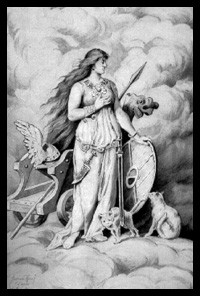
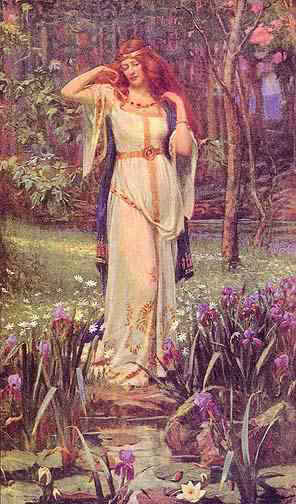
FREYA

•June 16, 2011 • Leave a Comment

The songs I know    that king’s wives know not,
Nor men that are sons of me;
The first is called help,    and help it can bring thee
In sorrow and pain and sickness.
A second I know,    that men shall need
Who leechcraft long to use.
.    .    .    .    .    .    .    .    .    .    .    .    .
.    .    .    .    .    .    .    .    .    .
A third I know,     if great is my need
Of fetters to hold my foe;
Blunt do I make    mine enemy’s blade,
Nor bites his sword or staff.
A fourth I know,    if men shall fasten
Bonds to my bended legs;
So great is the charm    that forth I may go,
The fetters spring from my feet,
Broken the bonds from my hands.
A fifth I know,    if I see from afar
An arrow fly ‘gainst the folk;
If flies not so swift    that I stop it not,
If ever my eyes behold it.
A sixth I know,    if harm one seeks
With a sapling’s roots to send me;
The hero himself    who wreaks his hate
Shall taste the ill ere I.
A seventh I know,    if I see in flames
The hall o’er my comrades’ heads;
It burns not so wide    that I will not quench it,
I know that song to sing.
An eighth I know,    that is to all
Of greatest good to learn;
When hatred grows    among heroes’ sons,
I soon can set it right.
A ninth I know,    if need there comes
To shelter my ship on the flood;
The wind I calm    upon the waves,
And the sea I put to sleep.
A tenth I know,    what time I see
House-riders flying on high;
So can I work    that wildly they go,
Showing their true shapes,
Hence to their own homes.
An eleventh I know,    if needs I must lead
To the fight my long-loved friends;
I sing in the shields,     and in strength they go
Whole to the field of fight,
Whole from the field of fight,
And whole they come thence home.
A twelfth I know,    if high on a tree
I see a hanged man swing;
So do I write    and colour the runes
That forth he fares,
And to me talks.
A thirteenth I know,    if a thane full young
With water I sprinkle well;
He shall not fall,    though he fares mid the host,
Nor sink beneath the swords.
A fourteenth I know,    if fain I would name
To men the mighty gods;
All know I well    of the gods and elves,–
Few be the fools know this.
A fifteenth I know,    that before the doors
Of Delling sang Thjothrorir the dwarf;
Might he sang for the gods,    and glory for elves,
And wisdom for Hroptatyr wise.
A sixteenth I know,    if I seek delight
To win from a maiden wise;
The mind I turn    of the white-armed maid,
And thus change all her thoughts.
A seventeenth I know,    so that seldom shall go
A maiden young from me;
.    .    .    .    .    .    .    .    .    .    .    .    .    .    .    .
.    .    .    .    .    .    .    .    .
An eighteenth I know,    that ne’er will I tell
To maiden or wife of man,–
The best is what none    but one’s self doth know,
So comes the end of the songs,–
Save only to her    in whose arms I lie,
Or else my sister is.
Images:

Pale Shadows

•June 1, 2011 • 1 Comment
A DIALOGUE OF SELF AND SOUL

I [My Soul] I summon to the winding ancient stair;
Set all your mind upon the steep ascent,
Upon the broken, crumbling battlement,
Upon the breathless starlit air,
‘Upon the star that marks the hidden pole;
Fix every wandering thought upon
That quarter where all thought is done:Who can distinguish darkness from the soul
(1)


 I[My Self]. The consecrates blade upon my knees
Is Sato’s ancient blade, still as it was,
Still razor-keen, still like a looking-glass
Unspotted by the centuries;
That flowering, silken, old embroidery, torn
From some court-lady’s dress and round
The wooden scabbard bound and wound
Can, tattered, still protect, faded adorn.
(2)
 
  I[My Soul.] Why should the imagination of a man
Long past his prime remember things that are
Emblematical of love and war?
Think of ancestral night that can,
If but imagination scorn the earth
And intellect is wandering
To this and that and t’other thing,
Deliver from the crime of death and birth.
(3)

 I [My self.] Montashigi, third of his family, fashioned it
Five hundred years ago, about it lie
Flowers from I know not what embroidery —
Heart’s purple — and all these I set
For emblems of the day against the tower
Emblematical of the night,
And claim as by a soldier’s right
A charter to commit the crime once more.
(4)


I [My Soul.] Such fullness in that quarter overflows
And falls into the basin of the mind
That man is stricken deaf and dumb and blind,
For intellect no longer knows
I{Is} from the I{Ought,} or I{knower} from the I{Known — }
That is to say, ascends to Heaven;
Only the dead can be forgiven;
But when I think of that my tongue’s a stone.
(5)

 I [My Self.] A living man is blind and drinks his drop.
What matter if the ditches are impure?
What matter if I live it all once more?
Endure that toil of growing up;
The ignominy of boyhood; the distress
Of boyhood changing into man;
The unfinished man and his pain
Brought face to face with his own clumsiness;
The finished man among his enemies? —
How in the name of Heaven can he escape
That defiling and disfigured shape
The mirror of malicious eyes
Casts upon his eyes until at last
He thinks that shape must be his shape?
And what’s the good of an escape
If honour find him in the wintry blast?
I am content to live it all again
And yet again, if it be life to pitch
Into the frog-spawn of a blind man’s ditch,
A blind man battering blind men;
Or into that most fecund ditch of all,
The folly that man does
Or must suffer, if he woos
A proud woman not kindred of his soul.
I am content to follow to its source
Every event in action or in thought;
Measure the lot; forgive myself the lot!
When such as I cast out remorse
So great a sweetness flows into the breast
We must laugh and we must sing,
We are blest by everything,
Everything we look upon is blessed.
 
(6)
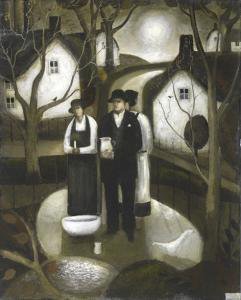
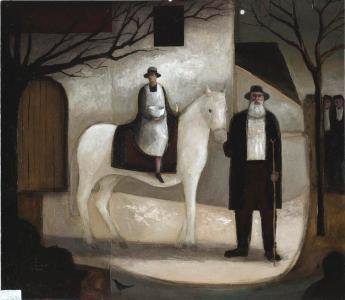
All paintings copyright of John Caple. facebook.com/john.caple courtesy of the John Martin Gallery, London
Poem by William Butler Yeats.


Picnic in Akeldama

Cooking... And something like cooking...

Tales From The Under Gardener's Lodge

Home, hearth and life immeasurable

Of Axe and Plough

Anglo-Saxon Heathenry and Roman Polytheism

My search for magic

Looking for magic in the modern world

Man of Goda

People of Goda, Clan of Tubal Cain

The Elder Tree

Life as a Witch.

Sorcerous Transmutations

Meanderings of the Muse:honouring the sacred muse in word and vision

Across the Abyss

Meanderings of the Muse:honouring the sacred muse in word and vision

Clan of the Entangled Thicket 1734

Meanderings of the Muse:honouring the sacred muse in word and vision

Daniel Bran Griffith - The Chattering Magpie

Meanderings of the Muse:honouring the sacred muse in word and vision

The Cunning Apostle

Cunning Man, Mystic, Eccentric & Outcast