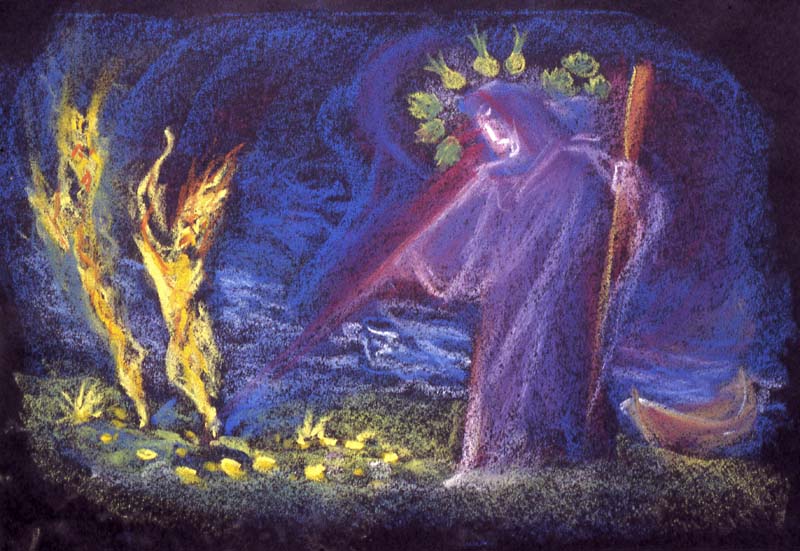
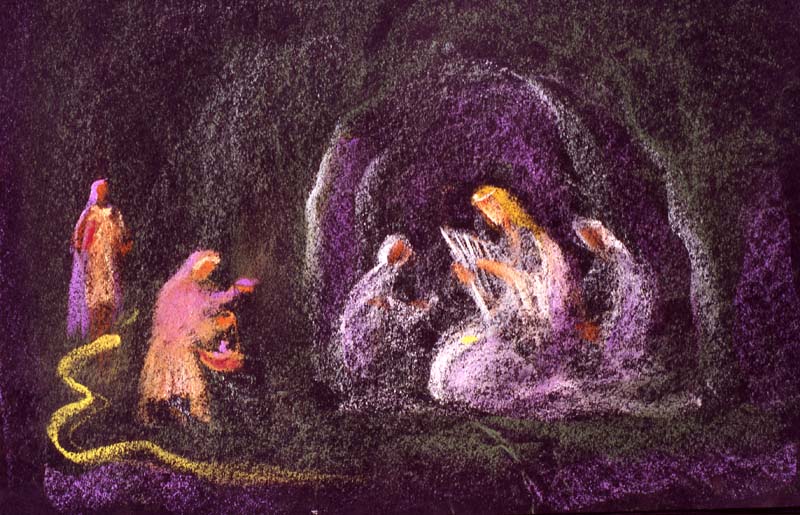
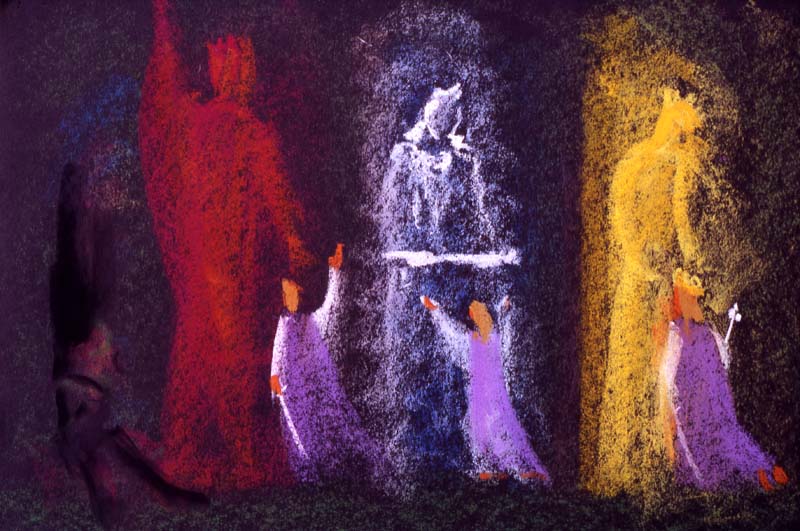
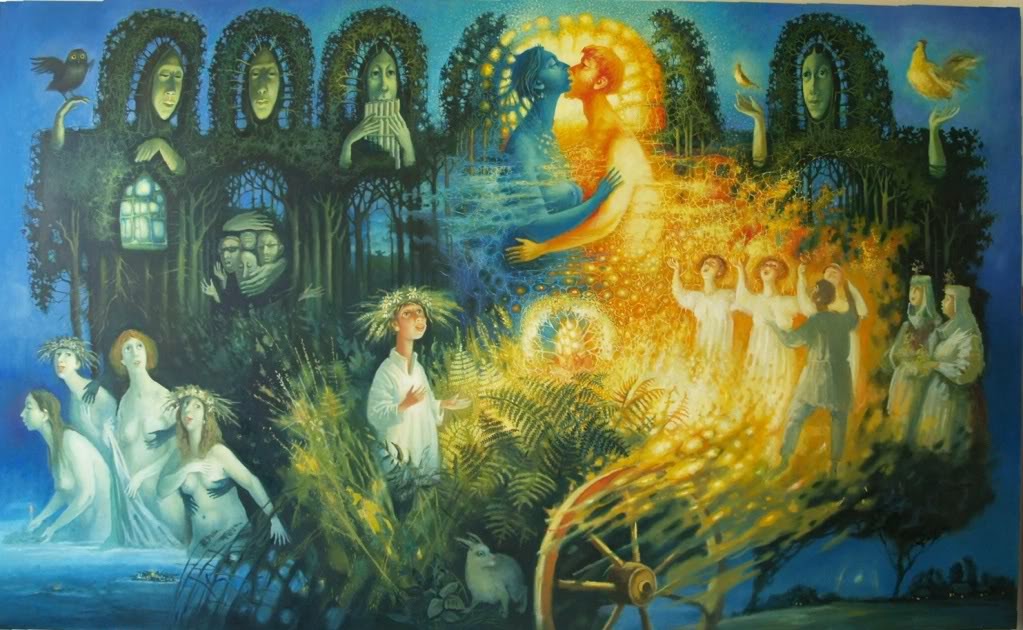
Appearing at Michaelmas in a German magazine in 1795 This gloriously mystical adult fairy tale by Johann Wolfgang von Goethe – “The Green Snake and the Beautiful Lily” explores the theme of personal alchemy inspired by light and balance, as virtues for spiritual transformation. The journey of the soul is outlined in a tale that champions morality and ethics over commerce and capital. It perfectly encapsulates the eternal pilgrimage of the mystic’s soul, and the treasure it seeks – the balance in all things.
“What is more noble than Gold?”.
“Light” replies the Snake.
“And what is more refreshing than Light?” asks the King.
If the extracts selected below whet your appetite, please do read it in full, visit the attendant artworks and read other connected works associated with it.
“Goethe came to recognise three principles at work in organic nature: metamorphosis, polarity and enhancement. In other words: changing of form, the meeting of opposites (for example, day and night) and a climax or ‘crowning glory’ in a piece of creation (like a flower on top of a plant). It is just these qualities of magical change, meeting of opposites and glorious moments of achievement, of fulfilment, that one finds in a Fairy Tale! When we bear this in mind, Goethe’s life-path of development as a natural scientist – bringing his art into science and his science into art – becomes more visibly relevant to his ability to create a true Fairy Tale. https://www.newview.org.uk/goethe.php
This Fairy Tale was written by Goethe as a response to a work of Schiller’s entitled Über die aesthetische Erziehung des Menschen (Letters on the Aesthetic Education of Man). One of the main thoughts considered in these ‘letters’ centred around the question of human freedom. What should be the condition of the human soul forces to achieve this freedom? Schiller recognised Necessity (instinct, passion, the realm of the Senses) and Reason as two forces in the human soul. If either one predominated over the other, it prevented the human being from attaining real freedom; either the soul would be driven by blind necessity, or else a cold reason would suppress all passion and instinct. https://www.newview.org.uk/goethe.php
Only by establishing a middle ground, where necessity and reason harmonised, could freedom exist. Thus Schiller had conceived of a threefold model of the human being, where, in the balance between the two poles of Necessity and Reason, Freedom would exist for the Human Personality. Schiller saw that a harmonious social life could only be founded on the basis of free human personalities. He saw that there was an ‘ideal human being’ within everyone and the challenge was to bring the outer life experiences into harmony with this ‘ideal’. Then the human being would lead a truly worthy existence. Schiller was trying to build an inner bridge between the Person in the immediate reality and the ‘ideal human being’. He wrote these ‘Letters’ during the time and context of the French Revolution. This revolution was driven by a desire for outer social changes to enable human personalities to become free. But both Schiller and Goethe recognised that freedom cannot be ‘imposed’ from the outside but must arise from within each person.”https://www.newview.org.uk/goethe.php
This remarkable tale does not end there however.
“At Michaelmas, September 29th, 1900, Steiner gave a private lecture where he spoke about the Fairy Tale under the title Goethe’s Secret Revelation(Goethe’s geheime Offenbarung). He was later to refer to this as his first anthroposophical lecture. […] The theme of Goethe’s Fairy Tale is the transformation of the soul, which is an alchemical process. The Fairy Tale itself is a piece of alchemy, as Steiner discovered, whereby he was able to state from his own spiritual research that it was a work of art inspired by Rosicrucian wisdom.”https://www.newview.org.uk/goethe.php
Both men insightfully aligned this mystical theme founded in balance to Michaelmas
“Those serving the Rosicrucian path are concerned with the transformation of substance – both the substance of the human soul and of the earth Herself. Matter can be viewed as condensed spirit, darkened light, held fast, ‘spell-bound’, enchanted into physical form, as it were. When a transforming spiritual impulse can penetrate into matter, the condensed, imprisoned spirit-form can be released anew into pure spirit. The transforming of ‘soul substance’ is the overcoming of selfish human desires, making the soul a fit vessel for the spirit. Spiritual transformation of substance is the basis of a true alchemy. Goethe’s Fairy Tale has an inner architecture that follows alchemical principles. These principles – of separation, purification and re-combining in a new way – can be seen in the tale: the differentiation of the characters and their tasks, the purification through love and sacrifice (which the Green Snake willingly does), then leading to a new community life-condition imbued with spirit. On the way through this process, death occurs, showing the Rosicrucian principle of ‘dying in order to become’. This principle Goethe upheld in his own life and creative work. Nature, going through Her cycles, readily describes this process with the dying away in autumn and the birth of new life in spring.” https://www.newview.org.uk/goethe.php
[…] The Green Snake, who has her home in a cleft in the rocks, is the embodiment of the subterranean forces of the soul. Life on Earth brings experiences to the human soul and the Green Snake is the embodiment of the sum of these experiences which when ripe, when ‘the Time has come’, can be sacrificed to form a permanent and fully conscious bridge to the spirit. These two conditions – of Lily and Snake – must be freely united in the soul in order for it to fulfil its true being. (Here we might recall Schiller’s three-fold picture.) The young Prince is the seeking soul. By the end of the tale, his unity with the Beautiful Lily has come about due to the awakening of previously slumbering soul forces enabling the Prince to unite with Freedom through the sacrifice of his life experience, when the time is ripe, as embodied in the actions of the Green Snake. His earthly life experience has now been transformed, becoming a new inner quality uniting the ‘two lands’. This is the new condition of soul that both Schiller and Goethe were striving to experience: The Free Human Personality. This soul transformation, bringing about new human community, is the outcome of the Fairy Tale.[…]
Originally Steiner had intended to create a dramatic form of Goethe’s Fairy Tale, but discovered that it could not happen because “it was clearly necessary to present these images in a far more concrete manner suited for our time”. And so Steiner metamorphosed the figures of Goethe’s Fairy Tale, essentially the different soul forces at work in one human soul, into individual human beings, where one soul force or another predominates, dealing with life’s tensions in a contemporary setting. This drama he called “The Portal of Initiation”. echoing the qualities of Jacob Boehme (a German mystic of the Middle ages), The characters in this mystery drama show the relationship of karma and destiny in human souls striving to come closer to the spirit. This Drama was performed in 1910 and Steiner wrote three more. In the second he drew upon traditions of the Knights Templar. The third and fourth Steiner claims as purely his own, representing the workings of Anthroposophy.
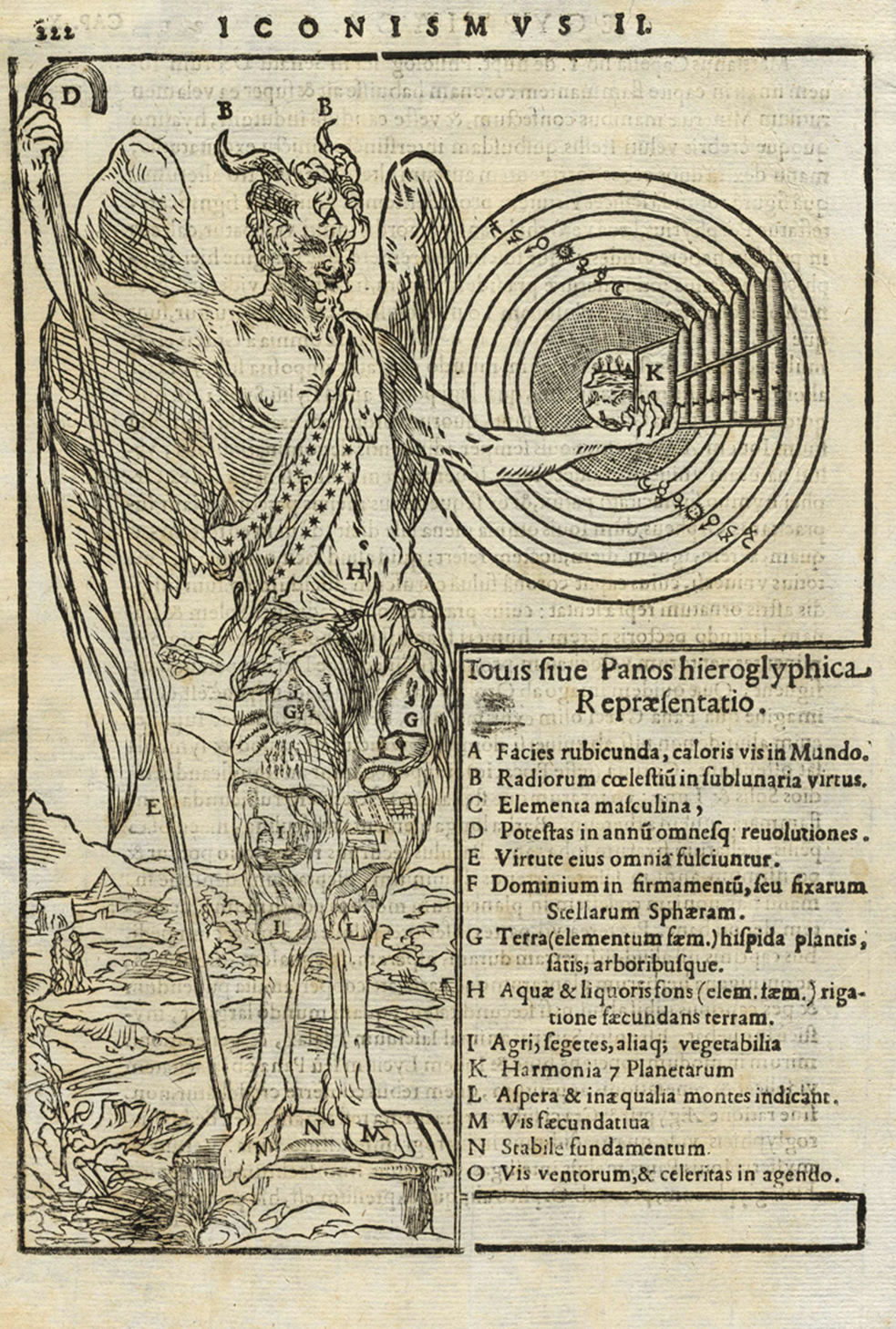
Athanasius Kircher, ‘Iovis sive Panos hieroglyphica raepresentatio.’ (1652-1654.)
The Following is my own interpretation of the imagery abound in this Illustration, and how it relates to the Latin expressions. (NB: not a translation of the Latin)
A = The Face: of the material world. (Facies rubicunda, caloris vis in Mundo.)
B = The (Goat) Horns: representing power beneath the Moon. (Radiorum cœlestiu in sublunaria virtus.)
C = The Shaggy Beard: depicting the wildness of male nature. (Elementa masculina.)
D = The Curved Staff Handle: depicting how wisdom molds what it touches, bending form into submission. (Potestas in annuomnesq reuolutiones.)
E = The Shaft of the Lituus* Staff: the pillar of personal virtue (power) being a symbol of office and calling (Virtute eius omnia fulciunrur.)
F = The Spotted Animal skin, draped over his shoulder, representing the stary canopy above the moon. (Dominium in firmamentu, feu fixarum Stellarum Sphæram.)
G = The Shaggy (Hips) Haunches: The valley’s peaks, vales and hills of the forested landscapes of Pan. (Terra (elementum fæm.) hispida plantis, satis, arboribusque.)
H = The Genitals: the vitality and vigour of life. (Aquæ & liquorisfons (elem.fæm.) rigatione fæcundans terram.)
I = The Lower Legs: The flowing rivers and streams that carry life and fertility to flora and fauna. (Agri, segetes, aliaq; vegetabilia.)
K = The Syrinx of 7 Reeds: becomes the planetary spheres of ethereal harmony. (Harmonia 7 Planetarum)
L = The Knee Joints of the Goat Legs: The Nodes that support the pillars of the Material Universe. (Aspera & inæqualia montes indicant.)
M = The Hooves: The beating thunder of our animal nature within and upon the earth. (Vis fæcundatiua)
N = The Square Pedestal Mount: That upon which the figure stands, lauded in elevation. (Stabile fundamentum.)
O = The Feathered Wings: The Transcendent nature of the Spirit. (Vis ventorum, & celeritas in agendo.)
People gather before the hut of an old woman who sits at the door with a black cat at her feet. A horseshoe hangs over the entrance, through which a male figure is seen in the shadows. This (wood-engraved) cutting is taken from the ‘Illustrated London News,’ 7 June 1851, p.542.[1]
The Spae Wife
Hidden awa, in a neuk o’ the fair,
Slicht, an sleekit, an sly,
The spae wife sits, in the spae wife’s tent,
Watchin the fowk gaun by.
Hidden awa, in her lang-luggit lair,
Her skill, the gift o’ the gab,
The spae wife sits, in the spae wife’s tent,
A wyver, wyvin her wab.
Her een’s twa lichtit spunks o’ fire,
Her hair’s a corbie’s wing,
She’s steep’t till the core, in the Black, black airt
Her truth’s a birlin ring.
Fur Misery’s a mairket place,
That’s trade fur as the sizzens,
The spae wife kens, the fly auld jaad,
That Hope sells mair nur besoms.
Her Ace o’ Trumps is promises,
She’s skilled at the hinneyed lee,
Thoombin the cairds o’ Fortune
Tae ken fit weird ye’ll dree.
Fur fit’s afore, ye’ll nae win by,
Bit a nod’s as guid as a wink,
An some wid sup wi’ the Deil himsel,
The Ace o’ Spaads tae jink.
As iron boos i’ the blacksmith’s haun,
As meal mells wi the miller,
The lassie’s thochts on a pyock o’ dreams
The spae wife’s thochts on siller.
In Scottish belief, a spaewife was a valued member of the community, much like the charmers, both being quite distinct from a witch – the latter was perceived elsewhere as a malefic practitioner of magic. Spaewives were consulted for healing and to foretell or divine the future; sometimes to lift a curse. Walter Traill Dennison, a 19th-century folklorist and Orkney native wrote of the folk tales of Orkney and the role of the spaewife there.
The 19th -century Orkney folklorist, Walter Traill Dennison, informs us of the nature of the Orcadian wise-woman, or spae-wife, who was said to possess: “…all the supernatural wisdom, some of the supernatural power, without any of the malevolent spirit of witches.”
Expounding her qualities yet further, Walter Traill Dennison says that: “The spae-wife in Orkney was generally well-regarded in her local community, treated with an awed-respect that, in many cases, probably bordered on fear.”
The Spaewife – Robert Louis Stevenson
“O, I wad like to ken — to the beggar-wife says I—
Why chops are guid to brander and nane sae guid to fry.
An’ siller, that’s sae braw to keep, is brawer still to gi’e.
— It’s gey an’ easy spierin’, says the beggar-wife to me.
O, I wad like to ken — to the beggar-wife says I—
Hoo a’ things come to be whaur we find them when we try,
The lasses in their claes an’ the fishes in the sea.
— It’s gey an’ easy spierin’, says the beggar-wife to me.
O, I wad like to ken — to the beggar-wife says I—
Why lads are a’ to sell an’ lasses a’ to buy;
An’ naebody for dacency but barely twa or three
— It’s gey an’ easy spierin’, says the beggar-wife to me.
O, I wad like to ken — to the beggar-wife says I—
Gin death’s as shure to men as killin’ is to kye,
Why God has filled the yearth sae fu’ o’ tasty things to pree.
— It’s gey an’ easy spierin’, says the beggar-wife to me.
O, I wad like to ken — to the beggar wife says I—
The reason o’ the cause an’ the wherefore o’ the why,
Wi’ mony anither riddle brings the tear into my e’e.
— It’s gey an’ easy spierin’, says the beggar-wife to me.
Spae*
Merriam-Webster online: Chiefly Scottish, meaning – foretell. Origin Middle English span, from Old Norse spā; akin to Old High German spehōn to watch or spy.
Dictionary.com: Chiefly Scottish, meaning to prophesy; foretell; predict. From Middle English span, from Old Norse spā; akin to Old High German spehōn to watch or spy.
A spaewife is a female prophetess, diviner and a seer, a diviner; she is one “who sees.” In Old Norse magical practise, she was referred to as spákona or spækona, appearing as a seeress (Vǫlva) in the sagas and legends. The Vǫluspá (Prophecy of the Vǫlva) is the first poem of the Poetic Edda, and it reveals how Óðinn sought out her wisdom and prophetic virtue.
A Spaewife, spae-wife or Spey-wife, is a Scots language term used as the title of several works of fiction: Robert Louis Stevenson’s poem “The Spaewife“[see above]; John Galt’s historical romance The Spaewife: A Tale of the Scottish Chronicles; and Paul Peppergrass’s The Spaewife, or, The Queen’s Secret [a tale of Queen Elizabeth I]
Appearing as a simple parable, this morality tale articulates the consequences of not teaching our children their proper place in society, there is a subtext of generational conflict that hints towards the necessity of Rites of Passage to resolve all these troubling issues. Death leads to transfiguration into a purer state of being. Liminality must be breached by a finality of purpose – the shift must complete as something other.
Perhaps the myth of the nine stags is also an expression of liberation from the constraints of societal impositions upon humankind.
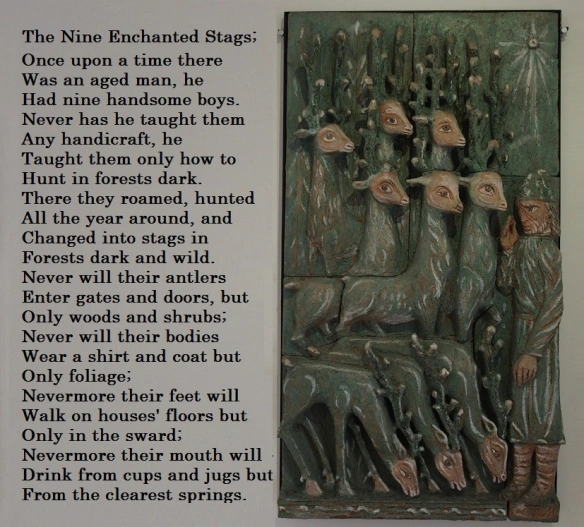
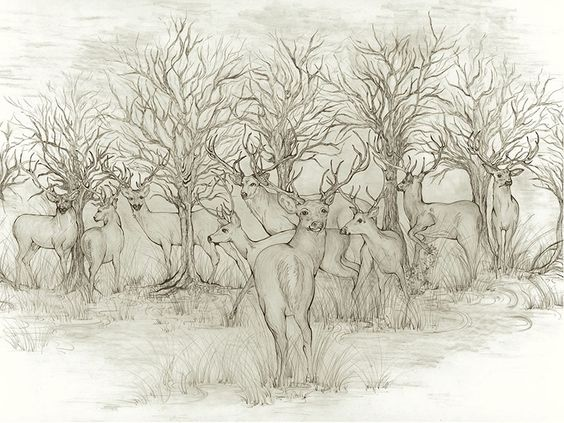
This tragic narrative tale relays the anguish of a father who had taught his nine sons only how to hunt, neglecting their education of the grave world beyond the forest. While hunting a large and beautiful stag, the brothers travelled deep into the forest, crossing a haunted bridge. Upon reaching the other side, they found themselves transformed into stags. That night they did not return home. Distraught with worry for his sons, the father spends many days searching for them. In the thickets, he spots a group of stags, and lifts his rifle and taking careful aim, prepares to fire. The largest stag who was his eldest son, boldly approaches his father, and reveals who they are. Overwhelmed at having found them, the father begs his children to come home. Shaking his huge antlered head, the son informs his father that as stags, they must now dwell in the forest forever, they have no means of returning or living in the world beyond the wooded prison he created for them. No doorway shall they ever pass through again, no cup shall they hold, no bed to sleep in, no shirt to wear.
Here is Bartók’s own translation of the text from the third movement:
Once upon a time there Was an aged man,
he Had nine handsome boys.
Never has he taught them Any handicraft,
he Taught them only how to Hunt in forests dark.
There they roamed, hunted All the year around,
and Changed into stags in Forests dark and wild.
Never will their antlers Enter gates and doors,
but Only woods and shrubs; Never will their bodies
Wear a shirt and coat but Only foliage;
Nevermore their feet will Walk on houses’ floors
but Only in the sward;
Nevermore their mouth will Drink from cups and jugs
[1] Suchoff, Benjamin (2001). Béla Bartók: Life and Work. Landham, Maryland: Scarecrow Press.
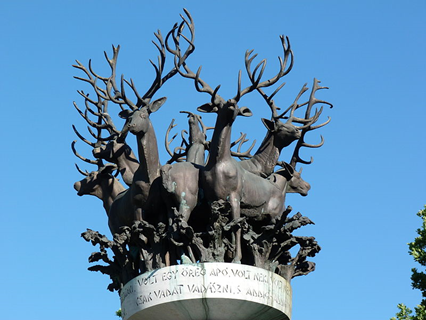
Sourced from within two Romanian colinde from Transylvania, in April 1914, Bartók was inspired to compose his rousing Cantata on the theme of the none enchanted stags. Colinde are ballads which are traditionally sung during the Wintertide. Moved by the plight of humankind during the Great Depression of the 1930s and a concern for the rising tide of fascism in Europe, some have suggested that the Cantata expresses Bartók’s humanistic ideal of a brotherhood of all people and nations and ultimately of individual freedom.
“Every man gives his life for what he believes. Every woman gives her life for what she believes. Sometimes people believe in little or nothing, and so they give their lives to little or nothing. One life is all we have, and we live it as we believe in living it…and then it’s gone. But to surrender who you are and to live without belief is more terrible than dying – even more terrible than dying young.” ~ Jeanne d’Arc.
‘The Maid of Orléans,’ was burned at the stake on the 30th May 1431, as a witch, a heretic and a traitor.
She was just 19.
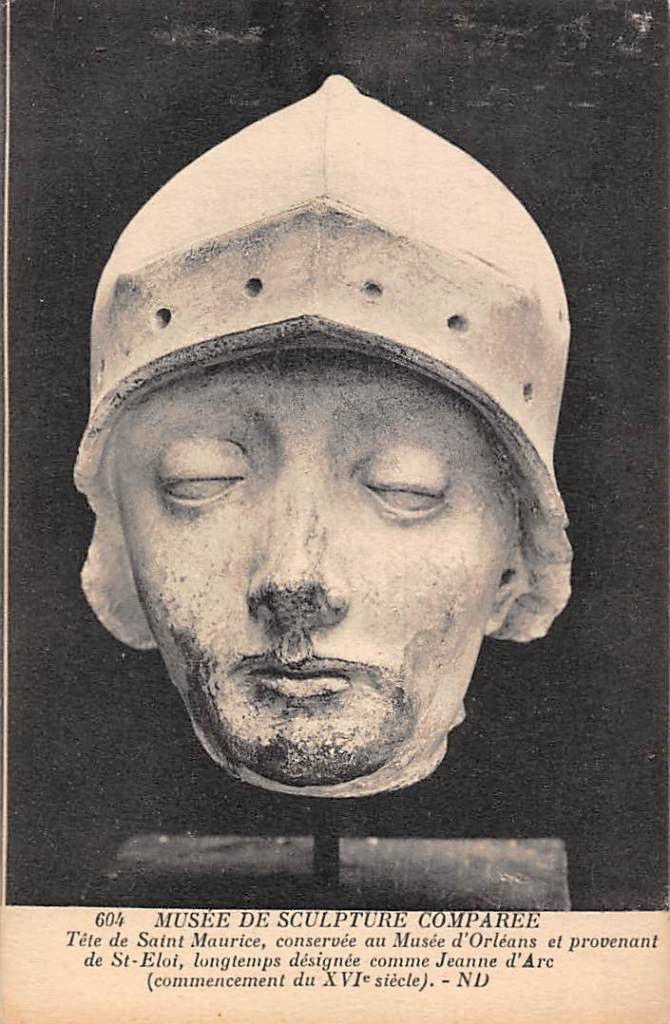
Image: Helmeted head of a late Gothic saint’s statue, in the past widely held to have been modelled after the likeness of Jeanne d’Arc.
The Prophecy
“France will be lost by a woman and saved by a virgin from the oak forests of Lorraine”
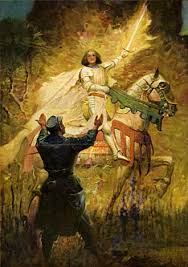
Her legend preceded her. It evolved long before the humble girl, Jeanne d’Arc was born. The writings of Bede and the ‘Prophecies of Merlin’ by Geoffrey of Monmouth, asserted the mythic prophecy of a humble young maid from the Oakwoods of Lorraine who would rise to become a sacrificial saviour of France. Riding a white stallion and attired in blazing armour, the vision was completed by a legendary blade, a sword of note, brandished by this remarkable heroine.
Image:The Prophetic MS
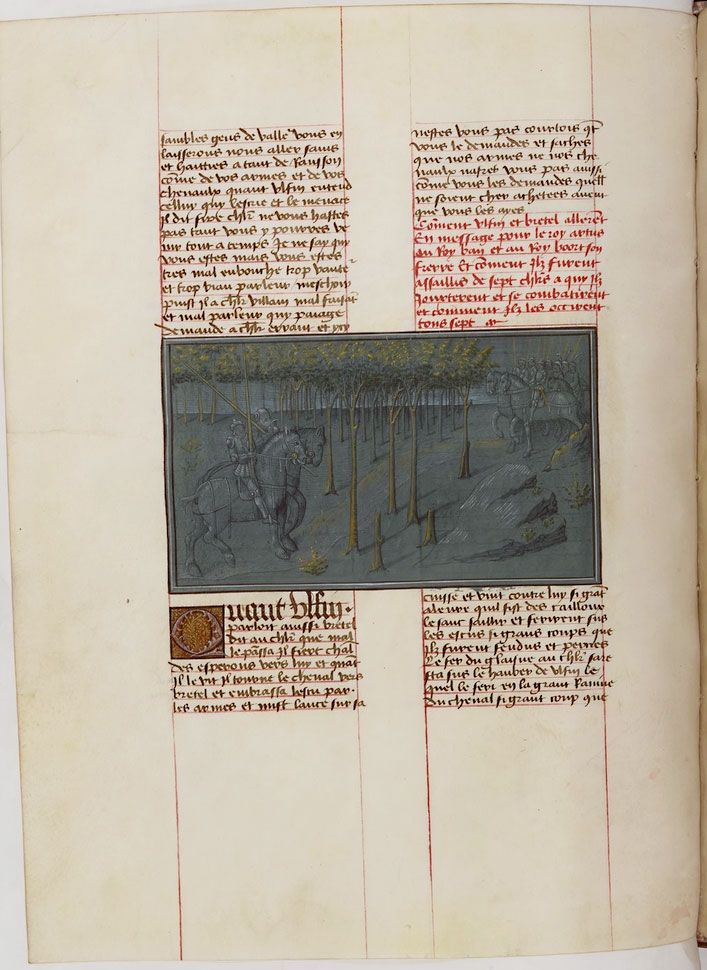
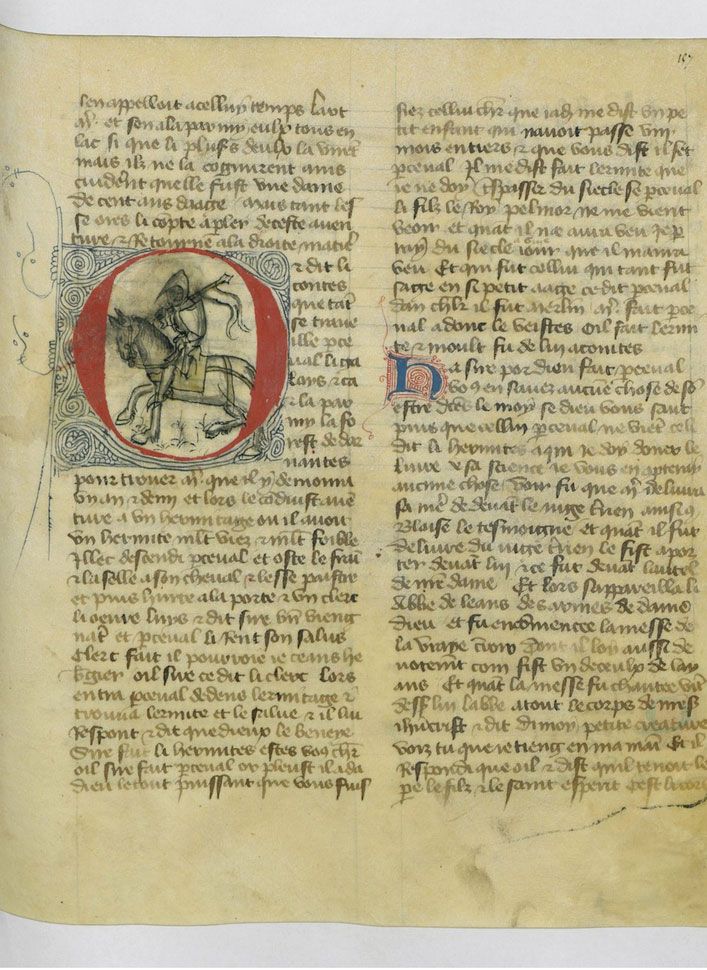
The alleged prophecies of Bede and Merlin by Geoffrey of Monmouth were widely circulated in manuscripts (1)
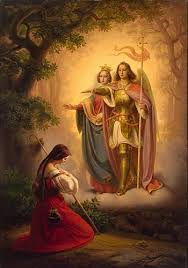
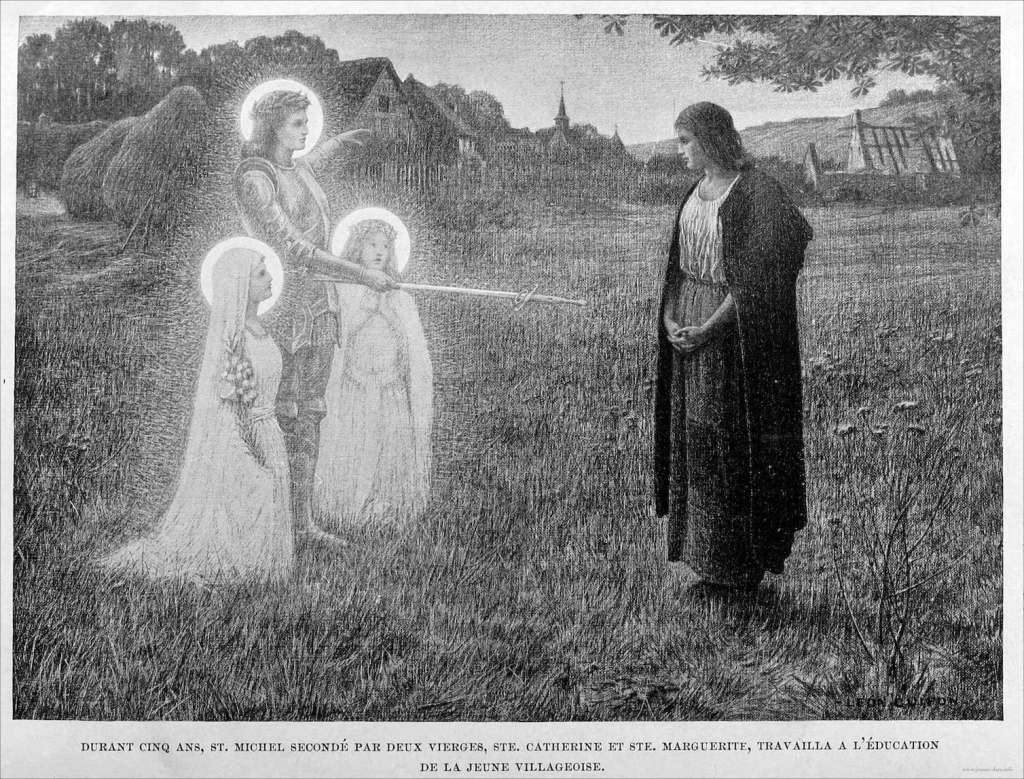
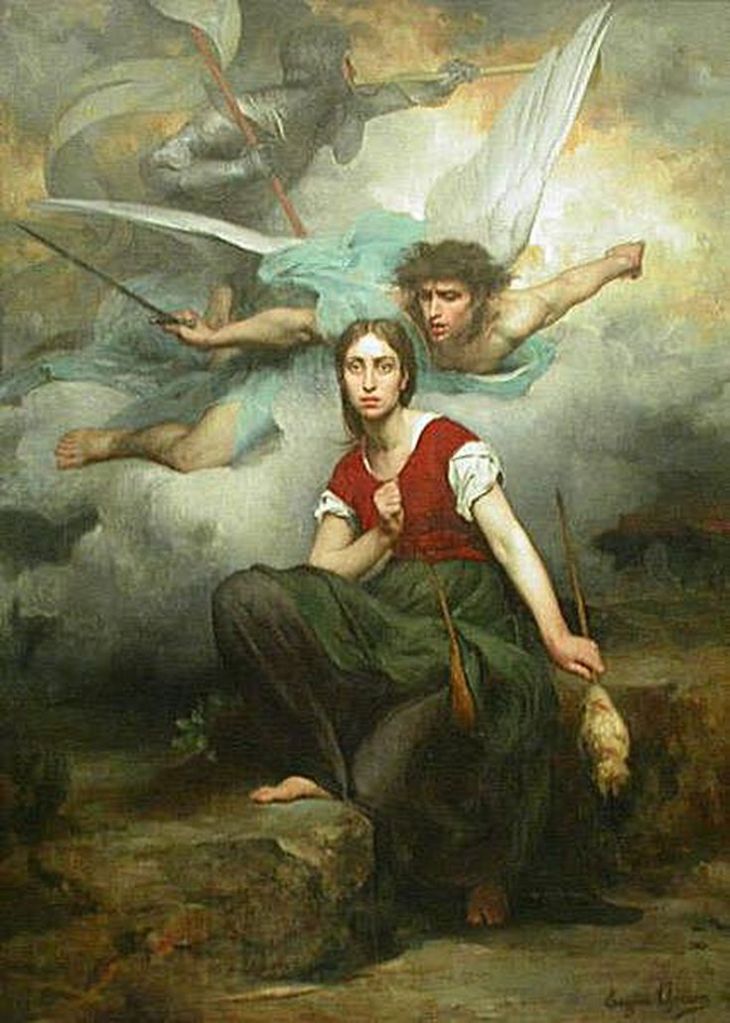
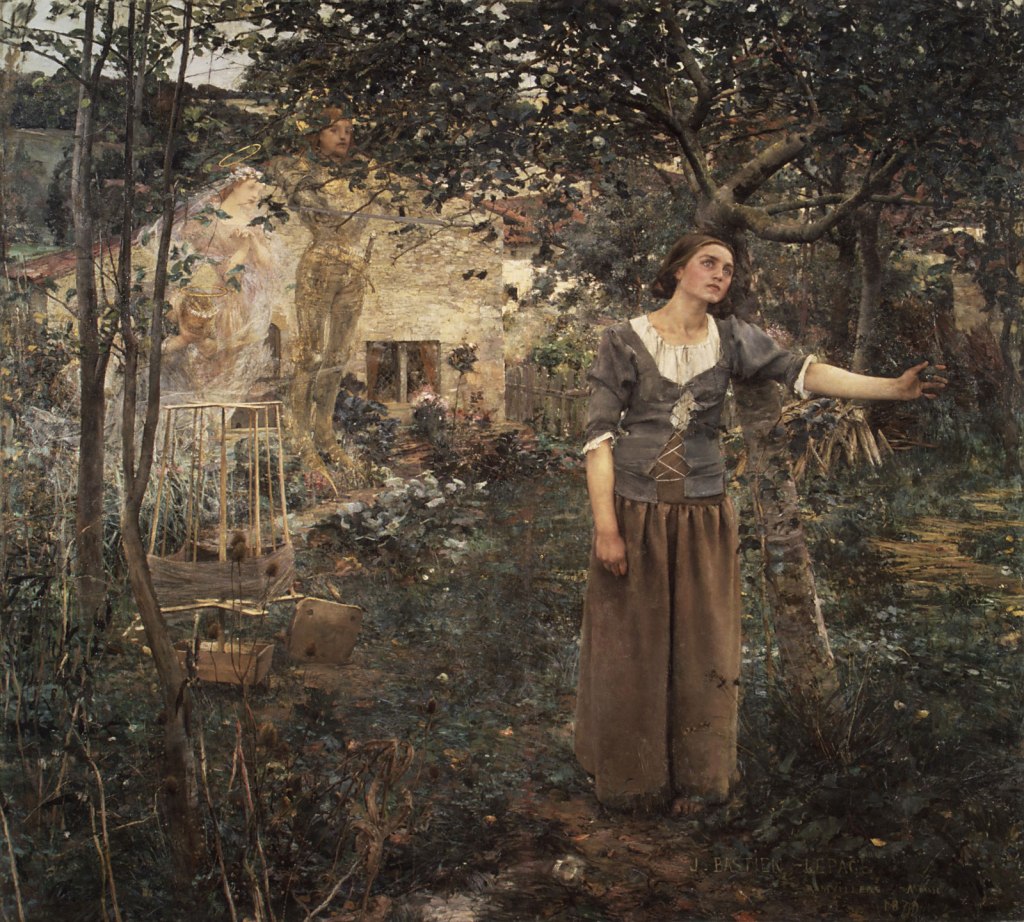
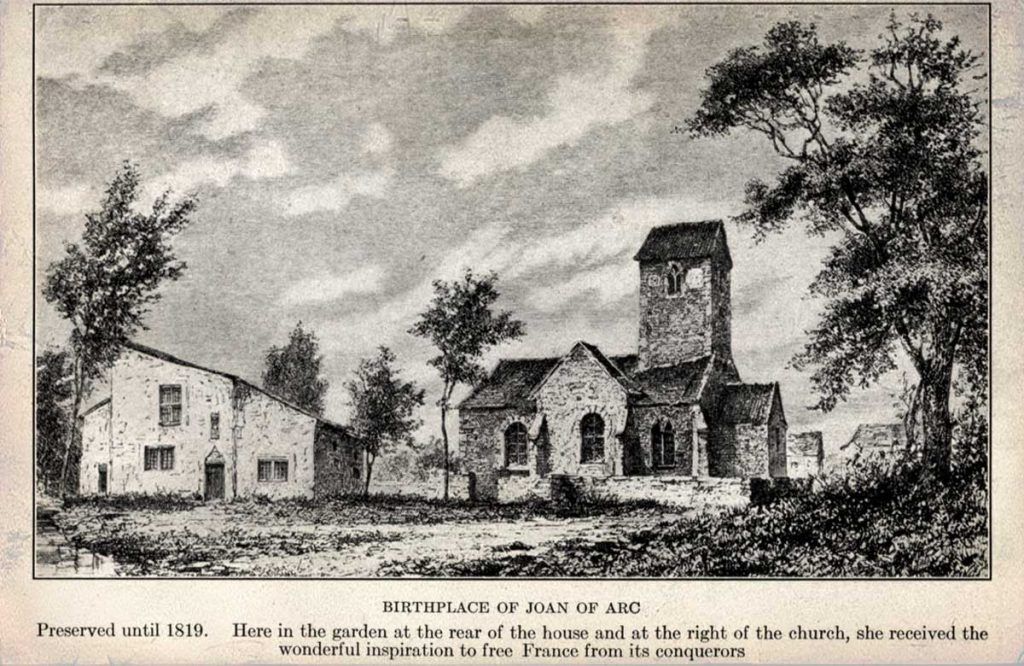
Jeanne d’Arc was born an illiterate peasant into a farming family at Domrémy, Lorraine, a pastoral backwater surrounded by oak forests, easily visible just over a mile away. Unsurprisingly, Jeanne’s visions caught the attention of the local clergy, when as a young girl she began experiencing spirit visitations. These were identified as the archangel Michael (the patron saint of Charles Valois, the Dauphin of France), Saint Margaret, a local saint, and Saint Catherine (of Alexandria), a dedicated family saint. This was entirely in keeping with local custom and folkloric tradition.
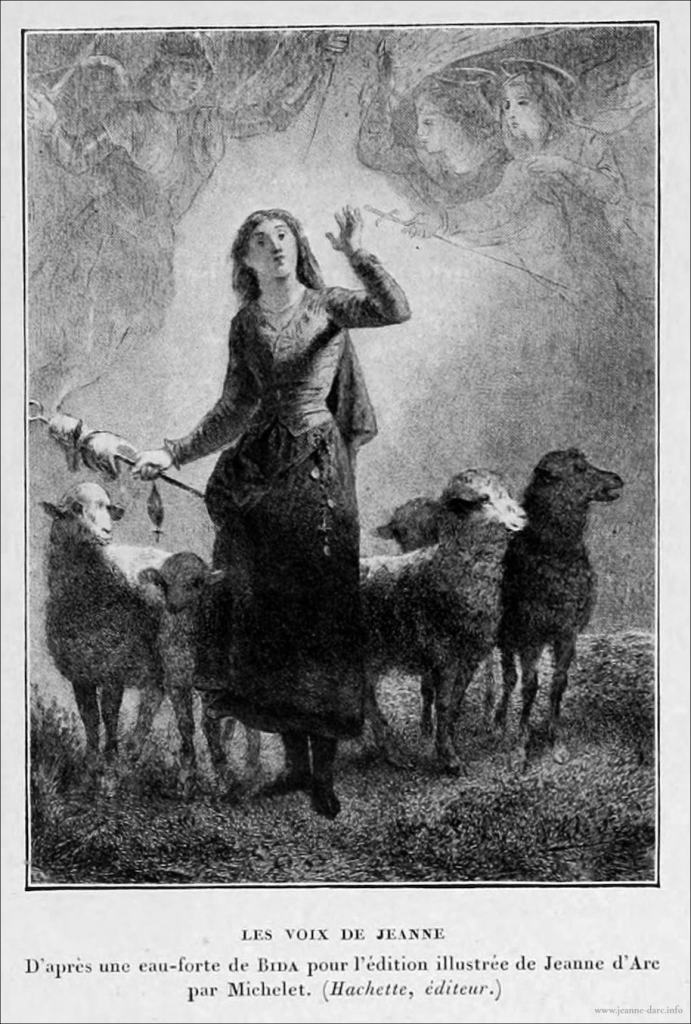
In reconstructing her life from local records, it would seem that around noon in the heat of high summer, Jeanne, a mere girl of 13, was drafting wool on her drop spindle whilst tending her father’s sheep on the land between their house and the church. To her left beneath the great tree beside the church, she saw a great light and had a vision of the archangel Michael, surrounded by other angels. Local traditions notwithstanding, it is probable that her first vision occurred on a ‘fast’ day, adding credence to the circumstances that collectively facilitated her envisioning. Lack of food, the heat, monotonous activity (spinning) are certain inducements to trance.
In the weeks that followed, the same vision appeared before her many times, and they spoke to her of a great destiny. Jeanne found refuge in her voices as the Hundred Years’ War continued to ravage northern France.
She maintained the voices were sent by God to be her guides, to direct her mission to deliver northern France from English domination, and to see the Dauphin, Charles of Valois crowned as the rightful King of France. A peace treaty brokered by England in 1420 had effectively disinherited the Dauphin, amid accusations of his illegitimacy, that placed King Henry V as ruler of both England and France.
Jeanne had witnessed several local raids during her childhood, sometimes by free-booters and opportunists with no allegiance to either side. Henry of Orly, was one such soldier of fortune, whose ragged band lived off local plunder. As local towns were laid to siege, the occupants of Jeanne’s village were temporarily forced to abandon their homes under threat of invasion. When they returned, many homes were burned, and their livestock stolen.
Her visions continued for three more years, by which time Jeanne reached a marriageable age. The rejection of suiters and an arranged marriage accelerated the immediacy of Jeanne’s mission; her persuasive zeal convinced a local court that she should not be forced to accept the match. At the tender age of 16, Jeanne took a vow of chastity, declaring that her mission required her to be a ‘Maid.’ Urged into action by the intensity of her voices, she was pressed to approach Robert of Baudricourt, the garrison commander at Vaucouleurs to gain an armed escort to see the Dauphin at Chinon. She convinced Baudricourt that without her by the Dauphin’s side, Orléans would fall, and France would be lost to the English. Her persistence attracted a small band of followers who may have been familiar enough with the prophecy to support her claims to be the Maid of France.
According to Jeanne’s loyal captain who escorted her, Jean de Metz, she had boldly stated that “I must be at the King’s side (…) there will be no help (for the kingdom) if not from me. Although I would rather have remained spinning [wool] at my mother’s side (…) yet must I go and must I do this thing, for my Lord wills that I do so.”
It was considered prudent that her journey through hostile Burgundian territory should be undertaken disguised as a male soldier, a necessity later used against her. “I was admonished to adopt feminine clothes; I refused, and still refuse. As for other avocations of women, there are plenty of other women to perform them.”
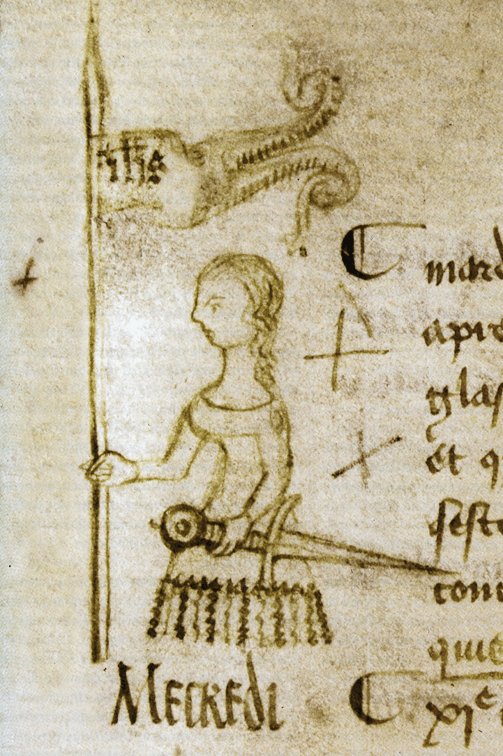
Image: Drawing of Jeanne d’Arc by Clément de Fauquembergue (a doodle on the margin of the protocol of the parliament of Paris, dated 10 May 1429. This is the only known contemporary representation of her.
Records provide various testaments to Jeanne’s clairvoyance and prophetic vision whereby she warned individual soldiers of their imminent deaths. For example, as she entered the Castle at Chinon where Charles Valois resided, a soldier cursed her; she responded “Ah, you make light of God, and yet you are so near your death.” He drowned that day.Arriving in the Great Hall, her voices singled out the Dauphin (Charles Valois) from his courtiers amidst whom he was concealed. Jeanne predicted to him the deliverance of Orléans, and ultimately of France, and of his victorious consecration as the King at Reims.
“When I entered into the chamber of the King,” said she, “I recognized him among the others on account of my Voices, which revealed him to me.”
Image: The Sword of Charles Martel
In private converse, Jeanne shared with him the words to a prayer he’d spoken to god in his private chapel, and informed him she had retrieved the lost sword of Charles Martel, the grandfather of Charlemagne. This prized relic was previously lost to an obscure burial, behind the altar of the church of Sainte Catherine de Fierbois. Renowned for its miracles, this wasa popular place of pilgrimage, for soldiers especially. Baudricourt had offered her a sword, which she declined, saying that the right sword would be found for her.
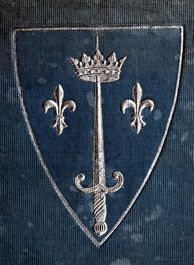
For Jeanne, the sword meant much more than a weapon, it was a symbol of the legend, a mythic element that roused the motivation and resolve of the soldiers who followed her. Under direction from Jeanne’s voices, an armorer was sent from Tours to find it. Buried for a long time, it was rusty and not sturdy enough for combat. (2) Once polished, it represented absolute and uncompromising Victory, a symbol that was ultimately drafted into her Coat of Arms. According to legend, it had five crosses on the blade.
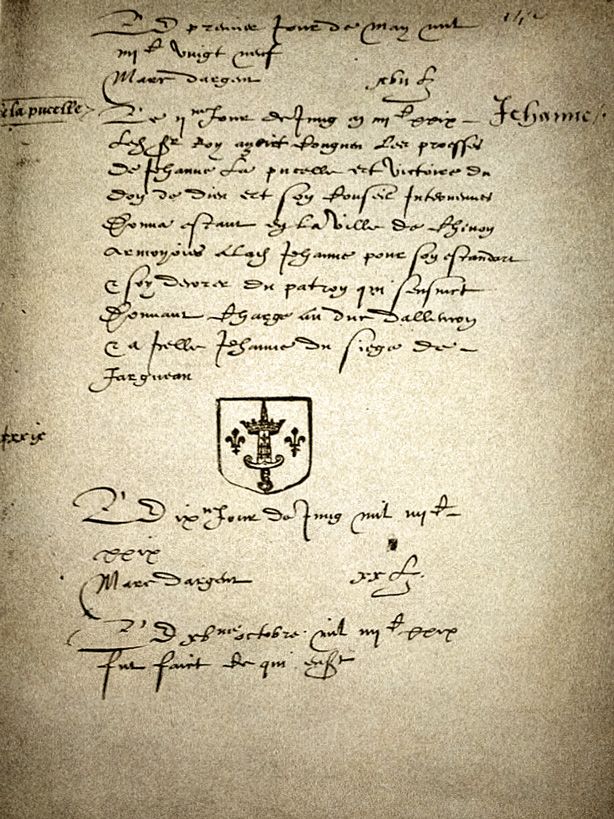
Image: Jeanne d’Arc Coat of Arms
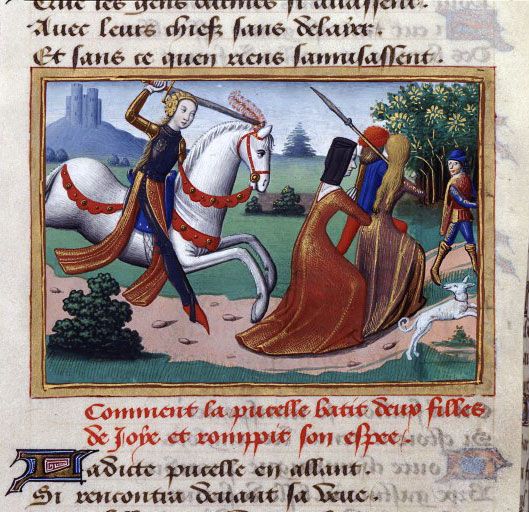
The Fierbois sword was lost after the failed siege of Paris, though an unsavoury rumour claims it was broken in half after Jeanne used it to chase away camp followers.
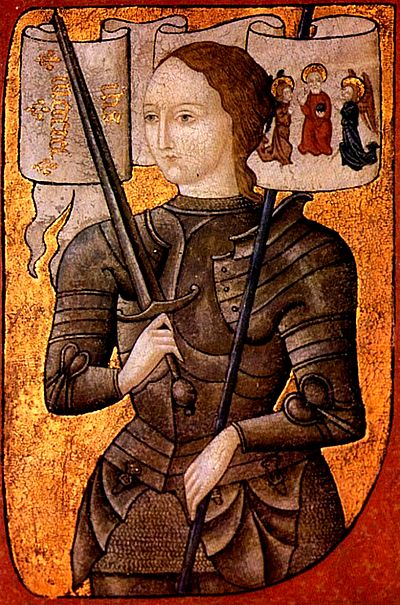
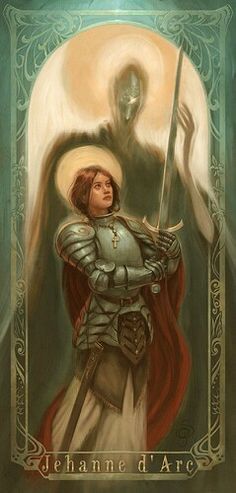
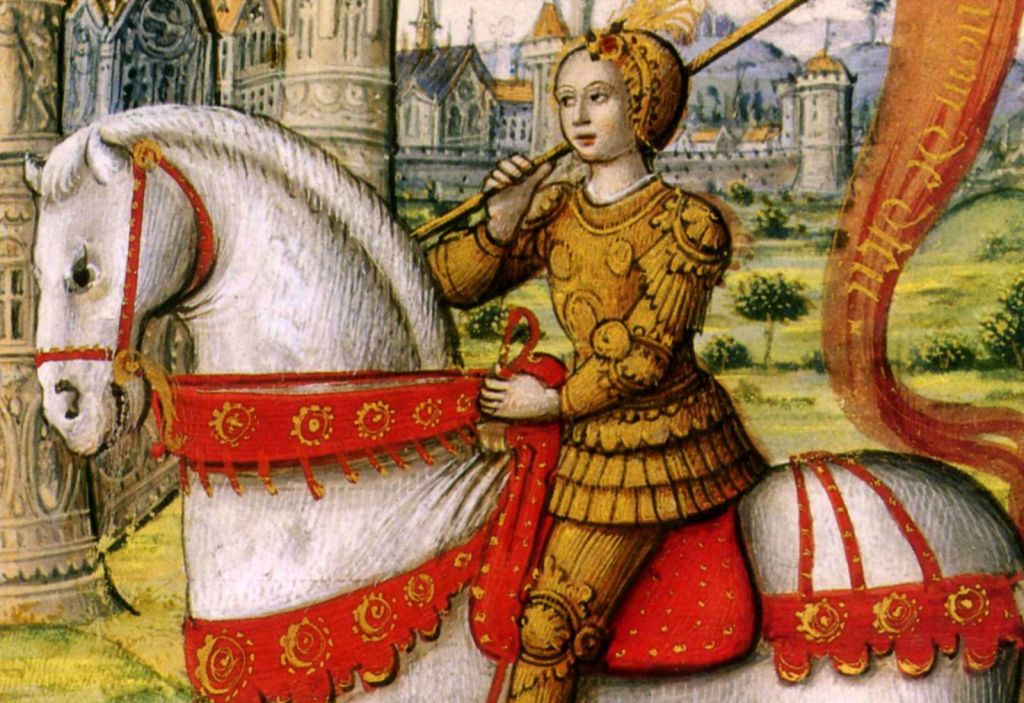
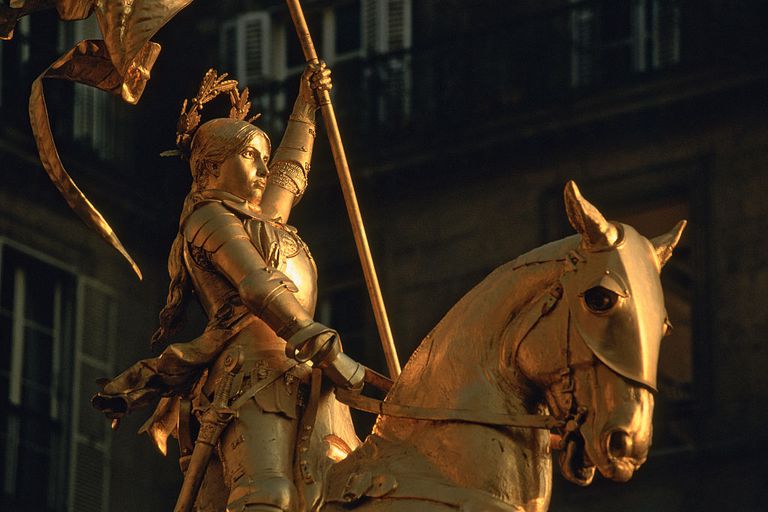
A relief expedition to Orléans early in 1429 was required, and gaining the Dauphin’s approval, Jeanne asked for permission to travel with the army. The Dauphin’s mother-in-law, Yolande of Aragon, confirmed Jeanne’s virginal status, then astutely provided Jeanne with a white horse, gleaming armour and a golden banner of France, in keeping with the prophecy. In addition, Yolande financed a small entourage from her own purse.
From her guides, Jeanne was also gifted with the remarkable ability to foresee certain events; indeed, she forecast her own wounding during an attack of Tourelles, 7th May, 1429. She was also aware her fame and status would be short-lived. A letter preserved in the archives of Brussels, relates to her prophecy. On the eve of the battle Jeanne declared that: “Tomorrow my blood will be shed.” Jeanne insisted that the King should not delay his departure for Reims, repeating, “I will only be with you for one year. It is needful, then that you use me to the full.”
Contemporary sources acknowledge Jeanne’s heroic role and mystical presence, and of a certain enchantment that radiated from her. As predicted, she was indeed wounded by an arrow that pierced her flesh between the neck and shoulder while holding her banner outside les Tourelles. This did not prevent her return to encourage a successful final assault on the fortress. The English retreated from Orléans the next day, and the siege was over. Jeanne had lifted the Siege of Orléans in just nine days. The Anglo-Burgundians, were defeated by Jeanne’s forces and were compelled to retreat back across the Loire River.
Image : Jeanne d’Arc with Banner, White Horse and Golden Armour
Taken from the many quotes in her letters, her motto could have been:“I am not afraid… I was born to do this.”
Jeanne also advised the Duke d’Alencon, of his imminent death by cannon; heeding her warning, his life was spared:“Gentle Duke,” she cried, “retire from where you stand, for if not that cannon down yonder will be the death of you.” Sadly, the Lord of Lude who replaced him, was killed immediately. As Jeanne was rallying the troops by the walls at Jargeau, her strong helmet withstood a stone missile, miraculously saving her life.
Several swift victories followed suit, allowing Charles VII to receive his promised coronation at Reims in 1429, which substantially weakened the Anglo-Burgundian claim to France. Although some distance from the front lines, Jeanne later sustained another wound when a crossbow bolt lanced her thigh during her failed bid to liberate Paris. Jeanne’s permission from the King allowing her to seize Paris, was delayed. Under possible advice from his court favourite, Georges de La Trémoille that Jeanne’s growing popularity may eventually become a threat to the King’s, precious time was lost. In the meantime, the Anglo-Burgundians fortified Paris and successfully repelled Jeanne’s September assault.
Just six months later, in the spring of 1430, orders from King Charles VII, bade Jeanne to block a Burgundian assault on Compiégne. During the melee, her horse threw Jeanne as the town’s gates closed to protect its inhabitants. Left outside, she was defenceless. The delighted Burgundians took Jeanne captive to a nearby stronghold at the English held Rouen. Jeanne never left. A year later she was dead. Her short meteoric rise had indeed served its purpose.
Madness?
Jeanne’s descriptions of her visions are vivid and quite lucid. She asserted that a bright light often accompanied them and that their voices had greater clarity when church bells were sounded. Some experts have suggested that certain details Jeanne has provided, appear to allude to possible neurological and psychiatric conditions, which are known to trigger hallucinations or delusions. These include brain lesions, epilepsy, migraines, bipolar disorder and even schizophrenia! Others posit that drinking unpasteurized milk from immature cattle can cause bovine tuberculosis, a condition that generates seizures and dementia. However, due to a lack of credible symptoms, and contemporary testimonies, these speculative diagnoses are highly improbable; Jeanne remained in good health and of sound mind to the time of her death.
Jeanne was neither mad nor ill.
Others have championed the veracity of her pure envisioning. Ralph Hoffman, a professor of psychology at Yale University, has argued that visionary and creative states, including ‘hearing voices,’ are not necessarily signs of mental illness. Moreover, Jeanne never wavered from her faith in “King Jesus, King of Heaven and of all the earth, my rightful and sovereign Lord.”
But the speculation doesn’t end there. Revisionist theories about Jeanne d’ Arc contradict the official account of her life and death considerably. One claim doubts Jeanne’s existence at all, except as a work of later fiction designed to boost 19th century French nationalism. Another claim reveals the popular rumour also made during the 19th century, that Jeanne d’ Arc was the illegitimate daughter of the Queen, Isabeau of Bavaria, and Duke Louis of Orléans, hidden in pastoral Domrémy with the d’ Arc family. Presumably, this would mean that when Jeanne met the Dauphin, she would have indicated some sign to him, by which he could recognise her as his half-sister Hence the elaborate political ploy that necessitated her capture, false death and secret escape to bamboozle the English!
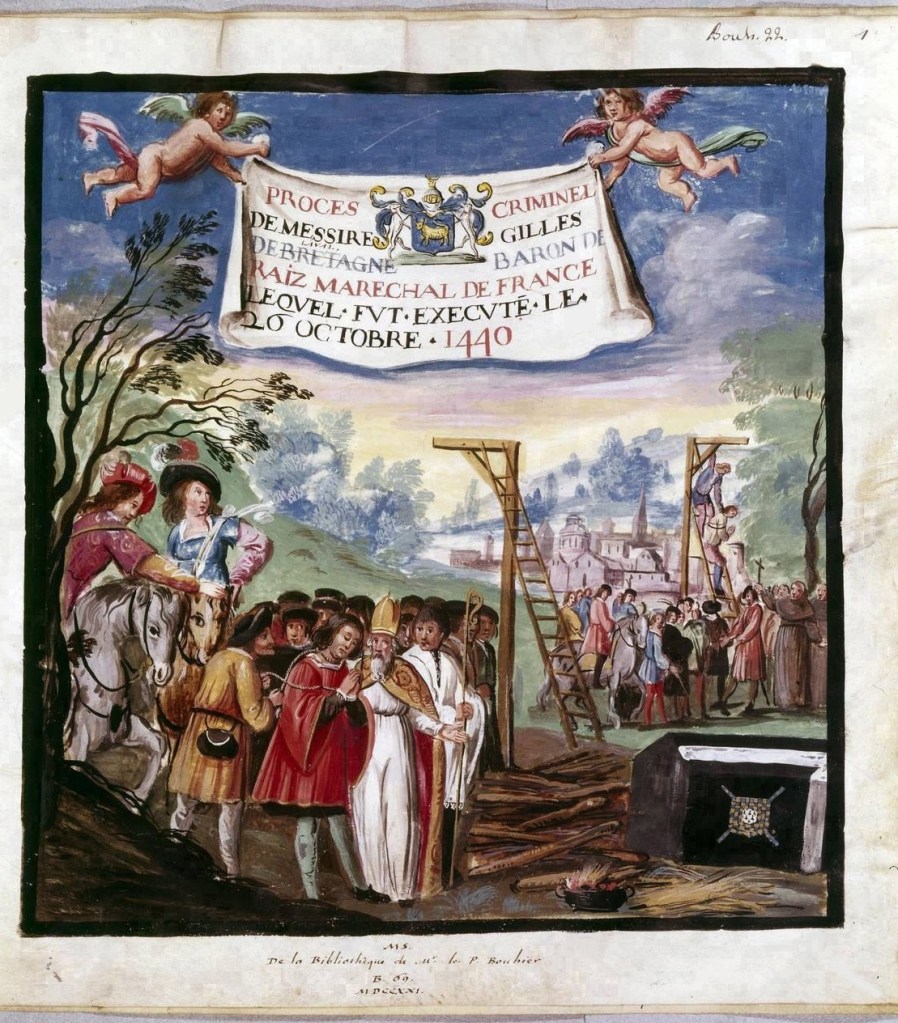
Some venture further, asserting her guilt for the valid charges of heresy; others suggest that occult reliquaries from charred bones and clothing were circulated into nefarious cultic factions. There is even a claim that a substitute was executed on the blazing pyre in her stead, and that she escaped to found an occult secret order linked to Gilles de Rais, a knight and leader in the French army. Rais had been a stalwart champion and companion-in-arms to Jeanne. His military brilliance was cruelly tarnished by his alleged confession and conviction (under extreme torture) as a serial killer and sexual abuser of children, mostly boys. For these and other crimes involving, heresy, sorcery and necromancy, Gilles de Rais, the former Marshal of France, was hanged over a smouldering pyre in 1440.
Lingering doubts concerning this verdict, initiated counter-arguments based on the notion that Gilles de Rais, was also a victim of an ecclesiastic plot or act of revenge by either the French State, or the Catholic Church, through the Inquisition. That the Duke of Brittany, who was given the authority to prosecute, received all the titles to Rais’ former lands after his conviction, is particularly damning evidence in support of his wrongful execution.
In the early 20th century, anthropologist Margaret Murray recognised the trial patterns and interrogation methods. Murray argued that Jeanne’s and Gilles’ condemnations as ‘witches’ was in fact correct, and that their (alleged) exploits could be explained by their adherence to a surviving current of paganism under the veneer of Catholicism. Murray further posited that Jeanne and Gilles were recognised by the peasants, military factions and nobility, as leaders of this ‘Old Religion,’ the superstitions and prophecies of which allowed them to enchant their followers, who practically worshipped Jeanne as the ‘Maid of France,’ sent by god to liberate them.
Murray explained that:“Gilles de Rais was tried and executed as a witch and, in the same way, much that is mysterious in this trial can also be explained by the Dianic Cult.” (3) Controversial occultist Aleister Crowley likewise questioned the involvement of the ecclesiastic and secular authorities in his case. Crowley described Rais as “in almost every respect (…) the male equivalent of Joan of Arc,” whose main crime was “the pursuit of knowledge.” (4) Speaking for the academic consensus who consider Gilles de Rais to be a depraved heretic, Norman Cohn argues that Murry’s and Crowley’s views are not supported by the records of Rais’ crimes and trial.(5)
Much to the chagrin of academics and historians, Rais’ trial and conviction were overturned in 1992, when Freemason Jean-Yves Goëau-Brissonnière, the Grand Master of the Grand Lodge of France, set-up an unofficial ‘court’ composed of former French ministers, writers lawyers, judges and UNESCO experts, all of whom were directed to re-examine the medieval source materials. Gilles de Rais was declared ‘not guilty.’ The contentious hearing, was partially turned into a fictionalized biography called ‘Gilles de Rais ou la Gueule du loup’ (Gilles de Rais; or, the Mouth of the Wolf). It is narrated by the writer Gilbert Prouteau. “No child’s corpse was ever found at his castle at Tiffauges and he appears to have confessed to escape excommunication (. . .) The accusations appear to be false charges made up by powerful rival lords to benefit from the confiscation of his lands.” (6)
None of these theories are considered credible by academic historians.
Murray’s assertion that the destruction of Jeanne’s mission was a deliberate manoeuvre by the Catholic Church which gained for them substantial victory against the surviving pagan cult, is at least borne out by fact. The Church did reclaim a great deal of authority and influence after the cessation of the Hundred Years’ War.
Nonetheless, the official version of Jeanne d’Arc’s life is no less fantastic.
Jeanne possessed a famously volatile temper; having little humour, she had wit aplenty! Her extreme piety and zeal was unmatched by even her most ardent followers. The Maid of Orléans had no tolerance for indecent or improper behaviour, swearing, theft, skipping Mass, condescension or cowardice. She had no compunction in metering out punishments for transgressors.
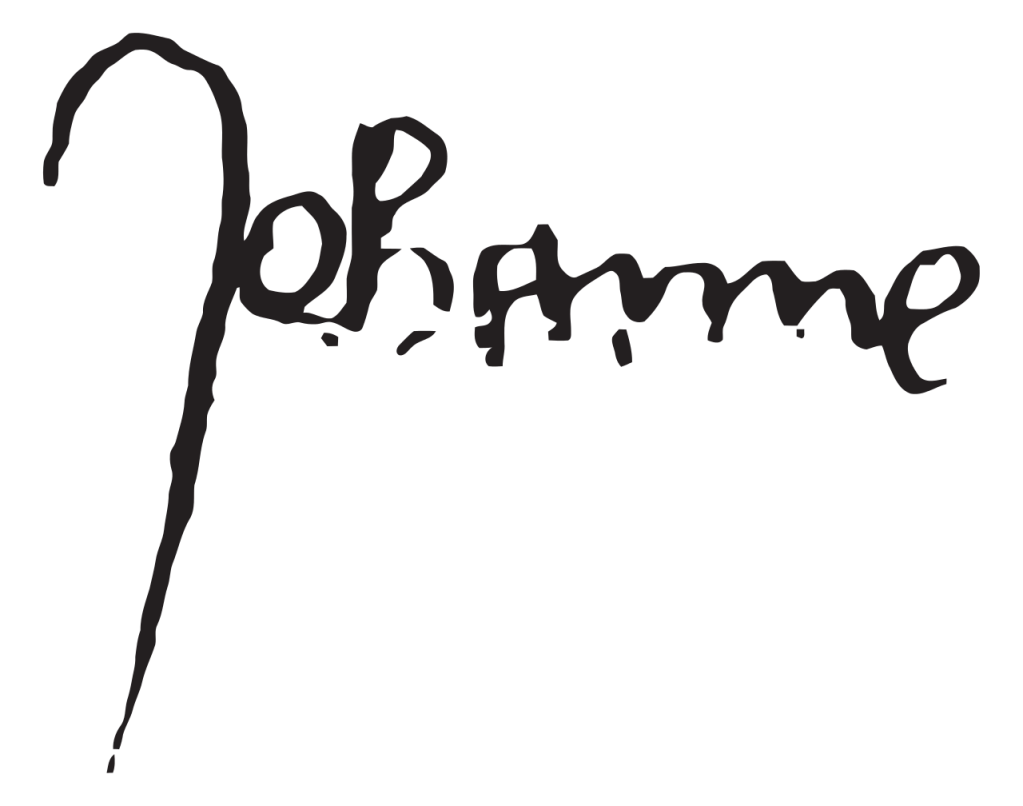
During her trial, Jeanne stated that she didn’t properly know her last name. Growing up in Domrémy, a village in north-eastern France, it is clear that the references to d’Arc, was properly associated with her father’s place of birth. Jeanne has explained that her father, a farmer, was called Jacques d’Arc. The assignation of it to Jeanne, was evidently an English scribal error in its assumption that she would take her father’s surname. Over time, d’Arc became further Anglicized as Darc or Tarc.
Jeanne’s mother, a devout Catholic, was named Isabelle Romée (also known as Isabelle de Vouthon). Unusually, it was a French custom in Lorraine for daughters to assume their mothers’ surnames. In medieval France, family surnames were very rarely fixed, and could vary considerably: Romée,’simply designated a person who had made a pilgrimage to Rome (or another place of religious significance). Similar adjustments have been made to Jeanne’s christian name, which was properly spelled: Jehanne d’Arc, Jehanne Tarc, Jehanne Romée or possibly even Jehanne de Vouthon. To her family, she was known simply as Jehanne, or Jehanette. To herself, only as “Jehanne la Pucelle” (‘Joan the Maid’) once her mission began.
Jeanne d’Arc had been caught in the furore of a protracted dispute over the French throne, whence destructive raids and trade embargos devastated the economy of France, reeling still several decades later from the ravages of the Black Death. The Maid’s incredible sincerity and conviction pulled the moral of the French army from its deep fugue, tipping the balance, which led eventually to France shaking off the English yoke of its oppressors. This was no mean feat; without Jeanne’s fearless heroism, the English were certain to establish a dual monarchy in France under English control.
Although Jeanne outlined military strategies, proposed diplomatic solutions to the English (which they rejected) and directed troops, Jeanne never actually fought in battle or killed an opponent. That was neither her role, nor her destiny. Marching alongside the troops brandishing the banner of France, infused them with spiritual succour; her bright presence and passionate speeches spurred them on to victory. Her charm and grace inspired thousands of soldiers to bravely follow her.
Because of her remarkable actions, Charles VII granted her family the official arms of nobility. Their arms were: Azure, a sword per pale argent, hilted or between a crown in chief, and two fleurs-de-lys of the last. (7) The inherent symbolism is striking.
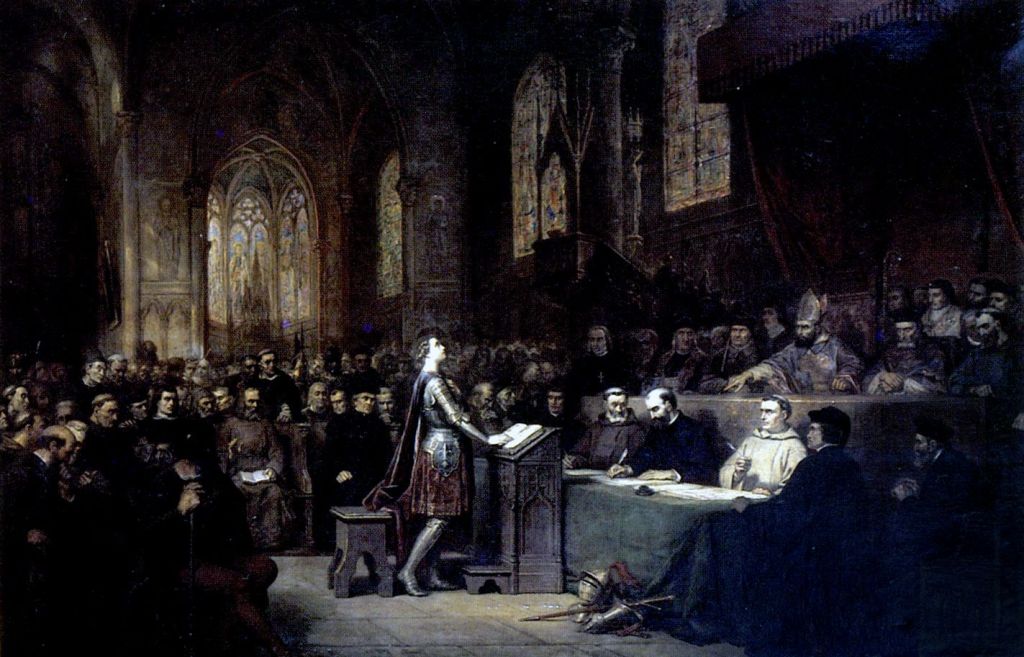
Though only a slip of a girl, a mere shepherdess with no military training, Jeanne’s military prowess is legendary. Envy was rife at court as countless knights fell under her spell. Her influence and power became a matter of concern to the extent that when Jeanne was captured on the 23rd May 1430, at Compiègne by Burgundian allies of the English, the court initially hesitated to extend protection to her. Headed by the pro-English bishop Pierre Cauchon, her trial began based on a variety of (trumped up) charges. To the English, the ability of this peasant girl to defeat their armies was regarded as proof that she was possessed by the Devil. She was mercilessly interrogated for her alleged crimes.
As legal proceedings against her began at Rouen, two attempts to free her were made by her loyal Armagnacs over the Winter of 1431. Both failed. According to 15th century sources, Charles VII was incensed by Jeanne’s trial and execution, and threatened to “exact vengeance” in retaliation upon captured Burgundian troops, especially to all“the English and women of England.” (8)
During her trial, the subject of Jeanne’s visions was paramount. She testified over and again as to their veracity, to her own piety, and of her mission deliver France from the invading English and establish Charles of Valois, the uncrowned Dauphin to the French throne, as the country’s rightful king.
Jeanne d’Arc’s fascinating visions intrigue us still, attracting considerable analysis as to their origin. Many Catholics regard her them as authentic, divinely inspired, even. Numerous scholars cede to a consensus that her faith was sincere. Her trial transcripts that might have recorded the details of her visions are problematic because Jeanne rejected standard procedure, in defence of the conflict it would place on the integrity of her oath both to the King and to God. Jeanne abjectly refused to answer questions relating to her visions. We cannot know to what extent surviving records are fabrications, possibly falsified at the time to protect state secrets.
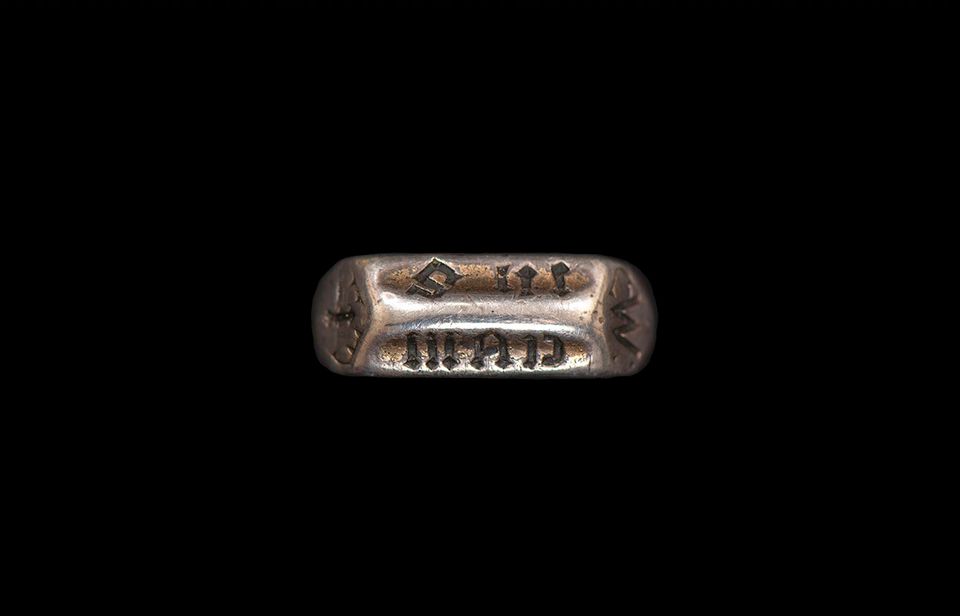
Incarcerated in a dank, musty cell, for months, her relentless captors quizzed her about the source of her voices, in their endeavours to make her slip. Failing to make the charge of sorcery stick, they turned to the intriguing markings on her silver ring. Inscribed with three crosses along with inscriptions ‘IHS’ (Jhesus) and ‘MAR’ (Maria), the devotional ring was a gift from her parents, possibly for her communion. It had been noted that before battle, she stroked the ring on her finger and muttered under her breath, actions she explained were part of her devotions to god, performed in honour of her father and mother.
Cardinal Henry Beaufort, uncle to the ruler of England and France, King Henry VI, presided over the trial and execution. Jeanne’s martyr’s ring was taken by the Cardinal to England where it remained for almost 600 years. Passed down through the Beaufort family for centuries, the religious relic was presented as a gift by one of the Cardinal’s descendants, Lady Ottoline Morrell, one of the ‘Bloomsbury Set,’ to her lover, the (Welsh) artist Augustus John, who sold it in 1914, at the onset of the Great War to The Royal Armouries. (9)
Witchcraft featured in the charges brought against Jeanne d’Arc, but that is not what condemned her. Of the 70 charges brought against her, ranging from sorcery to horse theft, an ecclesiastical court in Rouen were forced to whittle them down to around a dozen. Focus was centred upon her virginity and on her impropriety for imitating a man, a crime based in the biblical proscription against it. Her judges were particularly horrified by her cropped hair that mimicked the style adopted by her knightly companions.
The procedure was a travesty of such proportion, the trial records provided the grounds for overturning the verdict two decades later. In short, they were illegal and violated inquisitorial rules. It was entirely partisan and lacked jurisdiction. Having no adverse evidence, Jeanne should have been released. Politics demanded otherwise, and so her interrogators had to rely upon theological traps, all of which Jeanne navigated with astonishing wit. The finest example occurs in a scholarly principle of faith: for when asked if she knew she was in God’s grace, she answered, “If I am not, may God put me there; and if I am, may God so keep me. I should be the saddest creature in the world if I knew I were not in His grace.” (10) Church doctrine declared that no one could be certain of being in God’s grace. This was a trick question she should have had no hope of answering correctly. Whichever way she answered (yes or no), she admitted heresy or guilt accordingly. At every turn, she out-manoeuvred them.
Documents were falsified or substituted, and informations within, manipulated against her, often in contradiction to the court records. Her incarceration should have been under supervision of nuns, not male guards. She was denied counsel and appeal to the Pope. Under threat of immediate execution, she was forced to signed an abjuration document her illiteracy precluded her from grasping the connotations of.
Fending off several attempts of rape and molestation, Jeanne was reluctant to surrender her male clothing, that bound breech to shirt by a series of ties. The woman’s dress she was forced to wear after her abjuration, offered no such protection. Just a few days later, Jeanne told a tribunal member that she was forced to resume wearing her soldier’s garb as “a great English lord had entered her prison and tried to take her by force.” (11)
Heresy was a capital crime only in cases where the offense was repeated, thusshowing the accused to be guilty of a relapse in their oath. The Jury now had her, despite the point of law that allows for ‘cross-dressing’ if a necessity to safety, according to Catholic doctrine established by Thomas Aquinas in the Summa Theologica.
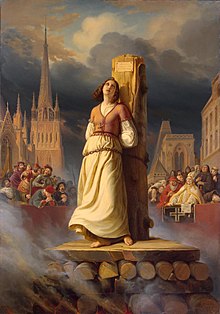
Overwhelmed by the light and beauty of her visions, Jeanne exhibited classic exstasis. Moved to tears, Jeanne was faithful to them until the last breath expired from her choking lungs. Declared guilty, her head was shaved in keeping with the sentence of heretic. Tied to a huge wooden pole, she was burned alive without reprieve or mercy. Horrified crowds gathered around her in the cobbled market square at Rouen, (Normandy was then under English rule) to witness this gross miscarriage of justice, nothing more than an expedient act of politics. Once engulfed by the flames, the English insisted that the coals should be raked back to expose her charred body, ensuring that her death was under no ambiguity. To prevent foraging for relics, her remains were burned twice more, until her thrice-burned body was reduced to ashes which were cast without ceremony into the Seine River. Her executioner, Geoffroy Thérage feared his own damnation for burning a holy woman.
Her fame only increased after her martyrdom, and even after her grisly execution, rumours she was still alive were circulated by several people, including her own brothers, for notoriety and for the elaborate gifts procured from those bewildered by the miracle. Nonetheless, once the war drew to its close, a petition was raised at the request of Inquisitor-General Jean Bréhal and Jeanne’s mother Isabelle Romée, for a posthumous retrial in 1455. As the English no longer posed a threat, a nullification trial was sanctioned by Charles VII to clear her name. Pope Callixtus III was actively engaged in the proceedings that condemned Jeanne’s former trial according to canon law. A secular vendetta had convicted an innocent woman on an errant issue of doctrinal law relating to a (biblical) clothing technicality. Investigations concluded it void, and her conviction was reversed – 7 July 1456.
Declared an innocent, she was added to the official roll of martyrs.
The Metropolitan Museum of Art in New York City has a helmet (of the right period) with a legendary attribution to Jeanne d’Arc. The site of her home in Domrémy-la-Pucelle is now a museum. The medieval church is much altered but still contains a 14th century statue of Saint Margaret, that Jeanne undoubtedly prayed before. The royal castle at Chinon where Jeanne met Charles VII, is now a ruin.
The Jeanne d’Arc museum at Chinon, France has a charred human bone fragment that is reputedly hers. Discovered in a Parisian Apothecary in 1867, in a jar along with a cat femur, a shard of carbonized wood and some charred linen. Apparently, because of the superstition associated with witches’ familars, it was standard medieval practice to throw black cats onto the pyre of ‘witches.’ Forensic analysis has indicated that the human bone is actually from a Ptolemaic mummy, possibly brought back during Napoleon’s Egyptian campaign.
And though highly acclaimed for her martyrdom in 1456, by Pope Callixtus III, she was not Canonized until the 16th May 1920, by Pope Benedict XV. (She had been Beatified on the 18th April 1909, by Pope Pius X) Her Feast Day is officially the 30th May. She joins the ranks of several other visionaries and warrior saints of France: Saint Denis, Saint Martin of Tours, Saint Louis, Saint Michael, Saint Rémi, Saint Petronilla, Saint Radegund and Saint Thérèse of Lisieux.
Jeanne d’Arc was a tragic pawn in a political arena, that martyred her on one side, and demonised her on the other. Undoubtedly a naive idealist, and national icon, she was also a spiritual mystic who inspired many hundreds of men to follow her into battle. A true heroine to her faith and people, she rightly stands amongst the ranks of other martial saints. Her patronage extends to all political martyrs, particularly to military captives; or those ridiculed for their faith and piety; soldiers and most poignant currently, women who have served in the WAVES (Women Accepted for Volunteer Emergency Service) and Women’s Army Corps.
She bravely raised the guiden pole to rally others to her cause, bore the banner and armour of her faith, and challenged the injustices of her time with her words and her sword, and this undoubtedly makes her a true heroine, and more – Jeanne d’Arc is the role model to aspire to, to follow! And yet, her light stands in contrast to those who would extinguish all that is true, and pure and beautiful in the world. I cannot help but ponder on the minds of the those who claim to represent the highest states of spirituality and faith, yet put politics and power, the trivia of ‘self’ before the highest Truth. If those people are willing to sacrifice one of their own, as they clearly did here with Jeanne, then ‘True’ faith is not only thin on the ground, but more precious than life itself……….
“One life is all we have and we live it as we believe in living it. But to sacrifice what you are and to live without belief, that is a fate more terrible than dying.”
See: Murray, Margaret. The Witch-Cult in Western Europe. Oxford, England: Clarendon Press. pp. 173–174. Gilles de Rais was tried and executed as a witch and, in the same way, much that is mysterious in this trial can also be explained by the Dianic Cult. (1921)
Crowley, Aleister. The Banned Lecture: Gilles de Rais. New Orleans, Louisiana: Black Moon Publishing. (2011)
By Paul Webster, (17 June 2013). “From the archive, 17 June 1992: Rehabilitation of France’s Bluebeard”. Retrieved 16 February 2017 – via The Guardian.
The ‘Salve Regina’ meaning ‘Hail Holy Queen’ is an 11th century Marion Hymn sung three days before Advent Sunday, when the mass is replaced by the Gregorian chant ‘Universi qui te expectant.’
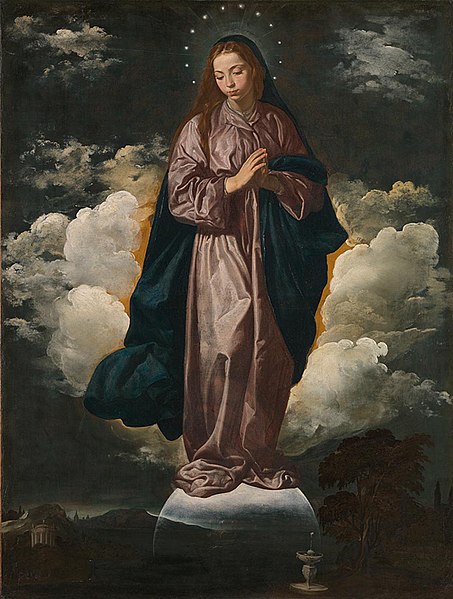
Hope is the maxim for this custom that as the Mother of Mercy and Gateway to Heaven, she will bring respite from the toil we endure in this ‘vale of tears’ that is life. Her gift is Hope, hope that manifests in the promise of fulfilment through living a spiritual life endowed with Faith in Her Grace.
Advent Sunday.
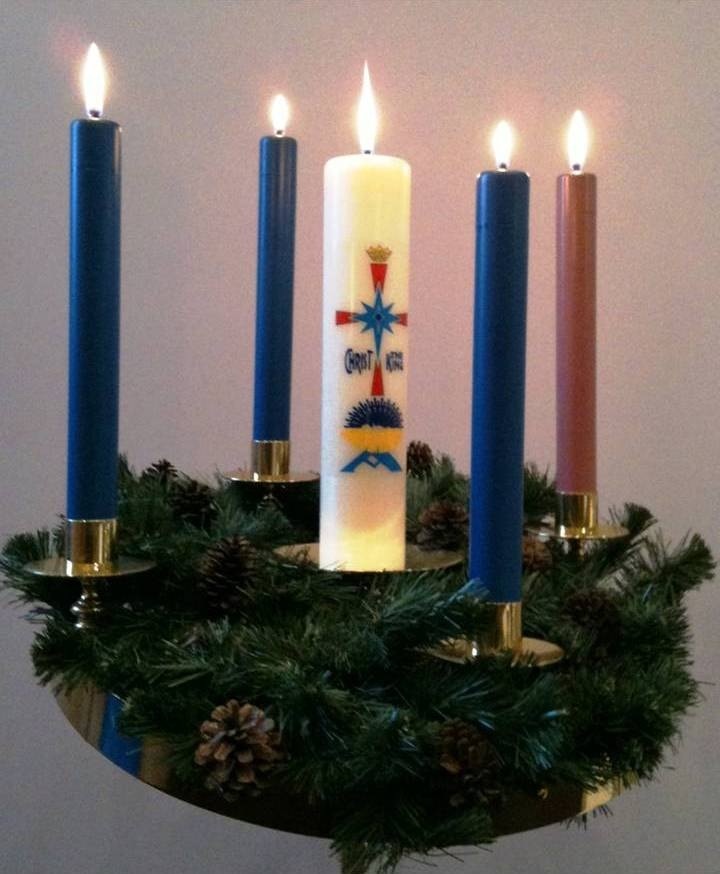
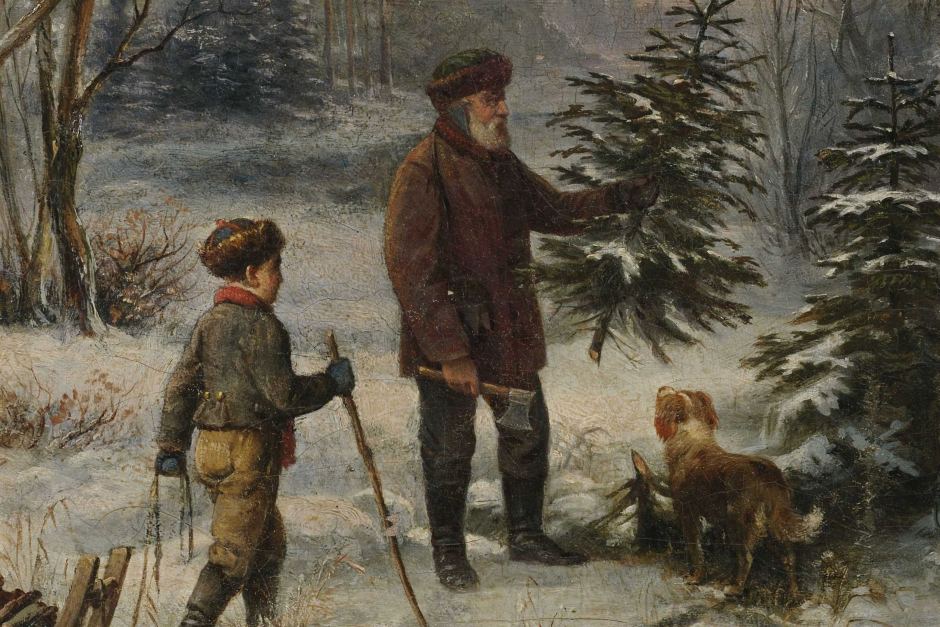
Customs include, wreath making, comprised of three blue candles, (sometimes black or violet) a rose candle and sometimes a white central candle for the solar eve itself. Devotional practices associated with the observance of Advent include keeping an Advent calendar, lighting an Advent wreath, daily prayers, erecting a Christmas tree or a Chrismon tree, lighting a Christingle, or setting up Christmas decorations, a custom that is sometimes done liturgically through a hanging of the greens ceremony around the home, church or chapel.
Originally a 16th century Lutheran tradition, the modern wreath as we know it was formed in the 18th century, and today adorns the doors of many homes throughout the Yuletide period.
“The wreath crown is traditionally made of fir tree branches knotted with a red ribbon and decorated with pine cones, holly, laurel, and sometimes mistletoe. It is also an ancient symbol signifying several things; first of all, the crown symbolises victory, in addition to its round form evoking the sun and its return each year. The number four represents, in addition to the four weeks of Advent, the four seasons and the four cardinal virtues, and the green colour is a sign of life and hope.
The fir tree is a symbol of strength and laurel a symbol of victory over sin and suffering. The latter two, with the holly, do not lose their leaves, and thus represent the eternity of God. The flames of candles are the representation of the Christmas light approaching and bringing hope and peace, as well as the symbol of the struggle against darkness. For Christians, this crown is also the symbol of Christ the King, the holly recalling the crown of thorns resting on the head of Christ.” [1]
From the 5th century, Advent has signified a period of fasting broken by the Christmas feast in celebration of the light of Hope.
Amidst the grief, the living mourn their loved ones, but amidst triumph, the victor in battle perhaps gloats a little. Yet fear of haunting by ones’ enemies especially, initiated taboos and rituals to prevent the spirits of the dead from returning to torment the living, or to take their vengence upon them.
hdr
Steps were taken to ensure this did not happen.
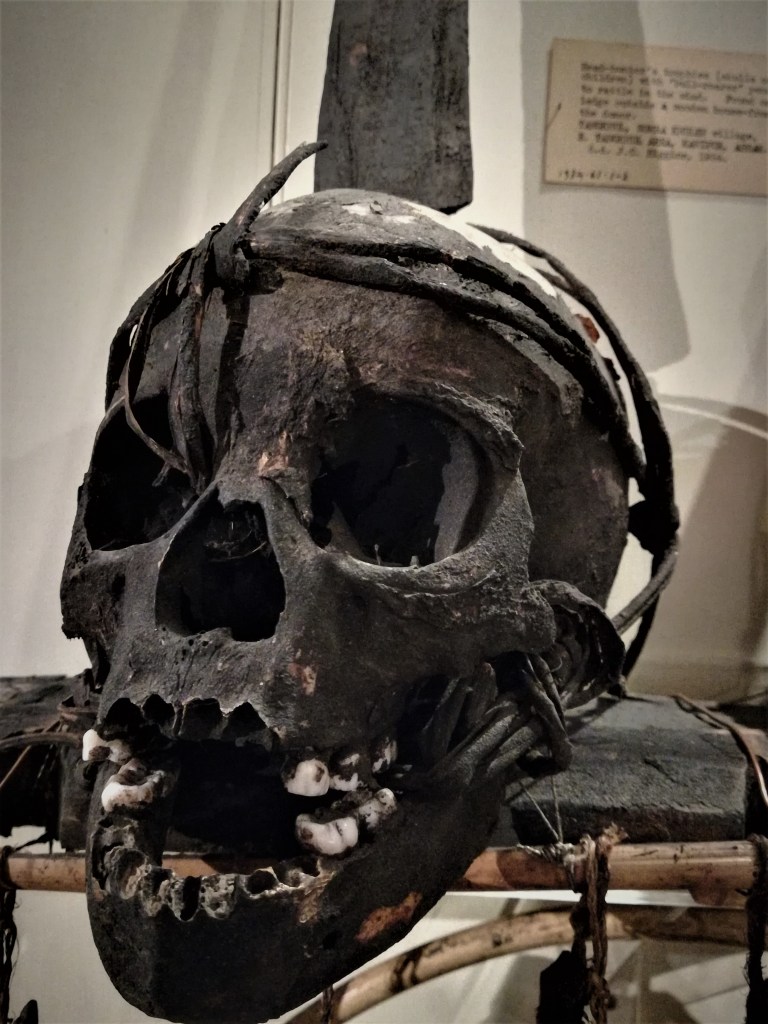
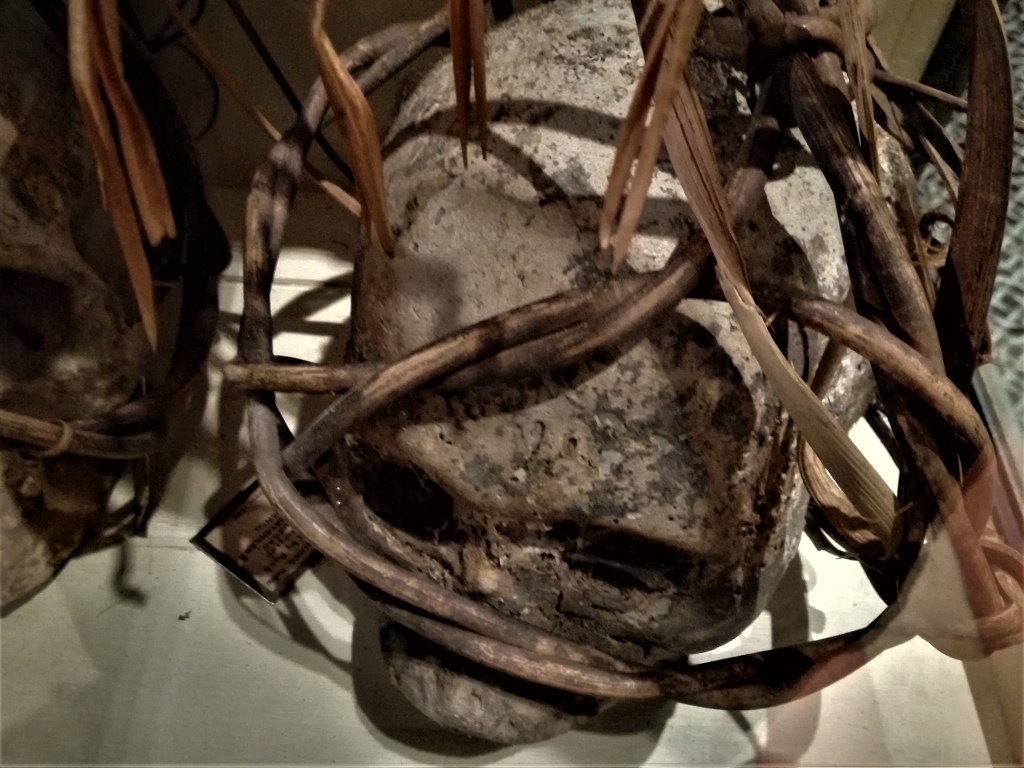
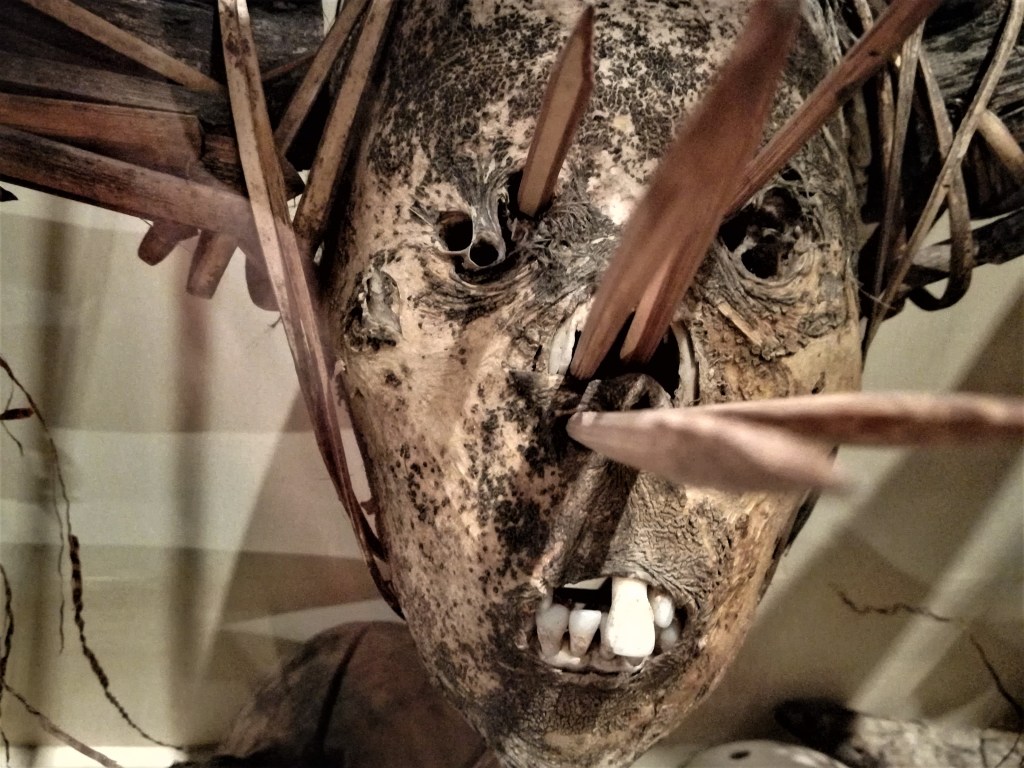
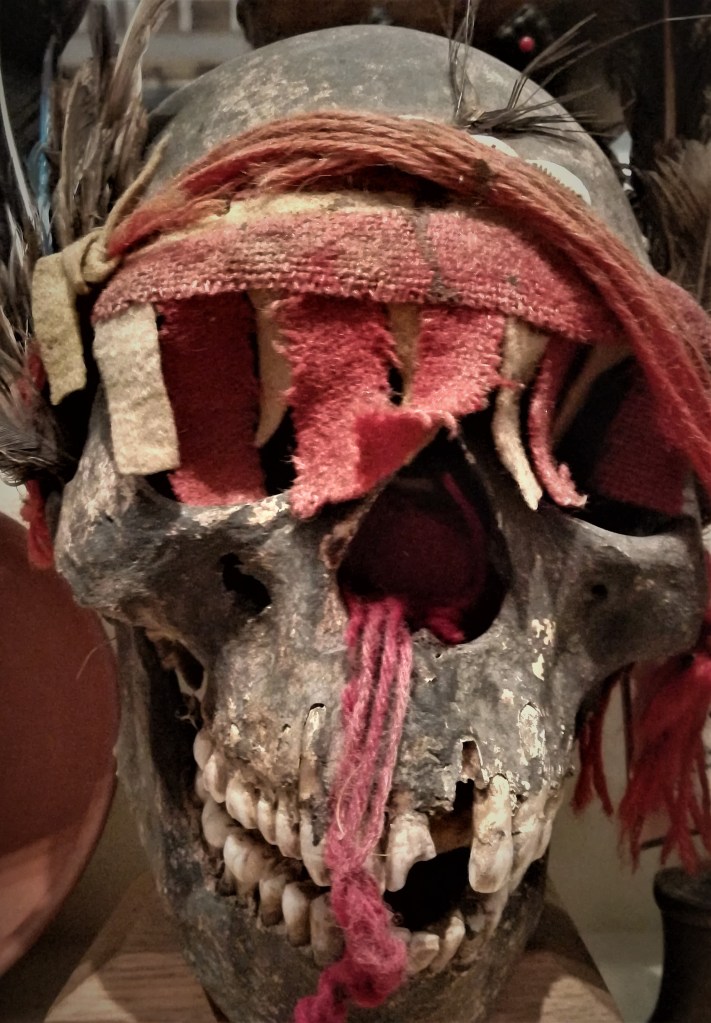
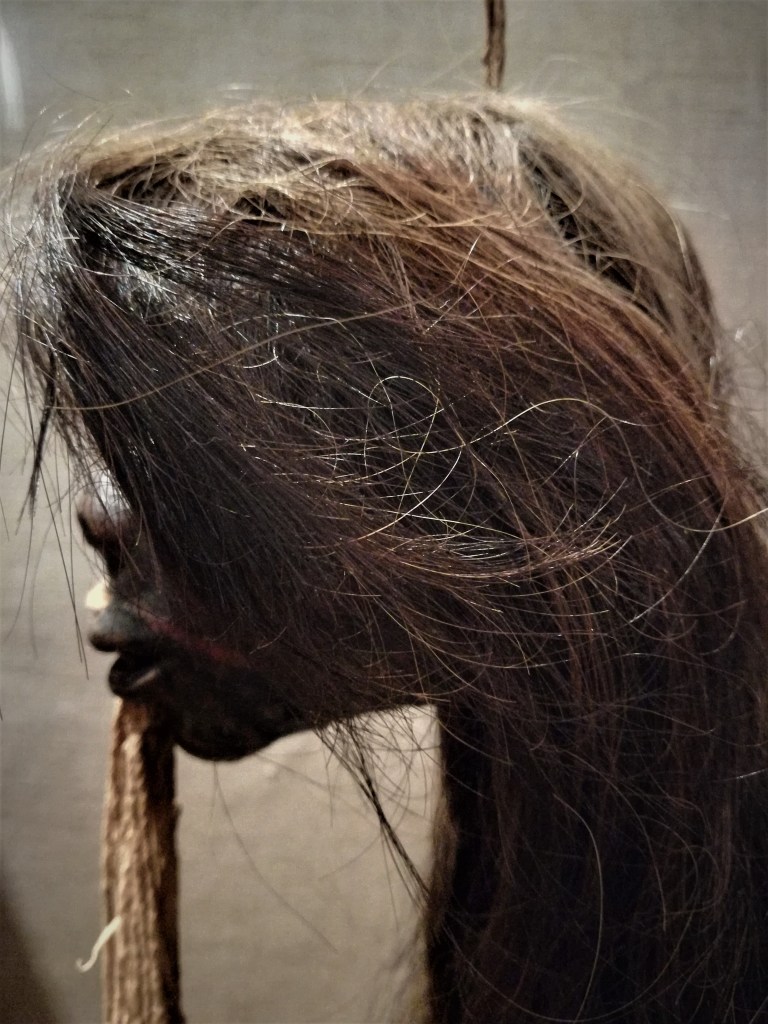
Artifacts like these are iconic, if somewhat grotesque battle trophies, but they also serve another purpose rooted in the instinctive fears and taboos surrounding death. These are in fact protective talismans for numerous indigenous, remote tribes peoples across South America, India, Africa and Australia.
hdr
Once beheaded, the skulls of ones’ enemies are bound in complex weaves of various organic materials, or shrunk and hung from carefully woven braids, interlaced with spella. Eyes are sewed shut, and beads or shells may be threaded into the flesh for extra protection.
Nostrils and mouths are pegged or pierced. The heads are defleshed and seared with hot sand and stones. These processes literally ‘sealed’ in the spirit of the defeated enemy to prevent it from returning to torment the living.
Binding the dead was practise common to all peoples the world over, and the few remaining examples attest to the extreme procedures involved. European folk tales provide hints to similar procedures whereby stakes, poles and iron bars were driven through the chest cavity or the skull.
These rituals were often conducted in secret.
hdr
An Egyptian spell typifies the importance of calling upon a higher powere of gods and ancestors to ensure the enemy is rendered impotent and the supplicant remains under their protection.
hdr
“O Ra in his egg, shining in his disk, rising from his horizon, floating on his sky, whose abomination is evil, raised on the supports of Shu, without equal among the gods, who gives the breath of flame of his mouth, who illuminates the two lands with his power of light, May you rescue the Osiris N from that god secret of forms, whose two eyebrows are the arms of the balance on the night of calculating theft.”
hdr
“It is Bringer by his Arm, as for that night of calculating theft, (it is) that night of fire-serpent with sacrifice. The one who casts lassos against the evil, (roping them in) to his slaughter-block that suppresses souls.”
hdr
“It is the tribunal that prosecutes the enemies of Osiris. May you together rescue the Osiris N from those ropemen, killers, sharp ones who love to behead, from whose guard none can escape, the following of Osiris.”
hdr
“They can have no power over me; I shall not descend into their cauldrons, because I know him, I know the name of that one who presses, among them in the house of Osiris, who shoots with his hand without being seen, who circles the land with flame in his mouth, who has reported the Nile Flood without being seen.”
Despite the popular notion that Gelasius abolished the Lupercalia, replacing it with the ‘Feast of the Purification of the Blessed Virgin Mary, there is no evidence to support this. The closest reference that links Lupercalia to any romantic elements of Saint Valentine’s Day, or the blessed virgin is found in Chaucer, which merges with poetic traditions of courtly love during the Marion Cult in popular tradition. However, we should remember how this geo-centric celebration coincides roughly with the Disirblot held by the Northern peoples in honour of ancestral Female guardians of the people and their lands.
Pagan Rome celebrated Lupercalia, held in February, which proves interesting due to its relevance the annual wild hunt. As the remnants of archaic pre-Roman pastoral rites that probably originated in the Sabian or Etruscan annual festival for the land and its protective spirits. Lupercalia exhibits several elements fundamental to the Wild Hunt traditions that are shared with the northern peoples.
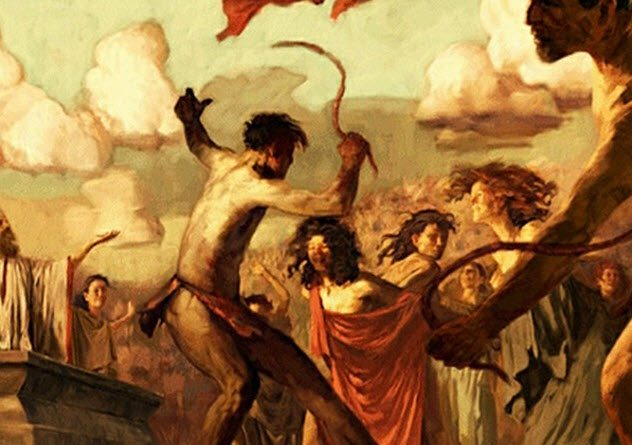
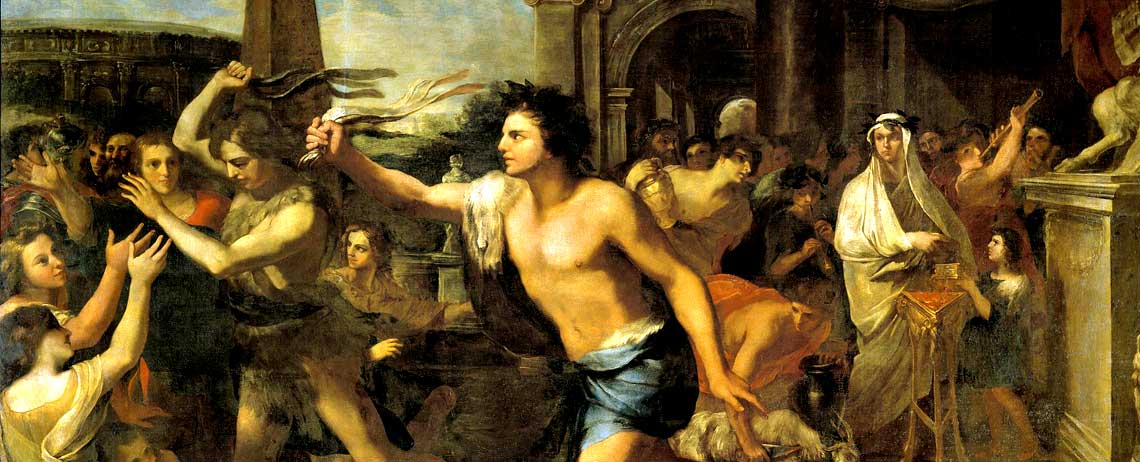
Lupercalia was a ‘Wolf Festival’ consecrated to Lupa, the she-wolf who nourished and protected the founders of Rome. That wild celebration took place at the mid-February kalends, to avert evil spirits and purify the city, reminding its citizens of the sting of life in death, and death in life. It was a ritual involving the purgation of its citizens of lingering spirits through flagellation by goatskin whips in honour of the Mother Goddess, Juno/Hera whose totemic beast was the goat/wolf.
Two noble youths were chosen from (the two named) ancestral families of Rome to lead the hunt, the Luperci in their riotous pilgrimage through and around the city boundaries. At the Lupercal altar, Vestal Virgins offered salted meal-cakes as a priest of the Luperci sacrificed a male goat and a dog. The foreheads of the two youths were anointed with blood from the sacrificial knife, then wiped clean with wool soaked in milk.
Thongs (known as februa) were cut from the flayed skin of the goat, whereupon the two youths, now adopting the role of wolves, were obliged to break out a peel of laughter, braying loudly as they began their hunt, scattering citizens everywhere as they rampaged, near naked, herding everyone to and from the boundaries of Rome, beating upon everyone they encountered with the thin strips of goatskin, purged under the aegis of Juno/Hera’s sacred goatskin mantle, they each wore. After completion of their circuit along the old Palatine boundary, in an anticlockwise direction around the hill, they returned to the Lupercal cave.
Lupercalia served to remind its citizens of their salvation from savagery and the primitive Sabian and Etruscan pastoralism of Rome founders and ancestors. As simple shepherds and goat herders, they were easy prey to the hunter, vulnerable to predators such as the wolves. In other words, it celebrated Arcadia as the mythical ancestral realm. Italic tradition associates the wolf with the Underworld, the ancestral realms. From the study of funerary reliefs, we can link the Lupercalia with the traditions of the dead, indeed the luperci themselves came to represent their returning ancestors.
Deemed essential to Rome’s continued safety and well-being, the Lupercalia festival initially occurred alongside traditional and Christian festivals. Despite the banning in 391CE of all non-Christian cults and festivals, Lupercalia clearly continued to propitiate the archaic land spirits and ancestral guardians of the city.
[Text copyright of shani oates, taken from ‘The Wild Hunt’ pending publication. Images are from wiki commons]
Greetings all as we enter a new secular year, one that the waxing light of the solar rays always inspires hope and better tidings. Traditionally, many of us relate to January through the ‘Janus’ perspective – fore and aft. We embrace whatever Fate has in store for us ‘braced’ with the gifts we have acquired along the many turnings endured in our lives up to this point of change and opportunity.
Beyond the
immediate needs and subjective aspirations of the individual self, the
objective world reflects the changing tides in subtle yet interconnected ways
that perhaps reveal and preserve a primality of survival, of deep-seated
instincts that modern social conventions have buried or eroded into
irrelevance.
As the
first real month of winter, January perfectly embodies the drive for survival
and for reproduction, though these are more typically associated with Spring,
being the season of actual birth, the natural product of those instinctive
drives. This view reveals how removed
many of us are from nature, or how fiercely we have suppressed those instincts.
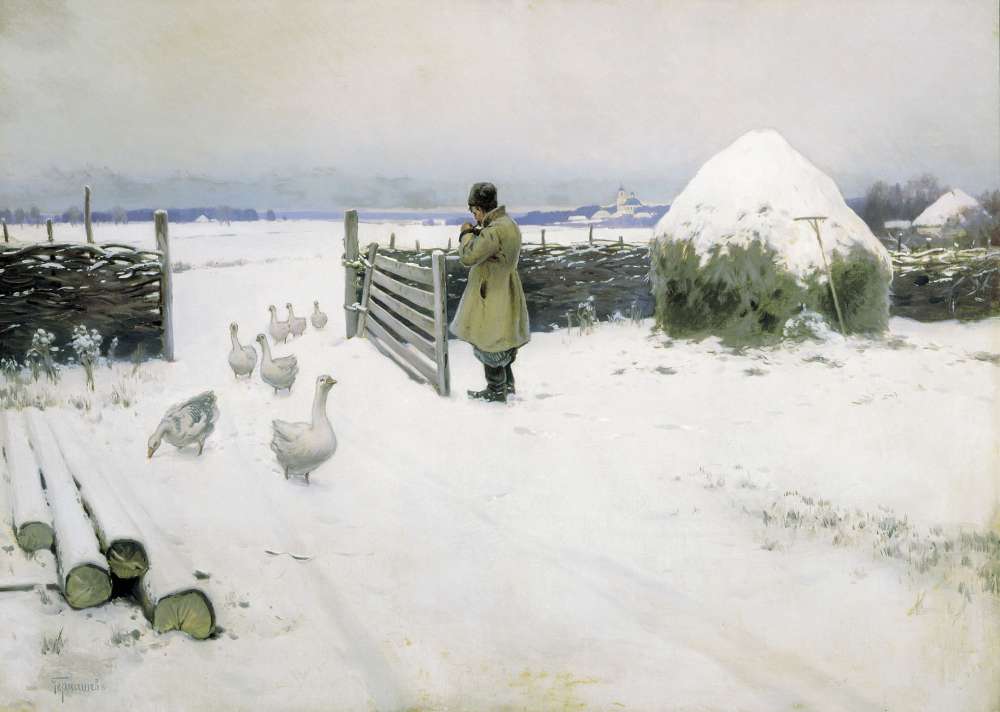
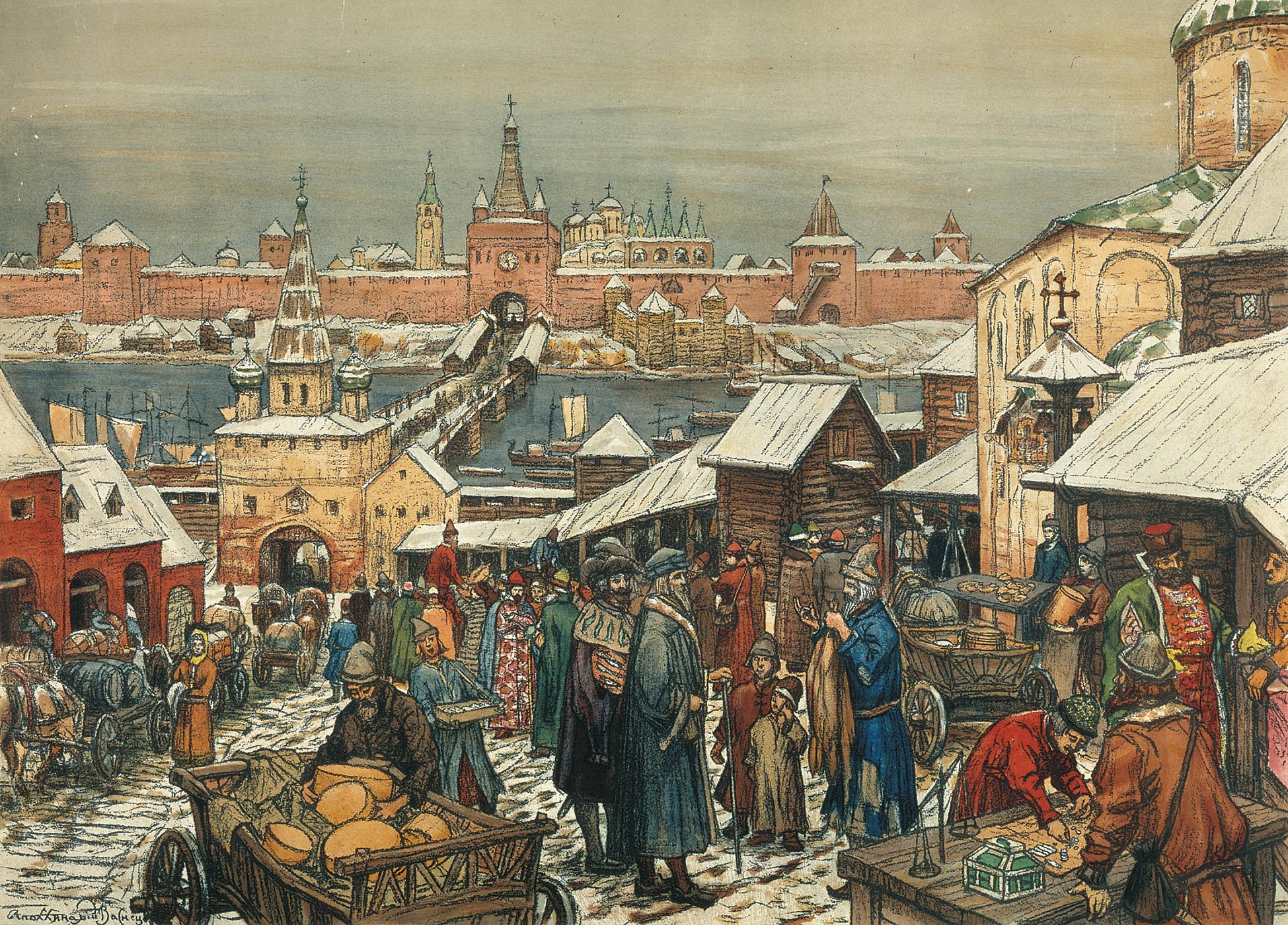
Known to the Gaelic Scots as Faoileach, the concept of this winter-tide eventually became condensed into the month of January. Deriving originally from faol-chu, meaning ‘wolf,’ Faoileach was to our ancestors, a wilder, bleaker period that brought death and the promise of life to come. Although there have been no (natural) wolves in Scotland for over two hundred and fifty years, this was the month their mating calls reached their peak. That eerie cacophony heralded perfectly the deep-rooted mood as Nature’s gift – to gather, to mate, to hunt and seek the companie of others to ‘dig-in.’
Outwardly, and above, the skies are abundant with meteor showers – bright shards of light, bursting against the inky black winter skies. Peering upwards as they appeared in the north eastern quadrant of the skies falling just before the rising dawn engulfed them, the wonder and promise of new life was surety against the chaotic gloom and uncertainty of winter. That hope literally kept the wolves from the door….the threshold of all things sacred and mundane, and the boundary of all things pertaining to life and death.
At this time, we too can re-connect with the thousands before us who have gazed in wonder at the phenomenal, celestial displays above and around us. January the 3rd-4th are the peak dates for the Quadrantids meteor shower as up to 50 meteors radiate out from Boötes in the hour before dawn. This year, the dark moon offers full visibility, so take a step outwards into the real world and embrace the true sensory gifts that Faoileach offers us.
All images are from Wiki Commons, various artists.
Author, muse, mystic, pilgrim, perennial philosopher and enquirer.. but primarily a seeker of gnosis within the Mysteries - all of which have led, and continue to lead me to uphold the gravid office of 'Maid' for the People of Goda, the Clan of Tubal Cain, wherein my duty is to cast forth ancestral lore within the bounds of its cultural and spiritual aegis, thereto translate and find expression as the Mysteries of its Tradition.



























 People of Goda, the Clan of Tubal Cain