mors venit, ut amans,

•November 11, 2012 • Leave a Comment

STAY CLOSE, MY HEART

Stay close, my heart, to the one who knows your ways;
Come into the shade of the tree that always has fresh flowers.
Don’t stroll idly through the bazaar of the perfume-makers:
Stay in the shop of the sugar-seller.

If you don’t find true balance, anyone can deceive you;
Anyone can trick out of a thing of straw,
And make you take it for gold.

Don’t squat with a bowl before every boiling pot;
In each pot on the fire you find very different things.
Not all sugarcanes have sugar, not all abysses a peak;
Not all eyes possess vision, not every sea is full of pearls.
O nightingale, with your voice of dark honey!

Go on lamenting!

Only your drunken ecstasy can pierce the rock’s hard heart!
Surrender yourself, and if you cannot be welcomed by the Friend,

Know that you are rebelling inwardly like a thread

That doesn’t want to go through the needle’s eye!
The awakened heart is a lamp; protect it by the hem of your robe!

Hurry and get out of this wind, for the weather is bad.
And when you’ve left this storm, you will come to a fountain;
You’ll find a Friend there who will always nourish your soul.

And with your soul always green, you’ll grow into a tall tree
Flowering always with sweet light-fruit, whose growth is interior.

(translated by Andrew Harvey)

‘Lux e tenebris lucet et luceat!’

•October 26, 2012 • Leave a Comment

Image


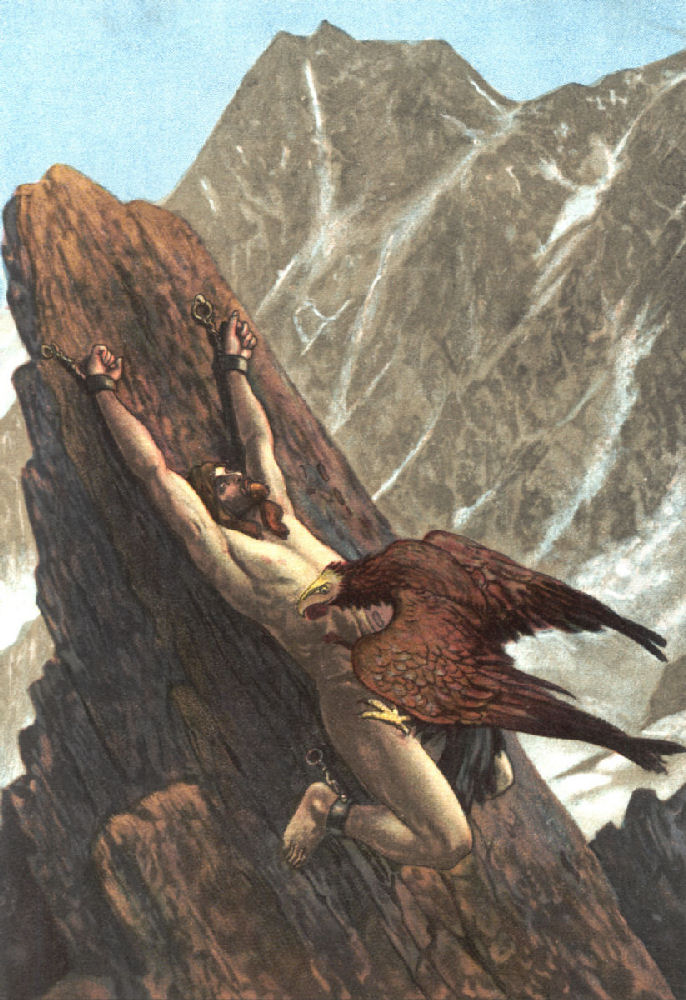
Prometheus and Hermes are both considered  to be ‘tricksters’. Both lay claim to the gift of fire. History though has awarded Hermes the credit of the ability to re-produce it.

Yet it is another to whom we owe thanks for its gift. Prometheus, then Herakles too are credited one after the other with this precious knowledge, dispersed among our kind.  Both are deemed to represent the archetypal hero.

But can a trickster also be a hero?

Should a hero also be a trickster?


History records this of Hermes whose role in wit is focused elsewhere:


“[Hermes] held in his hand the golden rod that he uses to lull men’s eyes asleep when he so wills, or again to wake others from their slumber; with this he roused them [the ghosts of the newly dead] and led them on, and they followed him, thinly gibbering … Hermes led them down through the ways of dankness. They passed the streams of Okeanos, the ‘Leukas Petre’ (White Rock), the ‘Pylai Helion’ (Gates of the Sun) and the ‘Demos Oneiron’ (Land of Dreams), and soon they came to the ‘Leimon Asphodelon’ (Field of Asphodel) where the Psykhai (souls) … have their habitation.”

– Homer, Odyssey 24.1 & 99


Image

“She [Maia] bare a son [Hermes] … a bringer of dreams, a watcher by night.”

– Homeric Hymn 4 to Hermes


“A sculptor was selling a white marble statue of Hermes which two men wanted to buy: one of them, whose son had just died, wanted it for the tombstone, while the other was a craftsman who wanted to consecrate the statue to the god himself … In his sleep, the sculptor saw Hermes himself standing at the Gate of Dreams (Pylai Oneiroi). The god spoke to him and said, ‘Well, my fate hangs in the balance: it is up to you whether I will become a dead man or a god!”  

 – Aesop, Fables 563 (from Babrius, Fabulae 30)


Image

Science and religion view the role of Hermes through a gnostic lens as the Serpent of wisdom, an avatar of the Divine Mind. They saw Seth, the 3rd son of Adam as the Agathodaemon, the Lion, Serpent/Sun and [father of Enoch/ Idris –Hermes Trismegistus]. Seth gave the Sabaeans their faith and with it the western perception of a righteous but ‘hidden god’.

Indeed, ‘mercurial’ eloquence is in fact silence, for the quick silver tongue holds its council, a mystery understood by even the most notorious exponents of the occult, Crowley too it seems deferred to ‘Harpocrates’, the silent Horus – the perfect child. Crowley perceived the path of the lightening flash upon the tree to be that of Silence.


Expressed succinctly in the maxim, to will, to dare to know and to be silent, occultists add – to evolve/evolove. Silence of course refers to the phenomenal periphery, the revealed world of appearances, where experiences are inexpressible by common language.

This effectively protects the sacred from the profane where they are deemed separate [albeit only] in our conscious awareness Therefore, silence is the most arcane mode of transmission. As contemplation between the self and the divine it is a passive act of submission. True magical silence is creative; talk dissipates and disrupts the flow of congress. This is afforded by only two states wherein a total absence of thought and speech induces:


1. dreamless sleep…… the domain of Hermes

2. Samadhi of the highest [non-volitional] kind….. the domain of Seth and of the ‘Hidden God’


These parallel:

  • Kenoma:           the material void of the earthly world of phenomena – Illusion of Truth
  • Pleroma:           the spiritual plenitude of the divine world of light   –  Truth of Illusion


ImageThe seven stages of alchemy refer not literally from lead to gold, nor even from Saturn to Sun, but from dross to purity, from dark to light, the ultimate light………..of God the Highest.  

But what is ‘ultimate light?

Of course, if the highest light is Zodiacal/Stellar Light [as the *8th stage of ascent], then the 9th being the Crystalline Sphere, the Primum Mobile/Primal Vortex [Kether] is the ‘darkness’ within and without that sensory brilliance.


Medieval Kabbalists considered the 8th level to be final based upon the earlier Chaldean model. It equates with the Throne. the central font of light, the darkness of creation, even of light. 

Saturn, the darkest planet is the representative of Set/Har – the Sun/Sirius duality. Set/Anubis = putrefaction  – the corruption that heralds new life. He is the Black Dragon, the ancient crocodile of the deep, Tiamat, Leviathan of the Abyss.


His Powers of Air –North and Mercury, are shown on the wings of the caduceus, the dual serpents, enforcing the dual currents of tide and life. The stellar father is hidden behind the solar son, the true and ultimate light of existence! Lead/Saturn to Gold/Sun = Carbon to Diamond = Malkhut to Kether – Saturn to Saturn !!!

 So it is then, the unified spirit and soul must begin their journey of rotation through these elements and realms, beginning with Saturn, the serpents’ lair of the underworld, where one overcomes sequential time, moving into ‘kairos’. The soul of the dead is assimilated to the progress of the stars as typified by Sirius, born again of the Mother Nuit in the eastern sky after its disappearance in the west. Superficially, at least, this follows the course of the sun.

 Within alchemy, the term INRI means: Igne Naturae Renovatur Integra

[Nature, by fire is renewed in its integrity……………….curious enigmatic metaphor for purification!

Image


 It also means: Yud; Nun; Resh; Yud = Fire, Water, Air and Earth – expressed as:


Yud      divine masculinity

He        divine femininity

Vau      physical masculinity

He        physical femininity


Mind is not the body, they are entirely separate; one serves the other according to Will.

Pythagoras upheld the principle of the primal oneness, the cosmic egg [of Mitra – the pale white rock] that split into cosmic duality; the impulse toward unification is love [re-union]. Two manifestations develop from the ultimate = consciousness and thought, male and female, one in essence, a mystery beyond being. To the Egyptians [with whom Pythagoras studied], this was the ‘Undifferentiated One’ – the One who is All who is Nothing………. Ayin.

Returning to alchemy, I note that the twin serpents of the caduceus are the Solar [Rosa Rubeus] and Lunar [Rosa Alba] dragons of the philosophers’ Mercury – the Father and Mother [fixed and volatile – sulphur and mercury.] Mercurial water is the agent of transmutation and return to divine unity, the essence of true magical transformation and exaltation, by this essence all things are resolved to their primal or Monadic being – their pristine existence. As each serpent devours the other, a phoenix rises from their ashes – the Perfected Being – Seth!

Image

Mithra is the deific entity, the phoenix that mediates between two ‘lights’, the visible and the invisible. It is the hiddeness of all being, the mysterious force of evolution and of the invisible light: Philosophically, the latent power of cognition, astrologically the source of the light of the heavens, and mystically the creative force of love.

Mithra is not the sun, but the divine vortex of spiritual fire, the Heart of the Universe.

The Sun/Son is its Manifestation.

Mithra is of course the Divine Monad, the First Cause, Ultimate and Divine Truth. 

To understand this, we have to meet, face and absorb our challenger whose trials give form to the ‘hidden’ force within and without…

The ‘Adversary’ engenders evolove through affliction and triumph.

The Adversary is all adverse force, the knowledge of opposing faction that finds resolution beyond them……. only in Perfection is such equilibrium won.. ……


Only ‘The’ Trickster is Heroic enough to sacrifice ‘Himself’ to this cause!


 Image


The Two Magicians

•October 17, 2012 • Leave a Comment

The Two Magicians

44.1 The lady stands in her bower door,
As straight as willow wand;
The blacksmith stood a little forebye,
Wi hammer in his hand.

 
44.2 ‘Weel may ye dress ye, lady

fair, your robes o red;
Before the morn at this same time,
I’ll gain your maidenhead.’
44.3 ‘Awa, awa, ye coal-black smith,
Woud ye do me the wrang

To think to gain my maidenhead,
That I hae kept sae lang!’
44.4 Then she has hadden up her hand,
And she sware by the mold,
‘I wudna be a blacksmith’s wife
For the full o a chest o gold.
44.5 ‘I’d rather I were dead and gone,
And my body laid in grave,
Ere a rusty stock o coal-black smith
My maidenhead shoud have.’
44.6 But he has hadden up his hand,
And he sware by the mass,
‘I’ll cause ye be my light leman
For the hauf o that and less.’


44.6b O bide, lady, bide,
And aye he bade her bide;
The rusty smith your leman shall be,
For a’ your muckle pride.
44.7 Then she became a turtle dow,
To fly up in the air,
And he became another dow,
And they flew pair and pair.


44.7b O bide, lady, bide, ’C..
44.8 She turnd hersell into an eel,
To swim into yon burn,
And he became a speckled trout,
To gie the eel a turn.
44.8b O bide, lady, bide, ’C..
44.9 Then she became a duck, a duck,
To puddle in a peel,
And he became a rose-kaimd drake,
To gie the duck a dreel.
44.9b O bide, lady, bide, ’C..
44.10 She turnd hersell into a hare,

To rin upon yon hill,

And he became a gude grey-hound, And boldly he did fill.
44.10b O bide, lady, bide, ’C..
44.11 Then she became a gay grey mare,
And stood in yonder slack,
And he became a gilt saddle,
And sat upon her back.
44.11b Was she wae, he held her sae,
And still he bade her bide;
The rusty smith her leman was,
For a’ her muckle pride.
44.12 Then she became a het girdle,
And he became a cake,
And a’ the ways she turnd hersell,
The blacksmith was her make.


44.12b Was she wae, etc.
44.13 She turnd hersell into a ship,
To sail out ower the flood;He ca’ed a nail intill her tail,
And syne the ship she stood.
44.13b Was she wae, etc.
44.14 Then she became a silken plaid,
And stretchd upon a bed,
And he became a green covering,
And gaind her maidenhead.
44.14b Was she wae, etc.

http://www.sacred-texts.com/neu/eng/child/ch044.htm

VULCAN – SMITH TO THE GODS

•October 2, 2012 • Leave a Comment


‘Fam’d Vulcan’s rustic sons with Bacchus reign


Image 

 ……… Vulcan …… His skill exerted …

And with new arms the victor God supply’d.

What skill the sooty artist has reveal’d

…………

Red metal flames, the roaring bellows blow;

Resounding deep at once the blast expires,

And twenty forges catch at once the fires:

Now like a tempest loud, now gentle, …

In hissing flames …

Th’ eternal anvils deeply fix’d behold!

…………

Taught by the God, the mimic tribe below

For meaner use their sweaty toil bestow;

…………


Image


Nor for convenience only are essay’d

The several labours of the swarthy trade;

…………

Did the god-founder of this art design,

And prove the craft a faculty divine.


…… Apollo, God of Song and Wit;

…… Mercury, and …… Bacchus ……

…… leave of absence ask’d of Jove, ……

To Britain’s Isle, with speed, they bent their flight,

And lighted here, ……

Old Vulcan’s Smithy soon, with ease, they found,

Directed by the thund’ring anvil’s sound; ……


[http://www.search.revolutionaryplayers.org.uk/content/files/60/84/327.txt]

photo credit  – [http://www.search.revolutionaryplayers.org.uk/content/files/60/84/327.txt]

bas relief from Herculaneum site images


MICHAELMAS

•September 25, 2012 • Leave a Comment

MICHAELMAS

“What is more noble than Gold?”.
“Light” replies the Snake.
“And what is more refreshing than Light?” asks the King.
“Speech” replies the Snake. (i)

Michaelmas  is one of four English ‘Quarter Days,’ days that occur  at the Equinoxes or Solstices  marking the beginnings of new natural seasons (i.e., Spring, Summer, Winter, Autumn).  They were very familiar during medieval times, being used to denote the natural division into ‘quarters’ of the year for legal purposes, especially for settling debts and fulfilling boons.

The other cardinal markers are Lady Day (the Feast of the Annunciation) on March 25.

The Feast of St. John on June 24, and Christmas on December 25.

Two souls reside, alas, within my breast,
And each one from the other would be parted.
The one holds fast, in sturdy lust for love,
With clutching organs clinging to the world;
The other strongly rises from the gloom
To lofty fields of ancient heritage.
Faust I, Scene 2, lines 1112-1117. (ii)

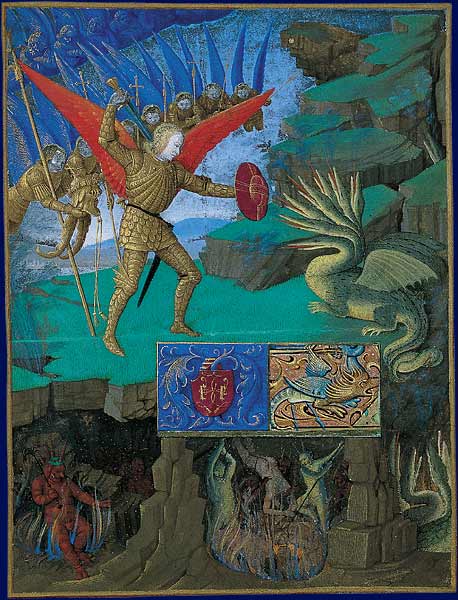
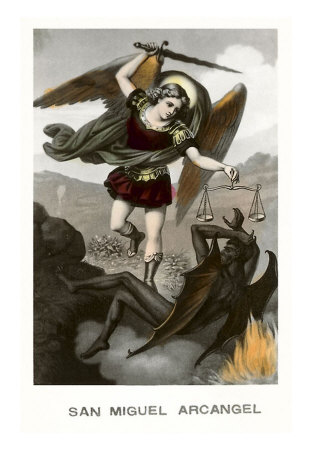
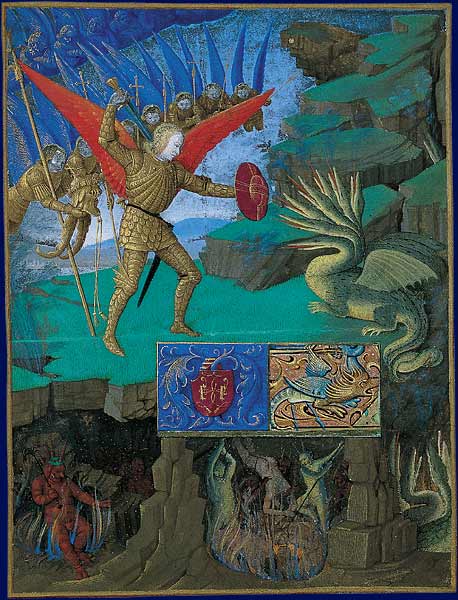
In the illustration of the fight of Michael with the Dragon one thing is clearly and strongly present; that is, the consciousness that man himself must give to his inner life of soul the direction and guidance that Nature cannot give. Our present-day thinking is inclined to mistrust such an idea. We are afraid of becoming estranged from Nature. We want to enjoy her in all her beauty, to revel in her abundance of life, and we are loath to let ourselves be robbed of this enjoyment by admitting that Nature has fallen from the Spiritual. In our striving for knowledge moreover we want to let Nature speak.

We fear to lose ourselves in all kinds of fantasy, should we allow the Spirit that transcends the perception of external Nature, to have a voice concerning the reality of things. Goethe had no such fear. He found nowhere in Nature any estrangement from the Spirit. He opened his heart to her beauty, to the inner power and might of all that she revealed. In the life of man he felt the presence of much that was inharmonious, much that grated and jarred, or that gave rise to doubt and confusion. And he felt an inner urge and impulse to live in communion with Nature, where the eternal laws of sequence and compensation prevail. Some of his most beautiful poems have sprung from such a life with Nature.

Goethe was however at the same time fully conscious of how the work of man must fulfil and complete the work of Nature. He felt all the beauty of the plants. But he felt too something incomplete in that life which the plant displays before man. In that which weaves and works unseen within the plant, there lay for him far more than manifests itself to the eye within the bounds of visible form.

For Goethe, what Nature attains is not the whole. He felt as well what we may call the purposes of Nature. He did not let himself be deterred by the fear of personifying Nature. He knew well that he was not as it were dreaming such purposes into the life of the plant out of any subjective fancy, he beheld them there quite objectively, just as truly as he could behold the colour of the flowers.

Goethe was conscious of how there is in Nature not only an ascending but also a descending life. He felt the growth from the seedling to leaf and bud and blossom and fruit; but he felt too how all in turn withers, decays, dries up and dies away. He felt the Spring: but he felt also the Autumn. In Summer he could partake with his own inner sympathy in the unfolding of Nature, but in Winter he could also partake in her death with the same openness of heart.

We may not find in Goethe’s works a clear expression in words of this twofold experience with Nature, but we cannot fail to be sensible of it in his whole manner of thought. It is as it were an echo of the experience of Michael’s fight with the Dragon. Only, the experience is lifted in Goethe to the consciousness of a later age. (iii)

Michaelmas  is one of four English ‘Quarter Days,’ days that occur  at the Equinoxes or Solstices  marking the beginnings of new natural seasons (i.e., Spring, Summer, Winter, Autumn).  They were very familiar during medieval times, being used to denote the natural division into ‘quarters’ of the year for legal purposes, especially for settling debts and fulfilling boons.

The other cardinal markers are Lady Day (the Feast of the Annunciation) on March 25.

The Feast of St. John on June 24, and Christmas on December 25.

In the illustration of the fight of Michael with the Dragon one thing is clearly and strongly present; that is, the consciousness that man himself must give to his inner life of soul the direction and guidance that Nature cannot give. Our present-day thinking is inclined to mistrust such an idea. We are afraid of becoming estranged from Nature. We want to enjoy her in all her beauty, to revel in her abundance of life, and we are loath to let ourselves be robbed of this enjoyment by admitting that Nature has fallen from the Spiritual. In our striving for knowledge moreover we want to let Nature speak.

We fear to lose ourselves in all kinds of fantasy, should we allow the Spirit that transcends the perception of external Nature, to have a voice concerning the reality of things. Goethe had no such fear. He found nowhere in Nature any estrangement from the Spirit. He opened his heart to her beauty, to the inner power and might of all that she revealed. In the life of man he felt the presence of much that was inharmonious, much that grated and jarred, or that gave rise to doubt and confusion. And he felt an inner urge and impulse to live in communion with Nature, where the eternal laws of sequence and compensation prevail. Some of his most beautiful poems have sprung from such a life with Nature.

Goethe was however at the same time fully conscious of how the work of man must fulfil and complete the work of Nature. He felt all the beauty of the plants. But he felt too something incomplete in that life which the plant displays before man. In that which weaves and works unseen within the plant, there lay for him far more than manifests itself to the eye within the bounds of visible form.

For Goethe, what Nature attains is not the whole. He felt as well what we may call the purposes of Nature. He did not let himself be deterred by the fear of personifying Nature. He knew well that he was not as it were dreaming such purposes into the life of the plant out of any subjective fancy, he beheld them there quite objectively, just as truly as he could behold the colour of the flowers.

Goethe was conscious of how there is in Nature not only an ascending but also a descending life. He felt the growth from the seedling to leaf and bud and blossom and fruit; but he felt too how all in turn withers, decays, dries up and dies away. He felt the Spring: but he felt also the Autumn. In Summer he could partake with his own inner sympathy in the unfolding of Nature, but in Winter he could also partake in her death with the same openness of heart.

We may not find in Goethe’s works a clear expression in words of this twofold experience with Nature, but we cannot fail to be sensible of it in his whole manner of thought. It is as it were an echo of the experience of Michael’s fight with the Dragon. Only, the experience is lifted in Goethe to the consciousness of a later age. (iv)

(i) http://www.newview.org.uk/green_snake.htm

                  (ii) [http://www.philosophyoffreedom.com/node/4142]

  (iii)[http://wn.rsarchive.org/Lectures/Michaelmas/19230930p01.html]

                                   (iv[http://wn.rsarchive.org/Lectures/Michaelmas/19230930p01.html]

all images are courtesy of wiki commons

Day Star

•September 12, 2012 • Leave a Comment

” we have also a more sure word of prophecy; whereupon ye do well that ye take heed, as unto a light that shineth in a dark place, until the day dawn and the daystar arise in your hearts.” [second epistle of Peter i]Image

THE GREAT HYMN TO SHAMASH


21. You climb to the mountains surveying the earth,

22. You suspend from the heavens the circle of the lands.

23. You care for all the peoples of the lands,

24. And everything that Ea, king of the counsellors, had created is entrusted to you.

25. Whatever has breath you shepherd without exception,

26. You are their keeper in upper and lower regions.

27. Regularly and without cease you traverse the heavens,

28. Every day you pass over the broad earth. . . .

33. Shepherd of that beneath, keeper of that above,

34. You, Shamash, direct, you are the light of everything.

35. You never fail to cross the wide expanse of sea,

36. The depth of which the Igigi know not.

37. Shamash, your glare reaches down to the abyss

38. So that monsters of the deep behold your light. . . .

45. Among all the Igigi there is none who toils but you,

46. None who is supreme like you in the whole pantheon of gods.

47. At your rising the gods of the land assemble,

48. Your fierce glare covers the land.

49. Of all the lands of varied speech,

50.. You know their plans, you scan their way.

51.. The whole of mankind bows to you,

52. Shamash, the universe longs for your light. . . .

88. A man who covets his neighbour’s wife

89. Will [ . . .] before his appointed day.

90.. A -nasty snare is prepared for him. [ . . .]

91. Your weapon will strike at him, and there will be none to save him.

92. [His] father will not stand for his defense,

93. And at the judge’s command his brothers will not plead.

94. He will be caught in a copper trap that he did not foresee.

95. You destroy the horns of a scheming villain,

96. A zealous [. . .] his foundations are undermined.

97. You give the unscrupulous judge experience of fetters,

98. Him who accepts a present and yet lets justice miscarry you make bear his punishment.

99. As for him who declines a present but nevertheless takes the part of the weak,

100.. It is pleasing to Shamash, and he will prolong his life. . . .

124. The progeny of evil-doers will [fail.]

125. Those whose mouth says ‘No’-their case is before you.

126. In a moment you discern what they say;

127. You hear and examine them; you determine the lawsuit of the wronged.

128. Every single person is entrusted to your hands;

129. You manage their omens; that which is perplexing you make plain.

130. You observe, Shamash, prayer, supplication, and benediction,

131. Obeisance, kneeling, ritual murmurs, and prostration.

132. The feeble man calls you from the hollow of his mouth,

133. The humble, the weak, the afflicted, the poor,

134. She whose son is captive constantly and unceasingly confronts you.

135. He whose family is remote, whose city is distant,

136. The shepherd [amid) the terror of the steppe confronts you,

137. The herdsman in warfare, the keeper of sheep among enemies.

138. Shamash, there confronts you the caravan, those journeying in fear,

139. The travelling merchant, the agent who is carrying capital.

140. Shamash, there confronts you the fisherman with his net,

141. The hunter, the bowman who drives the game,

142. With his bird net the fowler confronts You.

143. The prowling thief, the enemy of Shamash,

144. The marauder along the tracks of the steppe confronts you.

145. The roving dead, the vagrant soul,

146. They confront you, Shamash, and you hear all.

147. You do not obstruct those that confront you. . . .

148. For my sake, Shamash, do not curse them!

149. You grant revelations, Shamash, to the families of men,

150. Your harsh face and fierce light you give to them. . . .

154. The heavens are not enough as the vessel into which you gaze,

155. The sum of the lands is inadequate as a seer’s bowl…….

159. You deliver people surrounded by mighty waves,

160. In return you receive their pure, clear libations. . . .

165. They in their reverence laud the mention of you,

166. And worship your majesty for ever. . . .

174. Which are the mountains not clothed with your beams?

175. Which are the regions not warmed by the brightness of your light?

176. Brightener of gloom, illuminator of darkness,

177. Dispeller of darkness, illuminator of the broad earth.

Translation by W. G. Lambert, in his Babylonian Wisdom Literature

(Oxford, 1960,)I, 127 ff.

Image

•September 7, 2012 • 2 Comments


Alfred Tennyson, Lord Tennyson

Come down, O Maid

                                                                    COME down, O maid, from yonder mountain height:


In What pleasure lives in height (the shepherd sang)

height and cold, the splendour of the hills?

But cease to move so near the Heavens, and cease
To glide a sunbeam by the blasted Pine,
To sit a star upon the sparkling spire;
And come, for Love is of the valley, come,

 For Love is of the valley, come thou down

And find him; by the happy threshold, he,
Or hand in hand with Plenty in the maize,
Or red with spirited purple of the vats,
Or fox-like in the vine; nor cares to walk
With Death and Morning on the silver horns,
Nor wilt thou snare him in the white ravine,
Nor find him dropt upon the firths of ice,
That huddling slant in furrow-cloven falls
To roll the torrent out of dusky doors:

  But follow; let the torrent dance thee down

To find him in the valley; let the wild
Lean-headed eagles yelp alone, and leave
The monstrous ledges there to slope, and spill
Their thousand wreaths of dangling water-smoke,
That like a broken purpose waste in air:

 So waste not thou; but come; for all the vales

Await thee; azure pillars of the hearth
Arise to thee; the children call, and I
Thy shepherd pipe, and sweet is every sound,
Sweeter thy voice, but every sound is sweet;
Myriads of rivulets hurrying thro’ the lawn,
The moan of doves in immemorial elms,
And murmuring of innumerable bees.

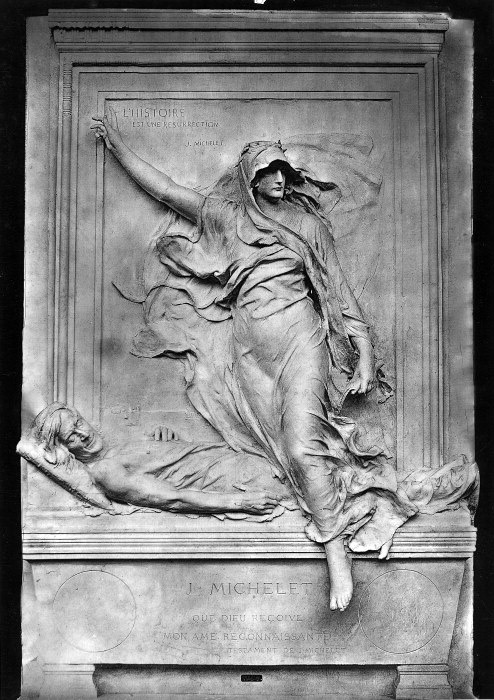
 nb_sculpture_mercie_marius_jean_antonin_tomb_of_jules_michelet_detail

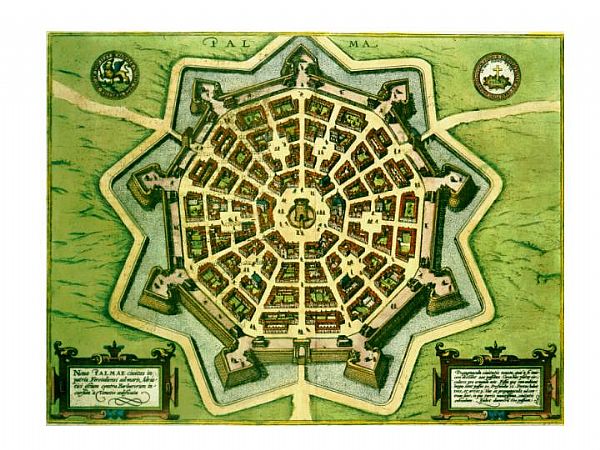
THE CITY OF THE SUN By Tommaso Campanells

•August 17, 2012 • Leave a Comment

Regarding Edin, Adocentyn, The City of God:


A Poetical Dialogue between a Grandmaster of the Knights Hospitallers and a Genoese Sea-Captain, his guest.


G.M. Prithee, now, tell me what happened to you during that voyage?

Capt. I have already told you how I wandered over the whole earth. In the course of my journeying I came to Taprobane, and was compelled to go ashore at a place, where through fear of the inhabitants I remained in a wood. When I stepped out of this I found myself on a large plain immediately under the equator.

G.M. And what befell you here?

Capt. I came upon a large crowd of men and armed women, many of whom did not understand our language, and they conducted me forthwith to the City of the Sun.

G.M. Tell me after what plan this city is built and how it is governed.

Capt. The greater part of the city is built upon a high hill, which rises from an extensive plain, but several of its circles extend for some distance beyond the base of the hill, which is of such a size that the diameter of the city is upward of two miles, so that its circumference becomes about seven. On account of the humped shape of the mountain, however, the diameter of the city is really more than if it were built on a plain.
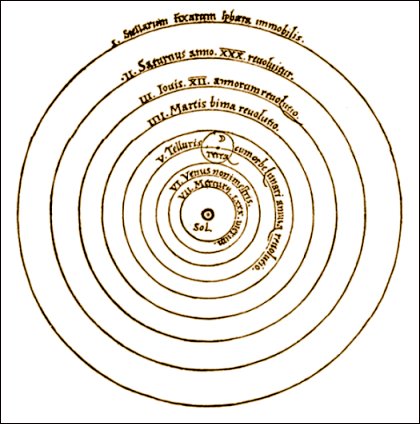
It is divided into seven rings or huge circles named from the seven planets, and the way from one to the other of these is by four streets and through four gates, that look toward the four points of the compass. Furthermore, it is so built that if the first circle were stormed, it would of necessity entail a double amount of energy to storm the second; still more to storm the third; and in each succeeding case the strength and energy would have to be doubled; so that he who wishes to capture that city must, as it were, storm it seven times. For my own part, however, I think that not even the first wall could be occupied, so thick are the earthworks and so well fortified is it with breastworks, towers, guns, and ditches.

When I had been taken through the northern gate (which is shut with an iron door so wrought that it can be raised and let down, and locked in easily and strongly, its projections running into the grooves of the thick posts by a marvellous device), I saw a level space seventy paces (1) wide between the first and second walls. From hence can be seen large palaces, all joined to the wall of the second circuit in such a manner as to appear all one palace. Arches run on a level with the middle height of the palaces, and are continued round the whole ring. There are galleries for promenading upon these arches, which are supported from beneath by thick and well-shaped columns, enclosing arcades like peristyles, or cloisters of an abbey.


But the palaces have no entrances from below, except on the inner or concave partition, from which one enters directly to the lower parts of the building. The higher parts, however, are reached by flights of marble steps, which lead to galleries for promenading on the inside similar to those on the outside. From these one enters the higher rooms, which are very beautiful, and have windows on the concave and convex partitions. These rooms are divided from one another by richly decorated walls. The convex or outer wall of the ring is about eight spans thick; the concave, three; the intermediate walls are one, or perhaps one and a half. Leaving this circle one gets to the second plain, which is nearly three paces narrower than the first. Then the first wall of the second ring is seen adorned above and below with similar galleries for walking, and there is on the inside of it another interior wall enclosing palaces. It has also similar peristyles supported by columns in the lower part, but above are excellent pictures, round the ways into the upper houses. And so on afterward through similar spaces and double walls, enclosing palaces, and adorned with galleries for walking, extending along their outer side, and supported by columns, till the last circuit is reached, the way being still over a level plain.
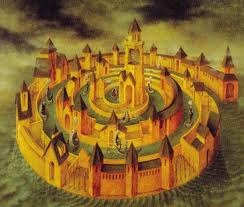
 

But when the two gates, that is to say, those of the outmost and the inmost walls, have been passed, one mounts by means of steps so formed that an ascent is scarcely discernible, since it proceeds in a slanting direction, and the steps succeed one another at almost imperceptible heights. On the top of the hill is a rather spacious plain, and in the midst of this there rises a temple built with wondrous art.
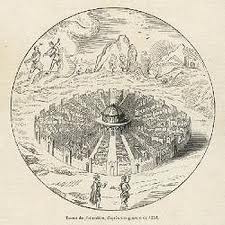
 

G.M. Tell on, I pray you! Tell on! I am dying to hear more.

Capt. The temple is built in the form of a circle; it is not girt with walls, but stands upon thick columns, beautifully grouped. A very large dome, built with great care in the centre or pole, contains another small vault as it were rising out of it, and in this is a spiracle, which is right over the altar. There is but one altar in the middle of the temple, and this is hedged round by columns. The temple itself is on a space of more than 350 paces. Without it, arches measuring about eight paces extend from the heads of the columns outward, whence other columns rise about three paces from the thick, strong, and erect wall. Between these and the former columns there are galleries for walking, with beautiful pavements, and in the recess of the wall, which is adorned with numerous large doors, there are immovable seats, placed as it were between the inside columns, supporting the temple. Portable chairs are not wanting, many and well adorned. Nothing is seen over the altar but a large globe, upon which the heavenly bodies are painted, and another globe upon which there is a representation of the earth. Furthermore, in the vault of the dome there can be discerned representations of all the stars of heaven from the first to the sixth magnitude, with their proper names and power to influence terrestrial things marked in three little verses for each. There are the poles and greater and lesser circles according to the right latitude of the place, but these are not perfect because there is no wall below. They seem, too, to be made in their relation to the globes on the altar. The pavement of the temple is bright with precious stones. Its seven golden lamps hang always burning, and these bear the names of the seven planets.

At the top of the building several small and beautiful cells surround the small dome, and behind the level space above the bands or arches of the exterior and interior columns there are many cells, both small and large, where the priests and religious officers dwell to the number of forty-nine.

A revolving flag projects from the smaller dome, and this shows in what quarter the wind is. The flag is marked with figures up to thirty-six, and the priests know what sort of year the different kinds of winds bring and what will be the changes of weather on land and sea. Furthermore, under the flag a book is always kept written with letters of gold.

G.M. I pray you, worthy hero, explain to me their whole system of government; for I am anxious to hear it.

Capt. The great ruler among them is a priest whom they call by the name Hoh, though we should call him Metaphysic. He is head over all, in temporal and spiritual matters, and all business and lawsuits are settled by him, as the supreme authority. Three princes of equal power—viz., Pon, Sin, and Mor—assist him, and these in our tongue we should call Power, Wisdom, and Love. To Power belongs the care of all matters relating to war and peace. He attends to the military arts, and, next to Hoh, he is ruler in every affair of a warlike nature. He governs the military magistrates and the soldiers, and has the management of the munitions, the fortifications, the storming of places, the implements of war, the armories, the smiths and workmen connected with matters of this sort.

But Wisdom is the ruler of the liberal arts, of mechanics, of all sciences with their magistrates and doctors, and of the discipline of the schools. As many doctors as there are, are under his control. There is one doctor who is called Astrologus; a second, Cosmographus; a third, Arithmeticus; a fourth, Geometra; a fifth, Historiographus; a sixth, Poeta; a seventh, Logicus; an eighth, Rhetor; a ninth, Grammaticus; a tenth, Medicus; an eleventh, Physiologus; a twelfth, Politicus; a thirteenth, Moralis. They have but one book, which they call Wisdom, and in it all the sciences are written with conciseness and marvellous fluency of expression. This they read to the people after the custom of the Pythagoreans. It is Wisdom who causes the exterior and interior, the higher and lower walls of the city to be adorned with the finest pictures, and to have all the sciences painted upon them in an admirable manner. On the walls of the temple and on the dome, which is let down when the priest gives an address, lest the sounds of his voice, being scattered, should fly away from his audience, there are pictures of stars in their different magnitudes, with the powers and motions of each, expressed separately in three little verses.

On the interior wall of the first circuit all the mathematical figures are conspicuously painted—figures more in number than Archimedes or Euclid discovered, marked symmetrically, and with the explanation of them neatly written and contained each in a little verse. There are definitions and propositions, etc. On the exterior convex wall is first an immense drawing of the whole earth, given at one view. Following upon this, there are tablets setting forth for every separate country the customs both public and private, the laws, the origins and the power of the inhabitants; and the alphabets the different people use can be seen above that of the City of the Sun.

On the inside of the second circuit, that is to say of the second ring of buildings, paintings of all kinds of precious and common stones, of minerals and metals, are seen; and a little piece of the metal itself is also there with an apposite explanation in two small verses for each metal or stone. On the outside are marked all the seas, rivers, lakes, and streams which are on the face of the earth; as are also the wines and the oils and the different liquids, with the sources from which the last are extracted, their qualities and strength. There are also vessels built into the wall above the arches, and these are full of liquids from one to 300 years old, which cure all diseases. Hail and snow, storms and thunder, and whatever else takes place in the air, are represented with suitable figures and little verses. The inhabitants even have the art of representing in stone all the phenomena of the air, such as the wind, rain, thunder, the rainbow, etc.

On the interior of the third circuit all the different families of trees and herbs are depicted, and there is a live specimen of each plant in earthenware vessels placed upon the outer partition of the arches. With the specimens there are explanations as to where they were first found, what are their powers and natures, and resemblances to celestial things and to metals, to parts of the human body and to things in the sea, and also as to their uses in medicine, etc. On the exterior wall are all the races of fish found in rivers, lakes, and seas, and their habits and values, and ways of breeding, training, and living, the purposes for which they exist in the world, and their uses to man. Further, their resemblances to celestial and terrestrial things, produced both by nature and art, are so given that I was astonished when I saw a fish which was like a bishop, one like a chain, another like a garment, a fourth like a nail, a fifth like a star, and others like images of those things existing among us, the relation in each case being completely manifest. There are sea-urchins to be seen, and the purple shell-fish and mussels; and whatever the watery world possesses worthy of being known is there fully shown in marvellous characters of painting and drawing.

On the fourth interior wall all the different kinds of birds are painted, with their natures, sizes, customs, colors, manner of living, etc.; and the only real phoenix is possessed by the inhabitants of this city. On the exterior are shown all the races of creeping animals, serpents, dragons, and worms; the insects, the flies, gnats, beetles, etc., in their different states, strength, venoms, and uses, and a great deal more than you or I can think of.

On the fifth interior they have all the larger animals of the earth, as many in number as would astonish you. We indeed know not the thousandth part of them, for on the exterior wall also a great many of immense size are also portrayed. To be sure, of horses alone, how great a number of breeds there is and how beautiful are the forms there cleverly displayed!

On the sixth interior are painted all the mechanical arts, with the several instruments for each and their manner of use among different nations. Alongside, the dignity of such is placed, and their several inventors are named. But on the exterior all the inventors in science, in warfare, and in law are represented. There I saw Moses, Osiris, Jupiter, Mercury, Lycurgus, Pompilius, Pythagoras, Zamolxis, Solon, Charondas, Phoroneus, with very many others. They even have Mahomet, whom nevertheless they hate as a false and sordid legislator. In the most dignified position I saw a representation of Jesus Christ and of the twelve Apostles, whom they consider very worthy and hold to be great. Of the representations of men, I perceived Caesar, Alexander, Pyrrhus, and Hannibal in the highest place; and other very renowned heroes in peace and war, especially Roman heroes, were painted in lower positions, under the galleries. And when I asked with astonishment whence they had obtained our history, they told me that among them there was a knowledge of all languages, and that by perseverance they continually send explorers and ambassadors over the whole earth, who learn thoroughly the customs, forces, rule and histories of the nations, bad and good alike. These they apply all to their own republic, and with this they are well pleased. I learned that cannon and typography were invented by the Chinese before we knew of them. There are magistrates who announce the meaning of the pictures, and boys are accustomed to learn all the sciences, without toil and as if for pleasure; but in the way of history only until they are ten years old.
Love is foremost in attending to the charge of the race. He sees that men and women are so joined together, that they bring forth the best offspring. Indeed, they laugh at us who exhibit a studious care for our breed of horses and dogs, but neglect the breeding of human beings. Thus the education of the children is under his rule. So also is the medicine that is sold, the sowing and collecting of fruits of the earth and of trees, agriculture, pasturage, the preparations for the months, the cooking arrangements, and whatever has any reference to food, clothing, and the intercourse of the sexes. Love himself is ruler, but there are many male and female magistrates dedicated to these arts.

Metaphysic, then, with these three rulers, manages all the above-named matters, and even by himself alone nothing is done; all business is discharged by the four together, but in whatever Metaphysic inclines to the rest are sure to agree.


Courtesy of  the  tremendous online resource  http://www.gutenberg.org/files/2816/2816-h/2816-h.htm

Images courtesy of http://www.universutopia.net/note.asp?L=EN&note_id=42

 Hekate – Dark…

•August 9, 2012 • Leave a Comment

 Image

Hekate – Dark Mistress of the Soul.


“The Black Goddess is so far hardly more than a word of hope whispered among the few who have served their apprenticeship to the White Goddess – she will lead man back to that sure instinct of love he long ago forfeited by intellectual pride……………….”


Robert Graves


 Image


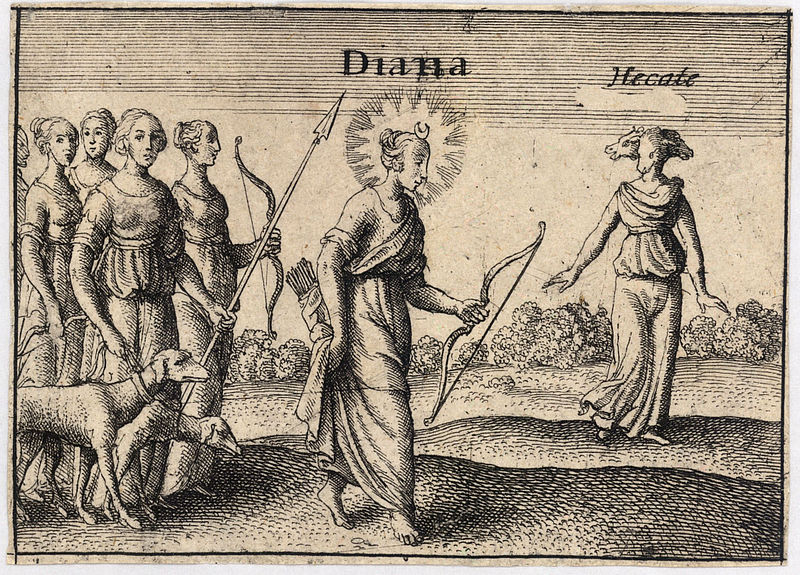
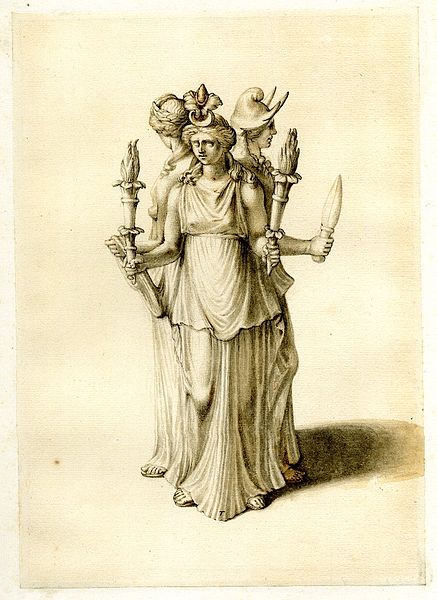
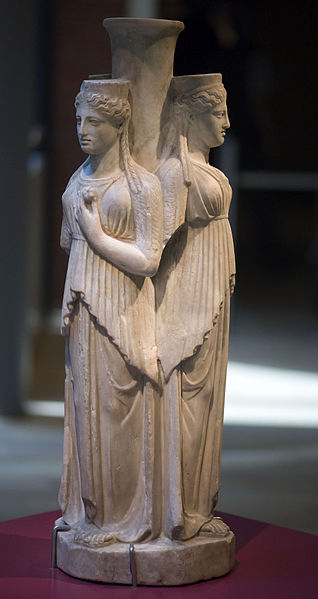
Both Hekate and Hermes share the role of psychopomp and protector of the crossroads and by-ways of the mental and physical planes. ‘Herm’ posts often stood beside those of ‘Hectarea’, the Triple-Formed Hekate, complete with three heads and six arms. Popular myth presents them as lovers or companions, as healers, patrons of Lunar energy and harbingers of death. Bridging the worlds, they reveal past, present and future simultaneously, bestowing prophetic visions and ancestral communication. From their shadowy twilight world of illusion their gifts of enchantment secure the rapture and bliss of their devotees. Another, less well-known epithet of ‘Hekatos’, meaning – ‘Distant-One’ (the airborne magic that strikes its target), is one that Hekate (as a form of Artemis), shares with Apollo. Legends also tell of her as a phosphorescent angel, shining in the darkness of the underworld, where her hypnotic light of trance-formation is revealed within the decaying mounds of the dead. Here her role merges with that of Persephone and of Demeter, with whom she became associated within alternative Greek mythologies.


It must be remembered that the Greeks always saw Hekate as the youthful maiden; she became Crone only to the Romans when Artemis and Selene supplanted her in this form [ibid.]. Martha Ann & Dorothy Myers-Imel [1993:157] also remind us that within the Eleusinian mysteries, the role of Brimo (the destroyer of life – the terrible one), who births Brimos (the saviour) is associated with Kybele, Demeter, Persephone and Hekate! She also guides Persephone back to the Upper world from Hades. Yet she is Phosphorous – Dawn and Twilight, Mother and Guardian, Bringer of the Dawn, of Life, Birth and Death, she is the Morning Star, the bringer of Gnosis, the ‘propylia’, the one before the gate and ‘propolos,’ the guardian of the threshold, and ‘psychopomp’ – the leader of the ‘way’. [2]


ImageThe shadowy world of dreams is where Demetra George [1992:148] suggests we are cocooned; within the nurturing breast of Hekate, suspended in liminal time, we reach a still-point (magical praxis of non-being). This, our moment of becoming, is where she is true mistress of our fate. Our total submission to her brings the rewards of true gnosis. Hekate guides the true seeker, Hekate blesses the newly born child, and Hekate shields and guides the soul upon it final journey. Remember, this young and beautiful fairy godmother wears a crown of stars. It is noted that devotees of the Chaldean Oracles contrived to promote Hekate as Sorteira (Saviour), an epiphanic celestial deity and cosmological principle of the cosmic soul, not unlike the ‘World Soul’ of the Neo-Platonists. [2] In Asia Minor (c800BCE), Hekate was a member of the Mother, Daughter & Son trinity of Kybele, Hekate and Hermes. Yet by 400CE, her role had devolved into the dark and sinister stalker of graveyards, snatcher of souls, Queen of Witchcraft and Sorcery, Patroness of Circe and Medea [ibid.]. The Romans, who deemed her roles connected to female blood matters surrounding birth and menstruation as impure, had shifted her, allying her to Diana Triformus, once again shared with Proserpina (Persephone).


[extract Above taken from hekate article written in 2002, printed in The Cauldron 2003 was published in ‘Tubelo’s green fire’ – mandrake of oxford 2010]

IMAGES= WIKI COMMONS

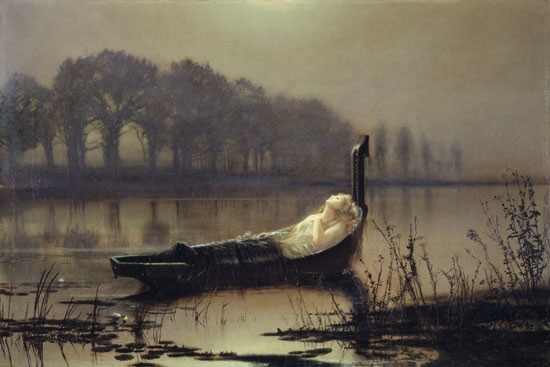
The Lady of Shalott by Alfred, Lord Tennyson

•August 4, 2012 • Leave a Comment


Image

Part I

On either side the river lie
Long fields of barley and of rye,
That clothe the wold and meet the sky;
And thro’ the field the road runs by
To many-tower’d Camelot;
And up and down the people go,
Gazing where the lilies blow
Round an island there below,
The island of Shalott.

Willows whiten, aspens quiver,
Little breezes dusk and shiver
Thro’ the wave that runs for everImage
By the island in the river
Flowing down to Camelot.
Four grey walls, and four grey towers,
Overlook a space of flowers,
And the silent isle imbowers
The Lady of Shalott.

Image

By the margin, willow veil’d
Slide the heavy barges trail’d
By slow horses; and unhail’d
The shallop flitteth silken-sail’d
Skimming down to Camelot:
But who hath seen her wave her hand?
Or at the casement seen her stand?
Or is she known in all the land,
The Lady of Shalott?

Only reapers, reaping early
In among the bearded barley,
Hear a song that echoes cheerly
From the river winding clearly,
Down to tower’d Camelot:
And by the moon the reaper weary,
Piling sheaves in uplands airy,
Listening, whispers “‘Tis the fairy
Lady of Shalott.”

Image

Part II

There she weaves by night and day
A magic web with colours gay.
She has heard a whisper say,
A curse is on her if she stay
To look down to Camelot.
She knows not what the curse may be,
And so she weaveth steadily,
And little other care hath she,
The Lady of Shalott.

And moving thro’ a mirror clear
That hangs before her all the year,
Shadows of the world appear.
There she sees the highway near
Winding down to Camelot:
There the river eddy whirls,
And there the surly village-churls,
And the red cloaks of market girls,
Pass onward from Shalott.

Sometimes a troop of damsels glad,
An abbot on an ambling pad,
Sometimes a curly shepherd-lad,
Or long-hair’d page in crimson clad,
Goes by to tower’d Camelot;
And sometimes thro’ the mirror blue
The knights come riding two and two:
She hath no loyal knight and true,
The Lady of Shalott.

But in her web she still delights
To weave the mirror’s magic sights,
For often thro’ the silent nights
A funeral, with plumes and lights,
And music, went to Camelot:
Or when the moon was overhead,
Came two young lovers lately wed;
“I am half sick of shadows,” said
The Lady of Shalott.

Image

Part III

A bow-shot from her bower-eaves,
He rode between the barley-sheaves,
The sun came dazzling thro’ the leaves,
And flamed upon the brazen greaves
Of bold Sir Lancelot.
A red-cross knight for ever kneel’d
To a lady in his shield,
That sparkled on the yellow field,
Beside remote Shalott.

The gemmy bridle glitter’d free,
Like to some branch of stars we see
Hung in the golden Galaxy.
The bridle bells rang merrily
As he rode down to Camelot:
And from his blazon’d baldric slung
A mighty silver bugle hung,
And as he rode his armour rung,
Beside remote Shalott.

All in the blue unclouded weather
Thick-jewell’d shone the saddle-leather,
The helmet and the helmet-feather
Burn’d like one burning flame together,
As he rode down to Camelot.
As often thro’ the purple night,
Below the starry clusters bright,
Some bearded meteor, trailing light,
Moves over still Shalott.

His broad clear brow in sunlight glow’d;
On burnish’d hooves his war-horse trode;
From underneath his helmet flow’d
His coal-black curls as on he rode,
As he rode down to Camelot.
From the bank and from the river
He flash’d into the crystal mirror,
“Tirra lirra,” by the river
Sang Sir Lancelot.

She left the web, she left the loom,
She made three paces thro’ the room,
She saw the water-lily bloom,
She saw the helmet and the plume,
She look’d down to Camelot.
Out flew the web and floated wide;
The mirror crack’d from side to side;
“The curse is come upon me,” cried
The Lady of Shalott.

Image

Part IV

In the stormy east-wind straining,
The pale yellow woods were waning,
The broad stream in his banks complaining,
Heavily the low sky raining
Over tower’d Camelot;
Down she came and found a boat
Beneath a willow left afloat,
And round about the prow she wrote
The Lady of Shalott.

And down the river’s dim expanse –
Like some bold seer in a trance,
Seeing all his own mischance –
With a glassy countenance
Did she look to Camelot.
And at the closing of the day
She loosed the chain, and down she lay;
The broad stream bore her far away,
The Lady of Shalott.

Lying, robed in snowy white
That loosely flew to left and right –
The leaves upon her falling light –
Thro’ the noises of the night
She floated down to Camelot:
And as the boat-head wound along
The willowy hills and fields among,
They heard her singing her last song.
The Lady of Shalott.

Heard a carol, mournful, holy,
Chanted loudly, chanted lowly,
Till her blood was frozen slowly,
And her eyes were darken’d wholly,
Turn’d to tower’d Camelot.
For ere she reach’d upon the tide
The first house by the water-side,
Singing in her song she died
The Lady of Shalott.

Under tower and balcony,
By garden-wall and gallery,
A gleaming shape she floated by,
Dead-pale between the houses high,
Silent into Camelot.
Out upon the wharfs they came,
Knight and burgher, lord and dame.
And round the prow they read her name,
The Lady of Shalott.

Image

Who is this? and what is here?
And in the lighted palace near
Died the sound of royal cheer;
And they cross’d themselves for fear,
All the knights at Camelot:
But Lancelot mused a little space;
He said, “She has a lovely face;
God in his mercy lend her grace.
The Lady of Shalott.”

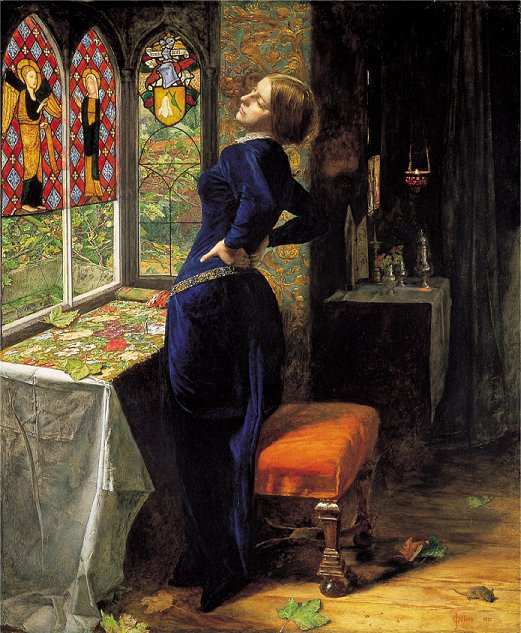
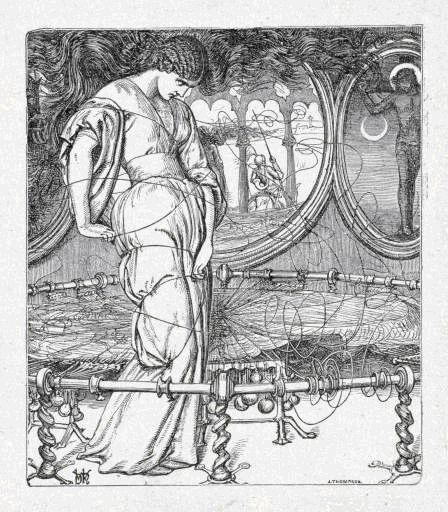
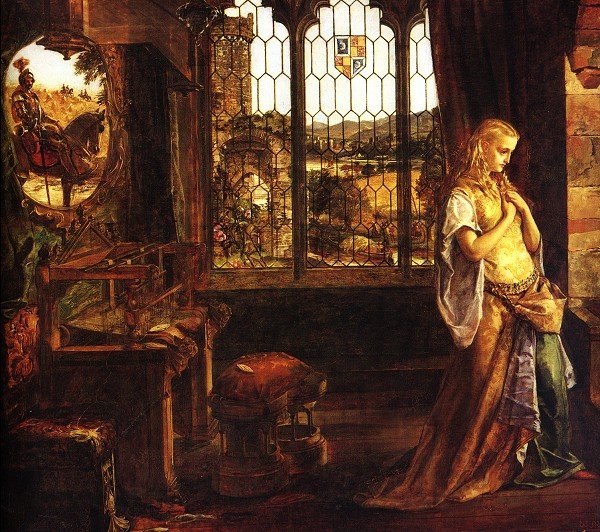
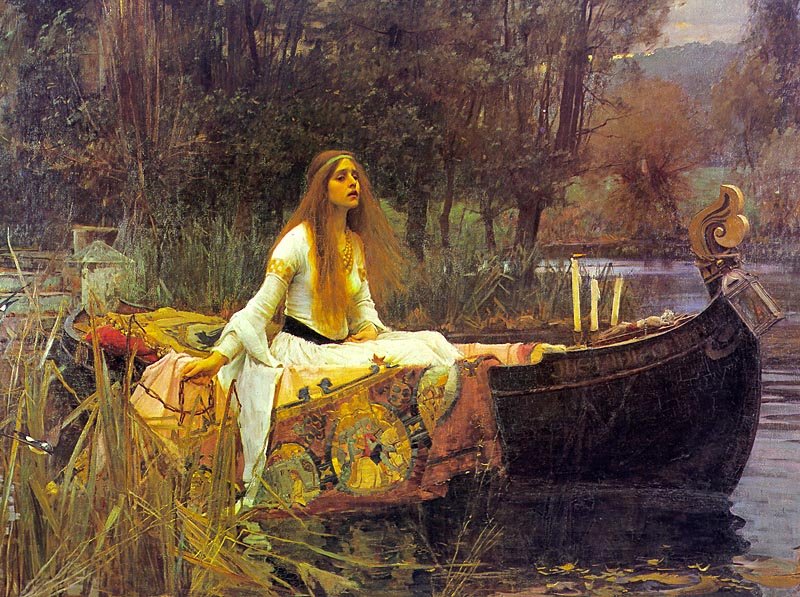
Image


 John Atkinson Grimshaw


John William Waterhouse,1888

William Maw Egley

Dante Gabriel Rossetti 

The Lady of Shalott, engraved by J. Thompson  published 1857


scriptorium.deviantart.com

 
Picnic in Akeldama

Cooking... And something like cooking...

Tales From The Under Gardener's Lodge

Home, hearth and life immeasurable

Of Axe and Plough

Anglo-Saxon Heathenry and Roman Polytheism

My search for magic

Looking for magic in the modern world

Man of Goda

People of Goda, Clan of Tubal Cain

The Elder Tree

Life as a Witch.

Sorcerous Transmutations

Meanderings of the Muse:honouring the sacred muse in word and vision

Across the Abyss

Meanderings of the Muse:honouring the sacred muse in word and vision

Clan of the Entangled Thicket 1734

Meanderings of the Muse:honouring the sacred muse in word and vision

Daniel Bran Griffith - The Chattering Magpie

Meanderings of the Muse:honouring the sacred muse in word and vision

The Cunning Apostle

Cunning Man, Mystic, Eccentric & Outcast