
“The Wulver” – “Howls of Yell’
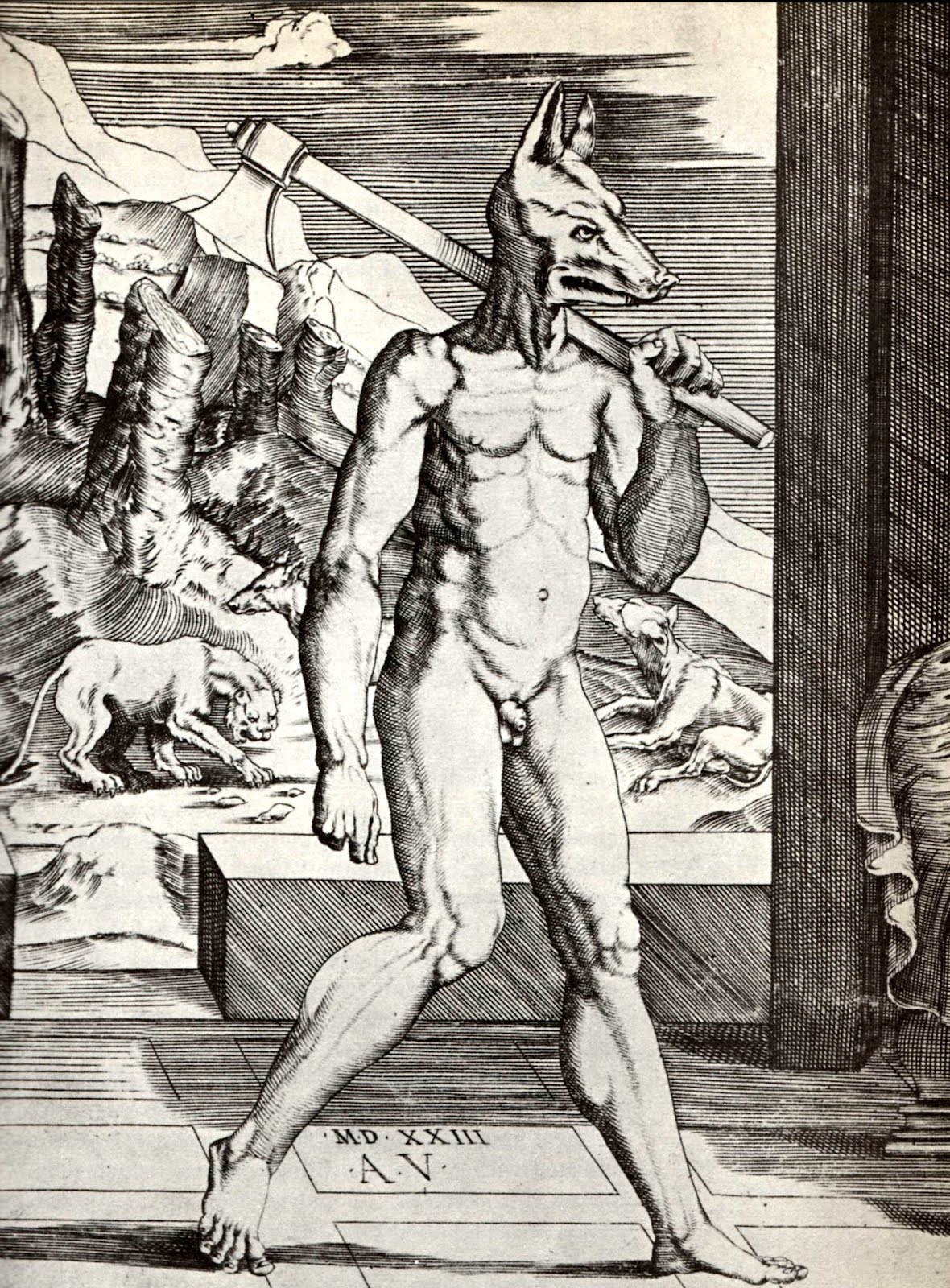
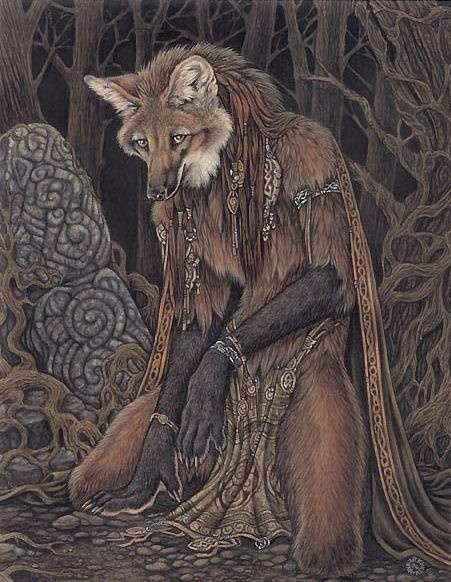
There are many tales of the Wulver, Wolves with the body of a man.
The Shetland Islands they call home, and numerous was once their clan.
Though they lived near humans, they cared not for our ways.
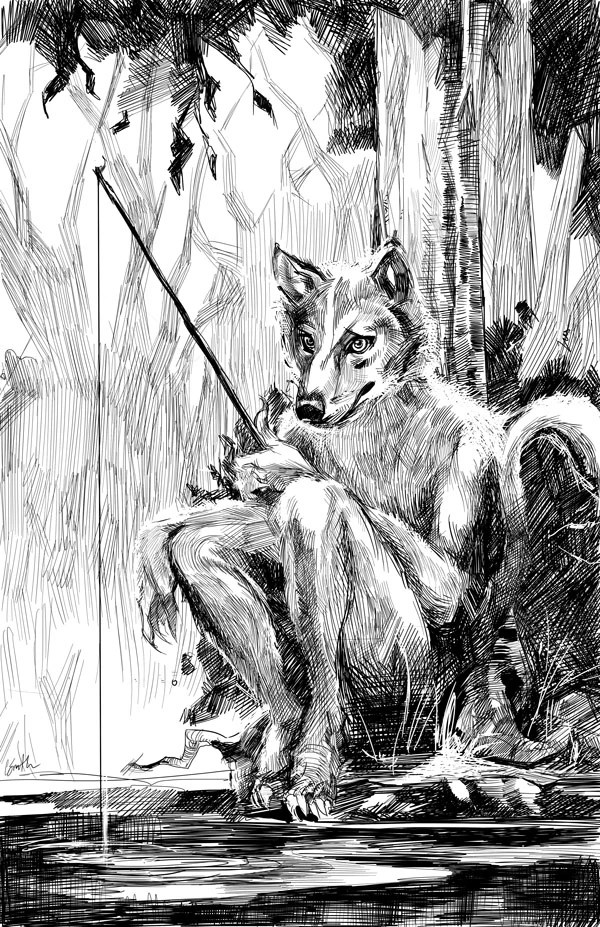
Keeping to their shore side caves, fishing was how they spent their days.
The people of the islands were content, to leave the Wulvers well alone.
For many years there was peace, no hostility was shown.
Then one Spring upon the sea, ships sails came into view.
They brought Vikings from the north lands, a sense of panic grew.
The men gathered their weapons, and charged to those raiders meet.
A short bloody battle there was fought, but the Islanders only found defeat.
The Northmen cut down every man, soon the tide was stained blood red.
Women and children who watched the slaughter, turned on their heels and fled.
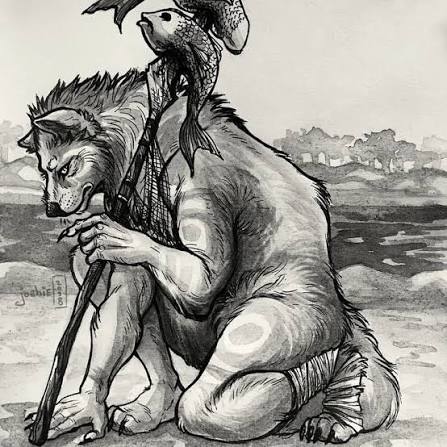
The Northmen had come for slaves, so, they began to give chase.
The Islanders fearing for their lives, needed to find a hiding place.
They run along the shoreline, towards a large cave they knew was there.
A cave that belonged to an old Wulver who to them had always been fair.
Reaching the old Wulver’s cave, they told him of their plight.
Begging him to take them in, to keep them from the north men’s site.
The Wulver agreed and hid them, then waited at the entrance of his lair.
Shortly after the Northmen arrived, the eyes widened at a creature so rare.
Stepping forward came the Northmen chief, of the Wulver showing no fear.
Gripping tighter to his axis hilt, as to the creature he drew near.
Wolfman you will fetch quite a price, he called, more than those hidden in your cave.
That fur of yours will be sought after, worth far more than any slave.
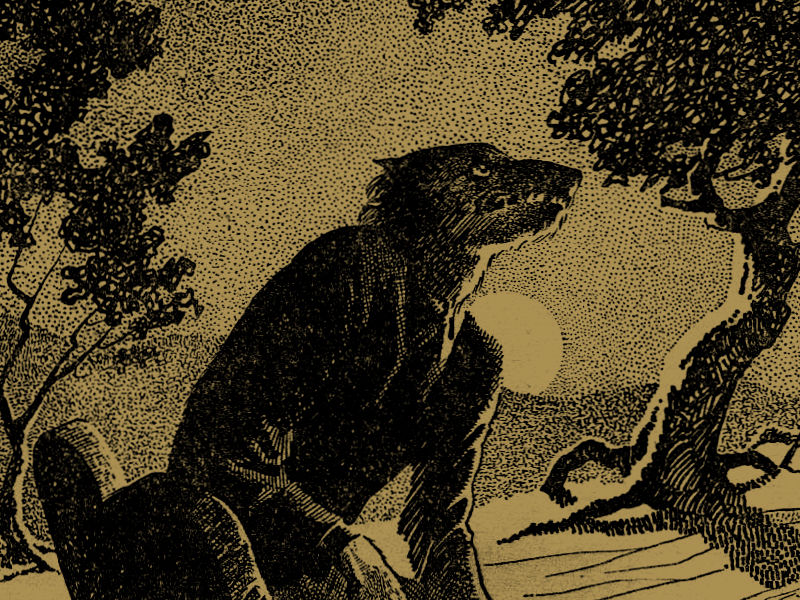
The old Wulver growled and bared his teeth, but he was only one against a horde.
He threw himself at the Northmen, his claws no match for axe and sword.
As a spear was finally thrust into his chest, he fell upon his knees to die.
With the last breath in his body, he let out a howl that pierced the sky.
The Northmen celebrated their kill, a fine prize would be the Wulver’s pelt.
The chief said this was worth the journey alone, far more than every Celt.
He lifted his axe and brought it down, they cheered as the Wulver’s head was taken.
Though over the cheers came a rumbling, it was as if the island itself was shaking.
In the distance it started with a low howl, it was met by others joining the song.
The sounds they made were haunting, to both anger and melancholy they belong.
The Northmen at this seemed shaken, no one had heard such sounds before.
Snarling jaws all in agreement, the Wulvers were going to war.
The Northmen gathered behind their Shields, waiting for the howls to cease,
yet the howling it got closer, and the volume did only increase.
Then suddenly there was silence, we thought the Northmen’s tensions grew,
before them now stood the cause, the Wulver pack was in full view.
The Wulvers surveyed what was before them, the old one lay on the shore dead.
Not only had these men killed him they had cheered taking his head.
Anger boiled within their blood, sickened were they at the wicked site.
There could be no question now, they this day would fight come.
The alpha gave a snarling bark, and the pack charged at the shield wall.
A mass of teeth tore armoured flesh, many a Northman soon to fall.
Swords slashed and hacked in return, while being ripped by sharpened claws.
The tide once more was turned blood red, crimsoned by Wulvers’ jaws.
Those within the cave heard shrieks and cries, yet all were too scared to look out.
Hiding at the very back wall, recoiling in fear with every shout.
They waited there with bated breath daring not to make sound.
Not knowing what would become of them if they were to be found.
Upon the battlefield so many had died, of the shield wall only one remained.
The Northman chief stared at his foes, a pack of jaws bloodstained.
He challenged the alpha to single combat, the alpha was more than happy to.
Before he could even swing his axe crunching teeth decided this battle through.
The bodies of the Northmen lay scattered, discarded upon the sand.
Their own cruelty had sealed the fate, of their not so merry band.
The wolves had lost great numbers to, and many tears that day were shed.
Those that were still able, gathered their gallant dead.
Many hours after they had parted the Islanders emerged under cover of night.
Yet the darkness could not shield their eyes from such a gruesome sight.
From that day this tale was born, one they would tell forever more.
For how were they to ever forget, when the Wulvers went to war .[1]
Hailing from the Shetland Islands, the Wulver is a mythical creature often described as having human form (sometimes fur-covered) but with the head of a wolf. According to Jessie Saxby, the Wulver legend describes this strange hybrid beast as a benevolent creature of nature, rather than a scary shape-shifter. In this respect it departs fully from the European werewolf legends, though when provoked, it can rise to savagery where and when needed, as this tale reveals. Like many other fae, or Otherworld spirit, the Wulver is reclusive, making its home in the greening mounds, in spartan caves.
However, and here comes the crunch, despite countless claims awash on the internet that claim ancient origin for the Wulver, akin to hoary legends in Celtic or Norse belief, historians firmly insist it all began in the 1930’s as an idea which evolved from a partially misunderstood, or misinterpreted etymology for descriptive terms relating to the fae who lived in the hills when translated across similar, but not identical languages.[2]
Tracing the origin of this curious creature, the historian Brian Smith of the Shetland Museum and Archives, observed how late 20th -Century scholars (namely Jakob Jakobsen) had amassed thousands of place names that were later misinterpreted. Shetland folklorist Jessie Saxby – who had written about the creature in her Shetland Traditional Lore, 1933 – was one of those. Perhaps Saxby had been inspired by heroic tales, of Beowulf and Grendel, of the Great Heathen Army, and of the Finnish folk tales circulating Scandinavian countries in her time? Her description of Wulvers as fur-clad humans spending their reclusive lives near water, fishing, as beings who could, if circumstance demanded it, become akin to a berserker.
Based on the á- element in the Old Norse word where álf becomes a wu- element within the evolving Shetland dialect historically, Jakob Jakobsen and another author, John Spence, referred to a hill known as “Wulvers Hool” (“Fairy Hill”). Mounds are traditionally the home of all creatures of the Otherworld across northern european traditions, so Saxby made no false leap here. Her crime it seems lay in her promotion of the legend as having legitimate history in the form she gave it, that she intuited, and that the Wulver had always existed in Shetland folklore.
Around the time of her interest and discovery of the ‘Wulver,’ and just prior to it, in 1901, Faroese scholar Jakob Jakobsen published a book-length article about Otherworld creatures and the places they inhabit.[3] He specifically refers to the Old Norse hóll, hill, and to words derived from it, suggesting places on the Isles with ‘Wol-‘names: Wolvhul, Wolwul, Wolewul, and Wolver(s)hul in Mid Yell. In Shetland, we witness a curious shift when the vowel ‘á’ often turns into ‘wo.’ From this, “Jakobsen compared the place called Wolver(s)hul in Yell with the Faroese noun álvarhús, fairy house. Jessie Saxby interpreted this with some largesse, as ‘Wulver’s Hool.’”[4]
Sadly, while there may be no Shetland ‘Wulver’ tradition older than 1930, the spirit and inspiration that created it is a prime example of things that lay dormant in the ‘Other,’ and are re-discovered and re-invented anew. Some tales are far older and have historical elements that ground them in time, some do not, they are like the ‘will o’ the wisps’ that lie in the mind, or in the imagination, awakened by a cracked twig on a forest floor, a breath of wind in the swaying tree-tops, in the rising sparks of a glowing fire, or the crashing waves of stoney beaches. Ideas birthed in literature originate in the deep-mind from collective memory, from experience, from familiarity, from unfamiliarity, from an active and lively imagination fuelled by history, romance and heroic tales of the past, all of which were drafted in the same manner, albeit in a different era. This is what Jessie Saxby gave us when she created the Wulver… and what a marvellous tale it is.[5]
[1] Jessie Saxby. Shetland Traditional Lore (Grant and Murray, 1932): 141
[2] So is this a modern example of what may have occurred many times in the long history of such transitions, though to be fair, caveats aside regarding language translations, things become attached to even remotely ‘similar’ legends that are pre-existent in the cultures of others.
[3] Jakob Jakobsen. Shetlandsøernes stednavne (København: Thiele, 1901)
[4] Brian Smith. Shetland Archives – ‘Wulver.’ https://www.shetlandmuseumandarchives.org.uk/blog/the-real-story-behind-the-shetland-wulver (Accessed 6/6/206).
[5] Had Saxby but claimed inspiration alone for this tale and poem, she might have received kinder and more widespread legitimate reception of it.
See also: “Six ancient myths from the Scottish islands.” The Scotsman. 7 July 2016.
Saxby, Jessie (11 January 1930). “Trows and Their Kindred, Part II”. The Shetland Times.
Saxby, Jessie (1905). “Sacred Sites in a Shetland Isle.” The Antiquary. 41: 138.
Images sourced on Pinterest, not credited

 People of Goda, the Clan of Tubal Cain