Song of the Beloved

•May 12, 2012 • Leave a Comment
Chapter VI
Communion Through Meditation
The Blessed Lord said:
1. It is the man who performs his duties without dependence on the fruits that deserves to be called a Sannyasin (renouncer) and a Yogin, not the one who keeps no fire or avoids works.
2. O son of Pandu! What is called Sannyasa or renunciation know that to be identical with Yoga or disciplines of selfless action. For, whoever has not abandoned subtle hankerings and self-centred objectives, can never become a Yogi, or a practitioner of spiritual communion through works.
3. For one who desires to ascend the path leading to the heights of spiritual communion (Yoga), detached work is the means. For one who has ascended it, quiescence is verily the means.
4. When one ceases to be attached to sense objects and to one’s actions, then that one, who has thus abandoned all subtle hankerings and self-centred objectives, is said to have ascended the heights of spiritual communion (Yoga).
5. One should uplift one’s lower self by the higher self. One should not depress or downgrade one’s self. For the self verily is both the friend and the foe of the self.
6. To him who has subdued the lower self by the higher self, the self acts like a friend. But to him who has lost his higher self by the dominance of the lower one. the self functions as the enemy, always hostile to him.
7. In one who has conquered his mind, the Self remains steady and unperturbed in the experience of the pairs of opposites like heat and cold, pleasure and pain, honour and dishonour.
8. A Yogin whose spirit has attained contentment through knowledge and experience, who is unperturbed, who has subdued his senses, to whom a lump of earth and a bar of gold are alike – such a Yogi is said to have attained steadfastness in spiritual communion.
9. Specially noteworthy in excellence is he who is even-minded in his outlook on friend and foe, on comrade and stranger, on the neutral, on the ally, on the good, and even on the evil ones.
10. Let a Yogin constantly practise spiritual communion, residing alone in a solitary spot, desireless, possessionless, and disciplined in body and mind.

11-12. At a clean spot, which is neither too high nor too low, a seat should be made with Kusha grass, spread over with a skin and a cloth. Firmly seated on it, the Yogi should practise spiritual communion, with mind concentrated and with the working of the imaginative faculty and the senses under control, for self-purification.
13-14. Holding the body, head and neck erect, motionless and firm, gazing at the tip of the nose and not round about, fearless, serene, restrained in mind, and established in the vow of continence, he should sit in spiritual communion with Me, looking upon Me as his highest and most precious end.
15. With the mind restrained from going outward to objects and always uniting with the Supreme in spiritual communion, the Yogi attains to Peace, which is the summit of bliss and enduring establishment in My state.
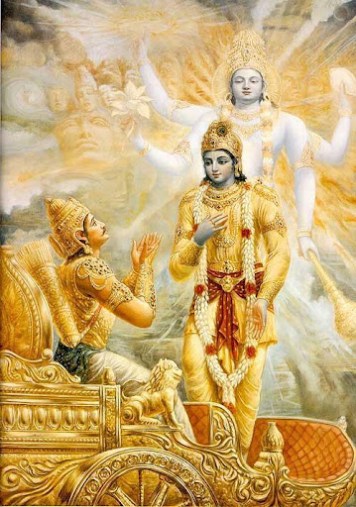
16. O Arjuna! Success in Yoga is not for those who eat too much, nor for those who eat too little. It is not also for those given to too much sleeping, nor to those who keep vigil too long.
17. For one who is temperate in food and recreation, who is detached and self-restrained in work, who is regulated in sleep and in vigil – Yoga brings about the cessation of the travail of Samsara.
18. When the disciplined mind is able to remain established in the Atman alone, when it is free from longing for all objects of desire – then is it spoken of as having attained to spiritual communion.
19. The flame of a lamp sheltered from wind does not flicker. This is the comparison used to describe a Yogi’s mind that is well under control and united with the Atman.
20. That state in which the Chitta (mind stuff), with its movements restrained by the practice of Yoga, finds rest; in which is experienced the joy of the Spirit born of the higher mind intuiting the Spirit.
21. In which he (the Yogin) experiences that endless bliss which is beyond the ken of the senses but is intuited by the purified intellect; wherein established, one does not waver from the Truth.
22. Having obtained which no other gain is considered as greater; remaining in which one is not shaken even by the heaviest of afflictions,
23. Know that severence of connection with pain as what is designated as Yoga. It has to be practised tirelessly with determination.
24-25. Abandoning imagination – born longings in their entirety, restraining all the senses with the mind on every side, and setting that mind firmly on the Self under the direction of a steadfast intellect, one should practise tranquillity little by little, and abstain from every kind of thought.
26. From whatsoever reason this wavering and fickle mind wanders away, it should be curbed and brought to abide in the Self alone.
27. Supreme Bliss wells up in a Yogi, who is tranquil in mind, whose passions are subdued, who is free from impurities and who is in the Brahmic state.
28. Thus, ever engaged in making the mind steadfast in spiritual communion and having all the impurities of the mind effaced thereby, the Yogin easily experiences the infinite Bliss of contact with Brahman.
29. The man of spiritual insight, established in same-sightedness, sees the Self as residing in all beings and all beings as resting in the Self.
30. He who sees Me in all beings, and all beings in Me – to him I am never lost, nor he to Me.
31. Established in the unity of all existence, a Yogin who serves Me present in all beings, verily abides in Me, whatever be his mode of life.
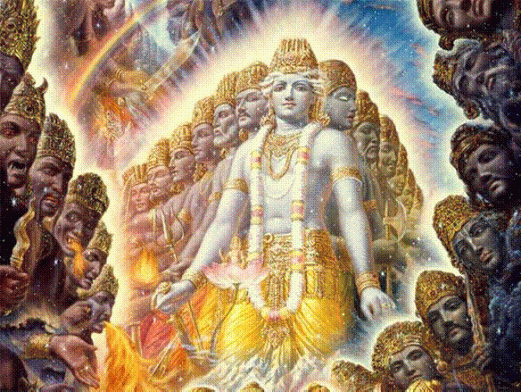
32. O Arjuna! In My view that Yogi is the best who, out of a sense of identity with others on account of the perception of the same Atman in all, feels their joy and suffering as his own.
Arjuna said:
33. O Slayer of Madhu! Owing to the fickleness of the mind, I find no way of firm establishment in spiritual communion through equanimity as instructed by you.
34. O Krishna! Verily, the mind is fickle, turbulent, powerful and unyielding. To control it, 1 think, is as difficult as controlling the wind itself.
The Blessed Lord said:
35. O mighty armed one! Undoubtedly the mind is fickle and difficult to be checked. Yet, O son of Kunti, it can be brought under control by dispassion and spiritual practice.
36. My view is that Yoga is difficult of attainment by men of uncontrolled mind. But for those who have their minds under control, it is possible to attain, if they strive with the proper means.
Arjuna said:
37. What, O Krishna, is the fate of a man who. though endowed with a firm faith, is not steadfast in his practices owing to distractions, and therefore fails to reach spiritual perfection?
38. O mighty-armed Lord! Bewildered in the path of Brahman, supportless, does he not lose both this world and the next? Does he not perish like a rain-cloud rent asunder?
39. O Krishna! My doubt in this respect has yet to be cleared completely. Indeed! I find none better than Thee to be that doubt dispeller.
The Blessed Lord said:
40. O son of Pritha! He does not meet with downfall either here in this world or in the hereafter. Know for certain, O dear one, that one who treads the path of virtue never goes the way of evil ones.
41. The fallen Yogi goes (after death) to the spheres of the righteous, and after having lived there for unnumbered years, is reborn in this world in a pure and prosperous family.

42. Or he is re-born in a family of men full of wisdom and spirituality. Re-birth under such conditions is passing hard to get in this world.
43. There, O scion of the clan of Kurus! he will regain the spiritual discernment of his previous birth, and then he will strive harder than ever for perfection.
44. Even if helpless, he will be driven towards the path of Yoga by the force of his previous striving. For even a beginner in the path of Yoga goes above the stage requiring the aid of Vedic ritualism (not to speak then of one who has made some progress in Yoga).
45. As for the Yogi striving diligently, he is cleansed of all his sins and gains spiritual perfection after passing through several embodiments. Finally he reaches the highest state (which consists in release from the bondage of the body).
46. A Yogi (one practising meditation) is superior to a man of austerity; he is superior to a scholar; he is superior to a ritualist too. Therefore, O Arjuna, be you a Yogi.
47. Of all the Yogins, he is the most attuned in spiritual communion, who worships Me with abiding faith, and with his innermost self fused with Me.

images from wiki commons with thanks

Floralia

•April 22, 2012 • Leave a Comment
 
The Feast of Flowers
(Floralia): an arcane festival involving the Rite of Baptism, a purification often performed as part of or prelude to the Eleusinian Mysteries. In the ‘Limnae’ (temple lakes) the ‘Myste’ (participants) were guided towards and through the ‘slim gate’ of Dionysus, to emerge there as full Initiates. It is considered a relic inherited from the Sabines.
Dionysus
The Romans welcomed the approach of May with their Floralia, a festival we have already described as remarkable for licentiousness; and there cannot be a doubt that our Teutonic forefathers had also their festival of the season long before they became acquainted with the Romans. Yet much of the mediæval celebration of May-day, especially in the South, appears to have been derived from the Floralia of the latter people. As in the Floralia, the arrival of the festival was announced[1]
 
“Fair Flora I fear I have no buds to give you,
No amorous hare, no spray of blossoms.

Only my hard and fissured heart,
beating dust, and dry of life…

I warm it in the sun as best I can,
but without green I fear it falters still.

With water from cool springs of crystal blue,
it drinks, but does not seem to find its fill.

I ask but one small boon of you, sweet mistress of the sacred urge to open:

The roses in the market, pass by them still they’re there with you! Though you have moved beyond the flower-seller’s stall, you know they’re there – their tender rosey souls shout out beyond their earthly, flowering confines.

So pass by me this way invisible-
and linger for a moment at my heart’s side.

For your wake of tender shoots and tendrils,
Overflow of pollen with sweet bee attendants

Might fill the crags and cracks of this my stony heart,
That seeds of blooms find purchase once again

And get them quickly to their holy work
That I might be renewed and opened,

With heart-flower faces smiling at the sun,
That I may dance along with you and laugh again

Along with all the floral folly that is spring
In her sundry, heady blooming.
Serica Antonius


Flora (Chloris)
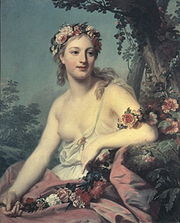
Flora, a licentious Goddess of springtime, was depicted as a beautiful maiden, wearing a crown of flowers.
 
Her festival, the Floralia, was celebrated particularly by the ‘ladies of the night’ across all levels of society. 
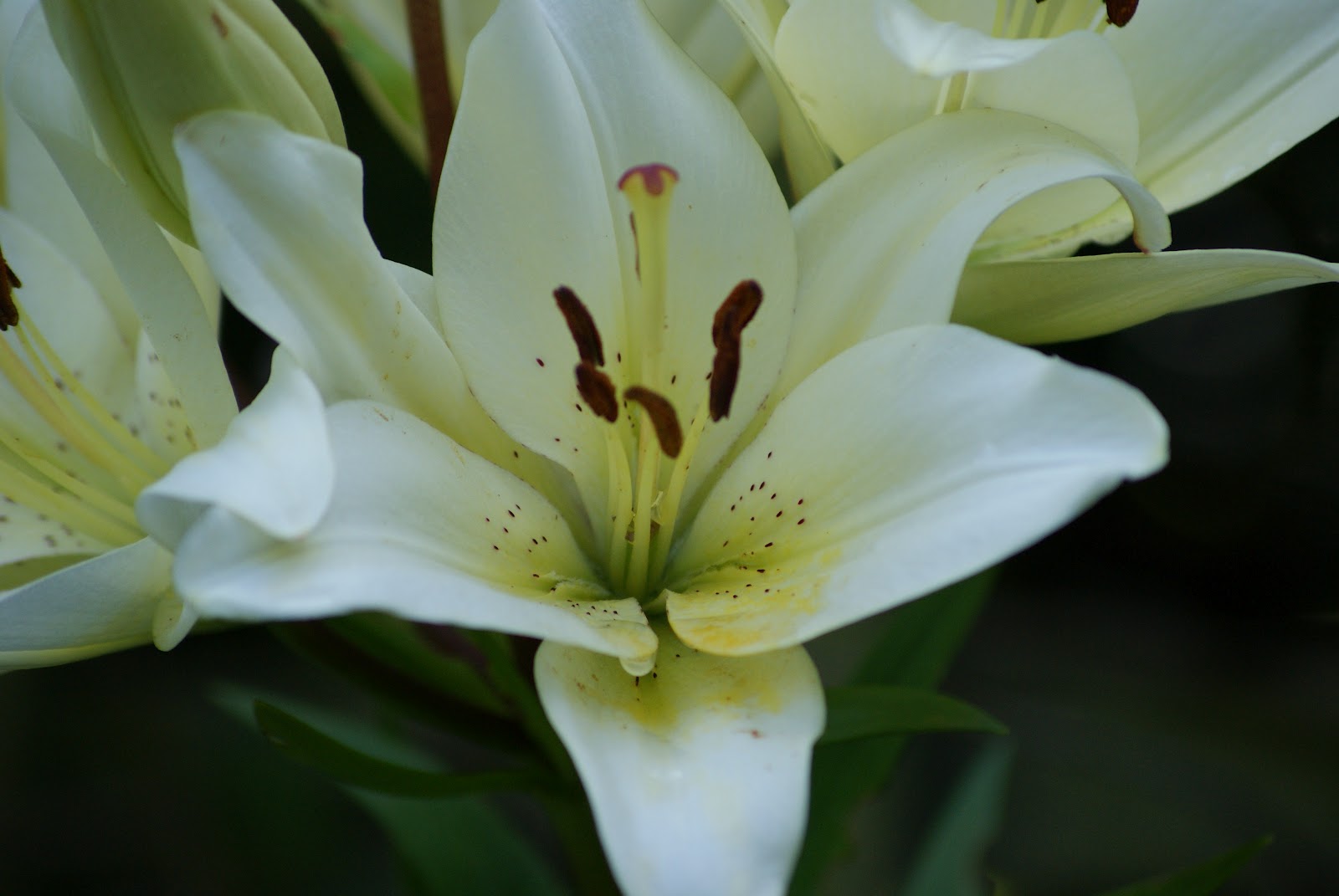
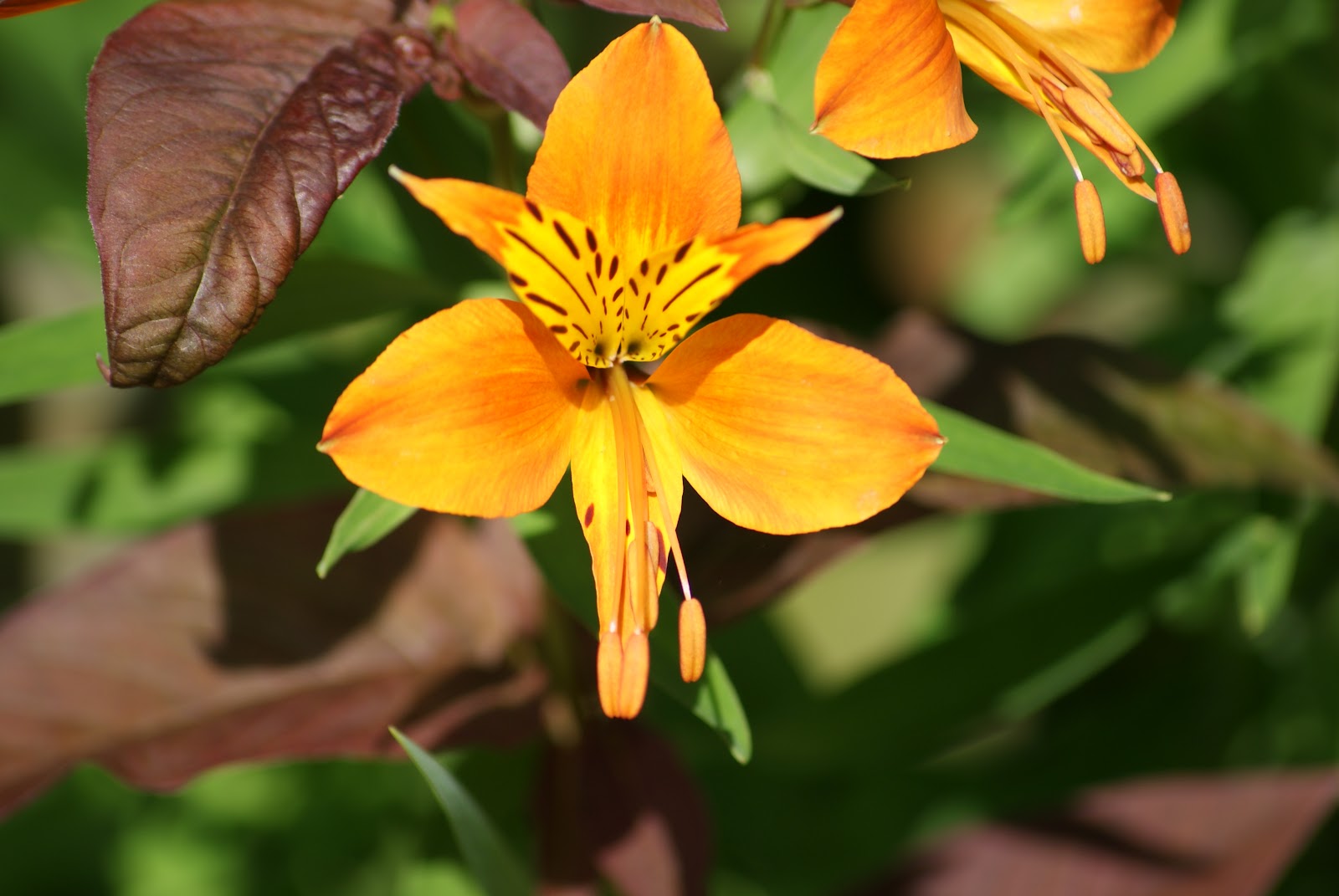
This reverence is reflected in the exotic flowers incorporated into her highly theatrical rites, expressing quite explicitly the simulacra of human sexual organs.  Female celebrants often paraded naked until authorities finally banned it during the 3rd century CE.


[i] Sacred texts
paintings: wiki-commons
photo images are copyright of shani oates

THE TRAUMA GODDESS

•April 5, 2012 • 1 Comment
I reshape family karma.


I am the diamond maiden, the player of games
The yogini is one of my forms
Showing that I am beyond earthly attachment
I am the shining revelation to the ascetic
The women in silk and roses
I am the harlot in black net and leather,
Who gives enjoyable punishment,
I am the glass bead master, creating universes of form
And a spark of me is in each bead, for I dwell in karma.
I am the Trauma Goddess, the Lady of Pain
In return for devotion I pull thorns from the heart
In return for obedience
I untie the knots in the belly and the head
I hold the vajra, which gives and receives
I reshape family karma
The Trauma Goddess is called for people in painful situations
Where anger and hatred block the path of the soul
I evaluate the benefits of revenge
And give better suggestions for spiritual growth.
I am not suited to polite society
To social striving, upward mobility, and making good impressions
I am radically honest, sensitive, brilliant, and blunt
I hold up a mirror to the best and worst facets of human life.
The Lady of Trauma is the mirror of pain
I reflect the disastrous ways that human beings interact
Then the reflections are stretched and distorted
With irony, and humour, and sadness
Loosening their grip on the heart
So that the person who seeks freedom
Can get a taste of being free.

“Lady of Trauma, Lady that absorbs pain
Ascetic and bhairavi and sannyasini and mistress
Pull me from the disaster that I have made of my life
Save me from the evil machinations of others.”
This is their prayer and I hear it in their hearts
As they chant my mantra.
“Saviour, Lady, Mother Goddess, Bodhisattva,
Love me as I love you
I am desperate and bound
Free me by your grace.”
I will give freedom, but not without realisation
Those who have been bound, bind others
Those who have suffered, cause suffering
I let them know how they have been affected
But also how they have affected others.
I do not wear bones because of death
I wear them because they represent what is beneath the surface
The blood that I drink is evil karma of those that I save
And the karma is then halted and does not pass to others.
I appear wrathful as I take on anger, hatred, fury, and the desire to destroy
Which are destroyed within me.
I am a dancer upon the pain of all mankind
I destroy the dark and corrupt.
My compassionate side is hidden
But for those whom I love
Who have taken on my dark grace
I open a path of shining light
With pain and sorrow left behind.

Creation Myths

•March 20, 2012 • Leave a Comment

Creation Myths:
Selected Musings from the Sacred Cuneiform tablets of Sumer.


Enlil, the king of all the lands, set his mind.

He thrust his penis into the Great Mountain (HAR.SAG)…
Summer and Winter, the fecundating overflow of the land, he poured into the womb.
Wheresoever Enlil would thrust his penis, he roared like a wild bull.
There, HAR.SAG spent the day, rested happily at night,
Delivered herself of Summer and Winter like rich cream…
Smooth, big Earth made herself resplendent, beautified her body
joyously.
Wide Earth bedecked her body with precious metal and lapis lazuli,
Adorned herself with diorite, chalcedony, and shiny carnelian.
Heaven arrayed himself in a wig of verdure, stood up in princeship.
Holy Earth, the virgin, beautified herself for Holy Heaven.
Heaven, the lofty god, planted his knees on Wide Earth,
Poured the semen of the heroes Tree and Reed into her womb.
Sweet Earth, the fecund cow, was impregnated with the rich semen of Heaven.
Joyfully did Earth tend to the giving birth of the plants of life,
Luxuriantly she brought forth rich produce, and gave birth to wine and honey.

After heaven had been moved away from earth,
After earth had been separated from heaven,
After the name of man had been fixed;
After An had carried off heaven,
After Enlil had carried off earth,
After Ereshkigal had been carried off into Kur as its prize;
……………………….
Behold the “bond of heaven and earth,” the city, . . .
Behold Nippur, the city, . . .
Behold the “kindly wall,” the city, . . .
Behold the Idsalla, its pure river,
Behold the Karkurunna, its quay,
Behold the Karasarra, its quay where the boats stand,
Behold the Pulal, its well of good water,
Behold the Idnunbirdu, its pure canal,
Behold Enlil, its young man,
Behold Ninlil, its young maid,
Behold Nunbarshegunu, its old woman.

 In those days the mother, her begetter, gave advice to the maid,
Nunbarshegunu gave advice to Ninlil:
“At the pure river, O maid, at the pure river wash thyself,
O Ninlil, walk along the bank of the Idnunbirdu,
The bright-eyed, the lord, the bright-eyed,
The ‘great mountain,’ father Enlil, the bright-eyed, will see thee,
The shepherd . . . who decrees the fates, the bright-eyed, will see thee,
He will . . . . he will kiss thee.”

Enten caused the ewe to give birth to the lamb, the goat to give birth to the kid,
Cow and calf he caused to multiply, much fat and milk he caused to be produced,
In the plain, the heart of the wild goat, the sheep, and the donkey he made to rejoice,
The birds of the heaven, in the wide earth he had them set up their nests
The fish of the sea, in the swampland he had them lay their eggs,

In the palm-grove and vineyard he made to abound honey and wine,
The trees, wherever planted, he caused to bear fruit,
The furrows . . .,
Grain and crops he caused to multiply,
Like Ashnan (the grain goddess), the kindly maid, he caused strength to appear.
Emesh brought into existence the trees and the fields, he made wide the stables and sheepfolds,
In the farms he multiplied the produce,
The . . . he caused to cover the earth,
The abundant harvest he caused to be brought into the houses, he caused the granaries to be heaped high.

Enlil answers Emesh and Enten:
“The life-producing water of all the lands, Enten is its ‘knower,’
As farmer of the gods he has produced everything,
Emesh, my son, how dost thou compare thyself with Eaten, thy brother?”
The exalted word of Enlil whose meaning is profound,
The decision taken, is unalterable, who dares transgress it!
Emesh bent the knees before Enten,
Into his house he brought . . ., the wine of the grape and the date,
Emesh presents Enten with gold, silver, and lapis lazuli,
In brotherhood and friendship, happily, they pour out libations,
Together to act wisely and well they determined.
In the struggle between Emesh and Enten,
Enten, the steadfast farmer of the gods, having proved greater than Emesh,
. . . O father Enlil, praise!

In those days Enki says to Enlil:
“Father Enlil, Lahar and Ashnan,
They who have been created in the Dulkug,
Let us cause them to descend from the Dulkug.”
At the pure word of Enki and Enlil,
Lahar and Ashnan descended from the Dulkug.
For Lahar they (Enlil and Enki) set up the sheepfold,
Plants, herbs, and . . . they present to him; p
For Ashnan they establish a house,
Plow and yoke they present to her.
Lahar standing in his sheepfold,
A shepherd increasing the bounty of the sheepfold is he;
Ashnan standing among the crops,
A maid kindly and bountiful is she.
Abundance of heaven . . . ,
Lahar and Ashnan caused to appear,

In the assembly they brought abundance,
In the land they brought the breath of life,
The decrees of the god they direct,
The contents of the warehouses they multiply,
The storehouses they fill full.
In the house of the poor, hugging the dust,
Entering they bring abundance;
The pair of them, wherever they stand,
Bring heavy increase into the house;
The place where they stand they sate, the place where they sit they supply,
They made good the heart of An and Enlil.


After the water of creation had been decreed,
After the name hegal (abundance), born in heaven,
Like plant and herb had clothed the land,
The lord of the abyss, the king Enki,
Enki, the lord who decrees the fates,
Built his house of silver and lapis lazuli;
Its silver and lapis lazuli, like sparkling light,
The father fashioned fittingly in the abyss.
The (creatures of) bright countenance and wise, coming forth from the abyss,
Stood all about the lord Nudimmud;
The pure house be built, he adorned it with lapis lazuli,
He ornamented it greatly with gold,
In Eridu he built the house of the water-bank,
Its brickwork, word-uttering, advice-giving,
Its . . . like an ox roaring,
The house of Enki, the oracles uttering.


“O name of my power, O name of my power,
To the bright Inanna, my daughter, I shall present . . .
The arts of woodworking, metalworking, writing, toolmaking, leatherworking. . . . building, basketweaving.”
Pure Inanna took them.
 “O name of My power, O name of my power,
To the pure Inanna, my daughter, I shall present . . ..
Lordship, . . .-ship, godship, the tiara exalted and enduring, the throne of kingship.”
Pure Inanna took them.
“O name of my power, O name of my power,
To the pure Inanna, my daughter, I shall present . . . .
The exalted scepter, staffs, the exalted shrine, shepherdship, kingship.”
Pure Inanna took them.


 all photos copyright of shani oates
gnostic painting from wiki images

Heaven and Hell

•February 13, 2012 • 1 Comment
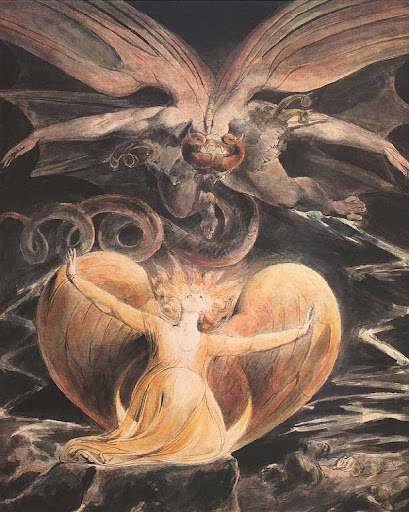
William Blake’s
The Marriage of Heaven and Hell
Rintrah roars & shakes his fires in the burden’d air;
Hungry clouds swag on the deep.

Once meek, and in a perilous path,
The just man kept his course along
The vale of death.
Roses are planted where thorns grow,
And on the barren heath
Sing the honey bees.

Then the perilous path was planted:
And a river and a spring
On every cliff and tomb:
And on the bleached bones
Red clay brought forth.

Till the villain left the paths of ease,
To walk in perilous paths, and drive
The just man into barren climes.

Now the sneaking serpent walks
In mild humility,
And the just man rages in the wilds
Where lions roam.

Rintrah roars & shakes his fires in the burden’d air;
Hungry clouds swag on the deep.

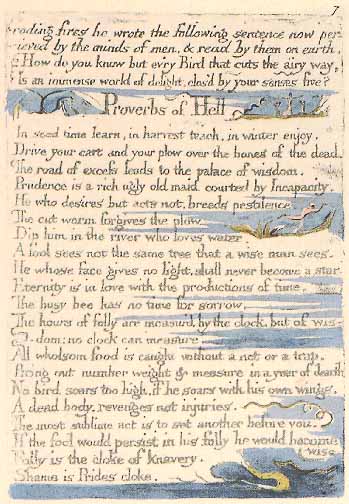
PROVERBS OF HELL
(Plate 7 )
In seed time learn, in harvest teach, in winter enjoy.
Drive your cart and your plow over the bones of the dead.
The road of excess leads to the palace of wisdom.
Prudence is a rich ugly old maid courted by Incapacity.
He who desires but acts not, breeds pestilence.
The cut worm forgives the plow.
Dip him in the river who loves water.
A fool sees not the same tree that a wise man sees.
He whose face gives no light, shall never become a star.
Eternity is in love with the productions of time.
The busy bee has no time for sorrow.
The hours of folly are measur’d by the clock, but of wisdom: no clock can measure.
All wholsom food is caught without a net or a trap.
Bring out number weight & measure in a year of dearth.
No bird soars too high, if he soars with his own wings.
A dead body, revenges not injuries.
The most sublime act is to set another before you.
If the fool would persist in his folly he would become wise.
Folly is the cloke of knavery.
Shame is Prides cloke.

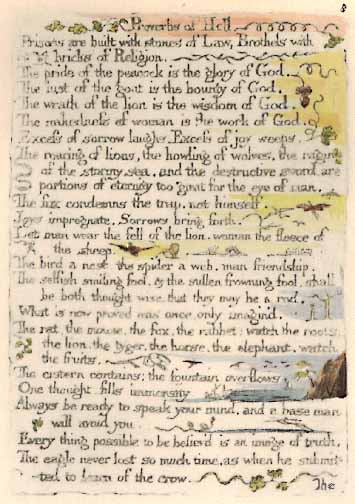
PROVERBS OF HELL
(Plate 8 )
Prisons are built with stones of Law, Brothels with bricks of Religion.
The pride of the peacock is the glory of God.
The lust of the goat is the bounty of God.
The wrath of the lion is the wisdom of God.
The nakedness of woman is the work of God.
Excess of sorrow laughs. Excess of joy weeps.
The roaring of lions, the howling of wolves, the raging of the stormy sea, and the destructive sword, are portions of eternity too great for the eye of man.
The fox condemns the trap, not himself.
Joys impregnate. Sorrows bring forth.
Let man wear the fell of the lion, woman the fleece of the sheep.
The bird a nest, the spider a web, man friendship.
The selfish smiling fool, & the sullen frowning fool, shall be both thought wise, that they may be a rod.
What is now proved was once, only imagin’d.
The rat, the mouse, the fox, the rabbit: watch the roots; the lion, the tyger, the horse, the elephant, watch the fruits.
The cistern contains; the fountain overflows.
One thought, fills immensity.
Always be ready to speak your mind, and a base man will avoid you.
Every thing possible to be believ’d is an image of truth.
The eagle never lost so much time, as when he submitted to learn of the crow.
PROVERBS OF HELL
(Plate 9)
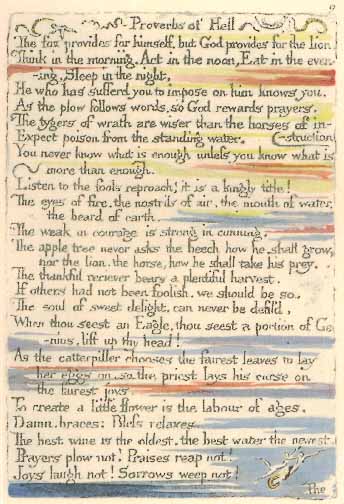
The fox provides for himself, but God provides for the lion.
Think in the morning. Act in the noon. Eat in the evening. Sleep in the night.
He who has suffer’d you to impose on him knows you.
As the plow follows words, so God rewards prayers.
The tygers of wrath are wiser than the horses of instruction.
Expect poison from the standing water.
You never know what is enough unless you know what is more than enough.
Listen to the fools reproach! it is a kingly title!
The eyes of fire, the nostrils of air, the mouth of water, the beard of earth.
The weak in courage is strong in cunning.
The apple tree never asks the beech how he shall grow, nor the lion, the horse, how he shall take his prey.
The thankful reciever bears a plentiful harvest.
If others had not been foolish, we should be so.
The soul of sweet delight, can never be defil’d.
When thou seest an Eagle, thou seest a portion of Genius, lift up thy head!
As the catterpiller chooses the fairest leaves to lay her eggs on, so the priest lays his curse on the fairest joys.
To create a little flower is the labour of ages.
Damn, braces: Bless relaxes.
The best wine is the oldest, the best water the newest.
Prayers plow not! Praises reap not!
Joys laugh not! Sorrows weep not!

PROVERBS OF HELL
(Plate 10)
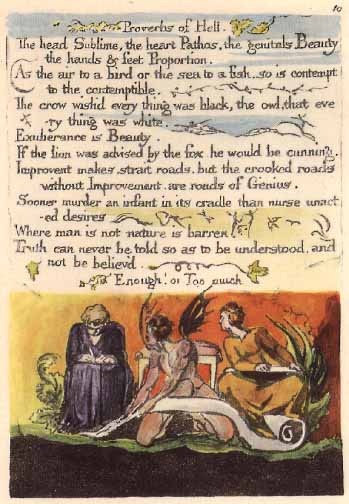
The head Sublime, the heart Pathos, the genitals Beauty, the hands & feet Proportion.
As the air to a bird of the sea to a fish, so is contempt to the contemptible.
The crow wish’d every thing was black, the owl, that every thing was white.
Exuberance is Beauty.
If the lion was advised by the fox, he would be cunning.
Improvement makes strait roads, but the crooked roads without Improvement, are roads of Genius.
Sooner murder an infant in its cradle than nurse unacted desires.
Where man is not nature is barren.
Truth can never be told so as to be understood, and not be believ’d.
Enough! or Too much!

Time: Shifting Seasons

•January 18, 2012 • Leave a Comment
In Prose and Verse:

“The cycle of nature—the progress from seed to fruition to dying-off and then renewal in the spring—was mirrored in the wild fields and the cultivated garden alike, while the fragility of harvest—the possible interruption of the cycle by drought, wind, or other natural calamities— established the pattern of how humans understood the workings of the cosmos.  The oldest of surviving sacred stories have their roots in the garden and reflect how humanity sought to understand the changeable patterns of their world and, at the same time, to imagine a world no longer subject to change.
Peg Streep  

“It is better to have lived one day as a tiger than a thousand years as a sheep.”
Tibetan saying

“To live is so startling it leaves little time for anything else.”
Emily Dickinson 
“There is an appointed time for everything. 
And there is a time for every event under heaven –
A time to give birth, and a time to die;
A time to plant and a time to uproot what is planted.”
Ecclesiastes, 3:1-2 

“Have you ever noticed a tree standing naked against the sky,
How beautiful it is? 
All its branches are outlined, and in its nakedness
There is a poem, there is a song. 
Every leaf is gone and it is waiting for the spring. 
When the spring comes, it again fills the tree with
The music of many leaves,
Which in due season fall and are blown away. 
And this is the way of life.”
Krishnamurti
 “Come, fill the Cup, and in the Fire of Spring
The Winter Garment of Repentance fling:
The Bird of Time has but a little way
To fly–and Lo! the Bird is on the Wing.”
Omar Khayyám   

“For eternally and always there is only one now, one and the same now; the present is the only thing that has no end.”

Erwin Schrodinger
“Winter is an etching, spring a watercolor, summer an oil painting and autumn a mosaic of them all.” 
 Stanley Horowitz
This grand show is eternal.  It is always sunrise somewhere; the dew is never all dried at once; a shower is forever falling; vapor is ever rising.  Eternal sunrise, eternal sunset, eternal dawn and glowing, on sea and continues and islands, each in its turn, as the round earth rolls.”
John Muir
“The day is of infinite length for him who knows how to appreciate and use it.”
Johann Wolfgang von Goethe
“Four seasons fill the measure of the year; there are four seasons in the minds of men.”
John Keats

“Time is a brisk wind, for each hour it brings something new… but who can understand and measure its sharp breath, its mystery and its design?” 
Paracelsus
 “Leaves have their time to fall,
And flowers to wither at the north-wind’s breath,
And stars to set; but all,
Thou hast all seasons for thine own, O Death!”
John Milton 
“The whole life of man is but a point of time; let us enjoy it.”
 Plutarch    
 “Time discovers truth.
Time heals what reason cannot.”
Seneca 
Original and beautiful artworks are copyright and courtesy of Victoria MacLeod at http://www.victoriamacleod.co.uk/


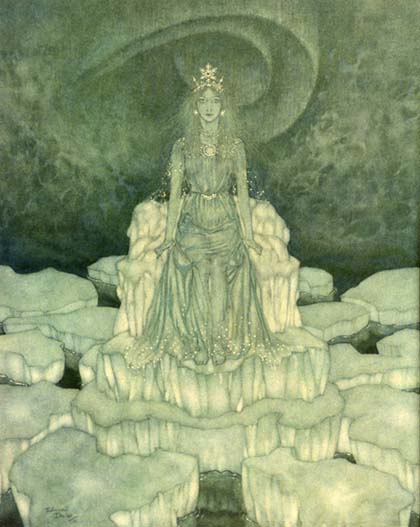
The Snow Queen

•January 4, 2012 • 1 Comment
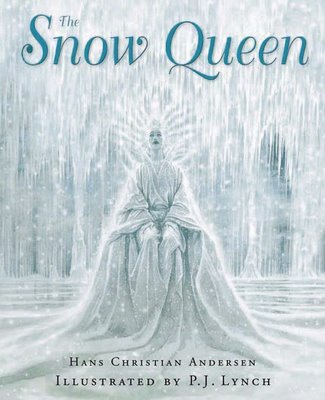
 The Snow Queen
A Summary of this Classic Tale:
An evil “troll,” “actually the devil himself”,[1] makes a magic mirror that has the power to distort the appearance of things reflected in it. It fails to reflect all the good and beautiful aspects of people and things while it magnifies all the bad and ugly aspects so that they look even worse than they really are. The devil teaches a “devil school,” and the devil and his pupils delight in taking the mirror throughout the world to distort everyone and everything. They enjoy how the mirror makes the loveliest landscapes look like “boiled spinach.” They then want to carry the mirror into heaven with the idea of making fools of the angels and God, but the higher they lift it, the more the mirror grins and shakes with delight. It shakes so much that it slips from their grasp and falls back to earth where it shatters into billions of pieces — some no larger than a grain of sand. These splinters are blown around and get into people’s hearts and eyes, making their hearts frozen like blocks of ice and their eyes like the troll-mirror itself, only seeing the bad and ugly in people and things.
Years later, a little boy, Kay, and a little girl, Gerda, live next door to each other in the garrets of buildings with adjoining roofs in a large city. One could get from Kay’s to Gerda’s home just by stepping over the gutters of each building. The two families grow vegetables and roses in window boxes placed on the gutters. Kay and Gerda have a window-box garden to play in, and they become devoted in love to each other as playmates.
Kay’s grandmother tells the children about the Snow Queen, who is ruler over the snowflakes that look like bees — that is why they are called “snow bees.” As bees have a queen, so do the snow bees, and she is seen where the snowflakes cluster the most. Looking out of his frosted window, Kay, one winter, sees the Snow Queen, who beckons him to come with her. Kay draws back in fear from the window.
By the following spring, Gerda has learned a song that she sings to Kay: Where the roses deck the flowery vale, there, infant Jesus thee we hail! Because roses adorn the window box garden, Gerda is always reminded of her love for Kay by the sight of roses.
It was on a pleasant summer’s day that splinters of the troll-mirror get into Kay’s heart and eyes while he and Gerda are looking at a picture book in their window-box garden. Kay’s personality changes: he becomes cruel and aggressive. He destroys their window-box garden, he makes fun of his grandmother, and he no longer cares about Gerda, since all of them now appear bad and ugly to him. The only beautiful and perfect things to him now are the tiny snowflakes that he sees through a magnifying glass.
The following winter he goes out with his sled to the market square and hitches it—as was the custom of those playing in the snowy square—to a curious white sleigh carriage, driven by the Snow Queen, who appears as a woman in a white fur-coat. Outside the city she shows herself to Kay and takes him into her sleigh. She kisses him only twice: once to numb him from the cold, and the second time to cause him to forget about Gerda and his family. She does not kiss him a third time as that would kill him. Kay is then taken to the Snow Queen’s palace on Spitsbergen, near the North Pole where he is contented to live due to the splinters of the troll-mirror in his heart and eyes.
The people of the city get the idea that Kay has been drowned in the river nearby, but Gerda, who is heartbroken at Kay’s disappearance, goes out to look for him. She questions everyone and everything about Kay’s whereabouts. Gerda offers her new red shoes to the river in exchange for Kay; by not taking the gift at first, the river seems to let her know that Kay is not drowned. Gerda next visits an old sorceress, who wants Gerda to stay with her forever.
She causes Gerda to forget all about her friend and, knowing that the sight of roses will remind Gerda of Kay, the sorceress causes all the roses in her garden to sink beneath the earth. At the home of the old sorceress, a rosebush raised from below the ground by Gerda’s warm tears tells her that Kay is not among the dead, all of whom it could see while it was under the earth. Gerda flees from the old woman’s beautiful garden of eternal summer and meets a crow, who tells her that Kay was in the princess’s palace. She subsequently goes to the palace and meets the princess and her prince, who appears very similar to Kay. Gerda tells them her story and they help by providing warm clothes and a beautiful coach. While traveling in the coach Gerda is captured by robbers and brought to their castle, where she is befriended by a little robber girl, whose pet doves tell her that they had seen Kay when he was carried away by the Snow Queen in the direction of Lapland. The captive reindeer, Bae, tells her that he knows how to get to Lapland since it is his home.
The robber girl, then, frees Gerda and the reindeer to travel north to the Snow Queen’s palace. They make two stops: first at the Lapp woman’s home and then at the Finn woman’s home. The Finn woman tells the reindeer that the secret of Gerda’s unique power to save Kay is in her sweet and innocent child’s heart:
I can give her no greater power than she has already,” said the woman; “don’t you see how strong that is? How men and animals are obliged to serve her, and how well she has got through the world, barefooted as she is. She cannot receive any power from me greater than she now has, which consists in her own purity and innocence of heart. If she cannot herself obtain access to the Snow Queen, and remove the glass fragments from little Kay, we can do nothing to help her …[2]
When Gerda gets to the Snow Queen’s palace, she is first halted by the snowflakes which guard it. The only thing that overcomes them is Gerda’s praying the Lord’s Prayer, which causes her breath to take the shape of angels, who resist the snowflakes and allow Gerda to enter the palace. Gerda finds Kay alone and almost immobile on the frozen lake, which the Snow Queen calls the “Mirror of Reason” on which her throne sits. Gerda finds Kay engaged in the task that the Snow Queen gave him: he must use pieces of ice as components of a Chinese puzzle to form characters and words. If he is able to form the word “eternity” (Danish: Evigheden) the Snow Queen will release him from her power and give him a pair of skates. Gerda finds him, runs up to him, and weeps warm tears on him, which melt his heart, burning away the troll-mirror splinter in it.
 Kay bursts into tears, dislodging the splinter from his eye. Gerda kisses Kay a few times, and he becomes cheerful and healthy again, with sparkling eyes and rosy cheeks: he is saved by the power of Gerda’s love. He and Gerda dance around on the lake of ice so joyously that the splinters of ice Kay has been playing with are caught up into the dance. When the splinters tire of dancing they fall down to spell the very word Kay was trying to spell, “eternity.” Even if the Snow Queen were to return, she would be obliged to free Kay. Kay and Gerda then leave the Snow Queen’s domain with the help of the reindeer, the Finn woman, and the Lapp woman. They meet the robber girl after they have crossed the line of vegetation, and from there they walk back to their home, “the big city.” They find that all is the same at home, but they have changed! They are now grown up, and they are delighted to see that it is summertime.
text copyright of :
four photographs copyright of Shani Oates
all other images copyright of:
danlea3.blogspot.com
childhoodreading.com
culturemouse.blogspot.com
beautifulcentury.blogspot.com

The Holly and the Ivy

•December 18, 2011 • 1 Comment
 

1. Green grow’th the holly
So doth the ivy
Though winter blasts blow na’er so high
Green grow’th the holly

2. Gay are the flowers
Hedgerows and ploughlands
The days grow longer in the sun
Soft fall the showers

3. Full gold the harvest
Grain for thy labor
With God must work for daily bread
Else, man, thou starvest

4. Fast fall the shed leaves
Russet and yellow
But resting buds are smug and safe
Where swung the dead leaves

5. Green grow’th the holly
So doth the ivy
The God of life can never die
Hope! Saith the holly


Musing the Muse

•November 24, 2011 • Leave a Comment
And it came to pass that within the Silence arose Thought, a movement of Nous within the Limitless Depth, alone and awake within the Silence and the Nous rose up from the Depth creating movement within it.

And this is the First Mystery whereby the Nous of the All came forth and stirred the Depth and the Silence.
And Nous was naked and perfect, unbound, unbegotten, unborn. Being the Nous of the Eternal, the Father, she carried within herself the All, and the All was the Light within her and she was thereby the enclosing Darkness of being, the womb and mother of all that was to be. So it was in the Beginning.
 Fragments from the Book of the Coiled Dragon, 130-133

“And Desire said, ‘I did not see you go down, yet now I see you go up. So why do you lie since you belong to me?’
     “The soul answered, ‘I saw you. You did not see me nor did you know me. You (mis)took the garment (I wore) for my (true) self. And you did not recognize me.’
     “After it had said these things, it left rejoicing greatly.
     “Again, it came to the third Power, which is called ‘Ignorance.’ [It] examined the soul closely, saying, ‘Where are you going? You are bound by wickedness. Indeed you are bound! Do not judge!’
     “And the soul said, ‘Why do you judge me, since I have not passed judgement? I have been bound, but I have not bound (anything). They did not recognize me, but I have recognized that the universe is to be dissolved, both the things of earth and those of heaven.’
     “When the soul had brought the third Power to naught, it went upward and saw the fourth Power. It had seven forms. The first form is darkness; the second is desire; the third is ignorance; the fourth is zeal for death; the fifth is the realm of the flesh; the sixth is the foolish wisdom of the flesh; the seventh is the wisdom of the wrathful person.
These are the seven Powers of Wrath.
 “They interrogated the soul, ‘Where are you coming from, human-killer, and where are you going, space-conqueror?’
     “The soul replied, saying, ‘What binds me has been slain, and what surrounds me has been destroyed, and my desire has been brought to an end, and ignorance has died. In a [wor]ld, I was set loose from a world [an]d in a type, from a type which is above, and (from) the chain of forgetfulness which exists in time. From this hour on, for the time of the due season of the aeon, I will receive rest i[n] silence.’ ” 
The Gospel of Mary Magdalene

Death is Life, for none would be without death
And Sacrifice; it is I who dies, I who am Sacrificed
If you hold the four winds in your hand, I am with you
For Day is but the Eye of the storm of Night
And I rule over all that is in Darkness.
The Book of Night

Images copyright of:
1 – spirithouse.yolasite.com
3 – evelynrodriguez.typepad.com


The Wild Hunt

•November 4, 2011 • Leave a Comment
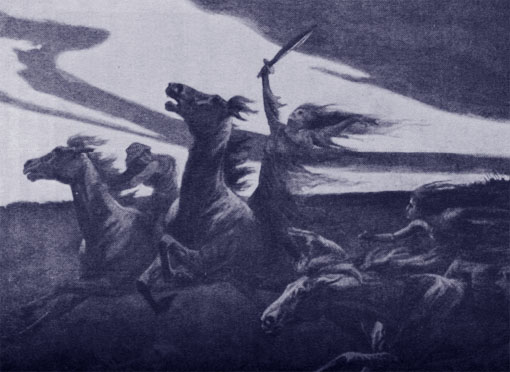
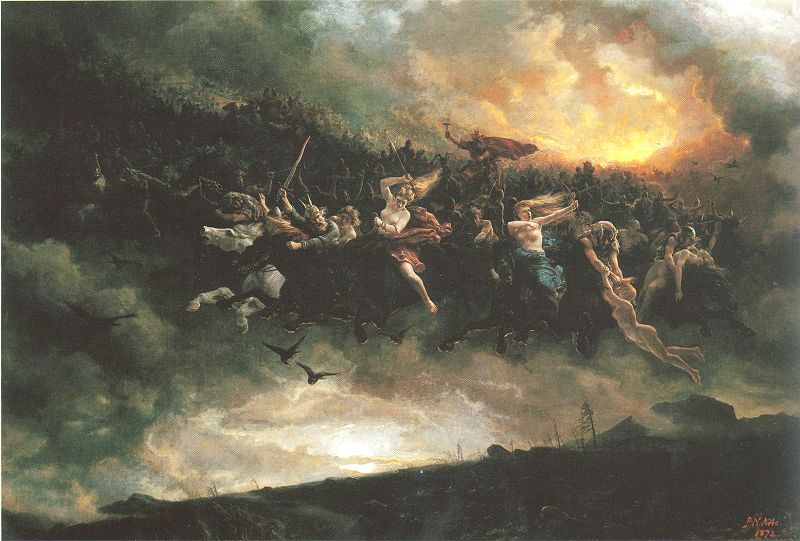
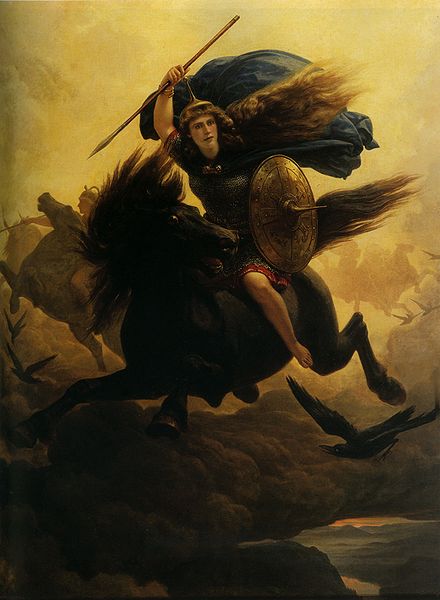
Åsgårdsreien
(The Wild Hunt)
Loudly through air at night they haste,
An uproar on wild black horses!
As a storm the wild crowds travel by
With nothing but clouds for foothold.
Over the valleys, the woods and meadows –
Through darkness and weather, they never heed.
The traveler throws himself frightened to ground.
Listen… what clamor! It’s the forces of Asgard!
Thor, the strong one, his hammer high,
Stands tall in his rig, in front of the pack.
He strikes his shield and hot red flames
Light up the nightly raid at the scene.
Horns blow, and an awesome noise
From bells and riding gear resounds.
Then the pack roars loudly and people listen
With rising fear in their quaking homes.
The Wild Hunt of Asgard raids the county
Whilst fall and winter at stormy nights.
But it favors to travel at Yuletide…
They feast with trolls and giants;
they closely ride by meadow and path
And pass the fearful nation.
Then, – take care farmer! Keep all in order!
As the wild hunt of Asgard may visit your home!
With the beer working in your lodge
Awaking the heathen Yule-tradition…
And fire from the fireplace shines
on swinging knives and crazy eyes,
Then a sudden shiver goes through the party,
Then sound the nightly black riders’ clamor…
Then the walls crack and the glasses dance;
the Armies of Asgard surround the building!
 
There was a wedding at Oevre Flage
Three holy Yule-days to the end.
Among the maids there were none like the bride
And no rival to the groom among men.
There was a glow to the shining hall
from set tables and expensive metal,
There was a treasure, the rumor says,
Of copper on walls and silver on tables.
And merrily sounded the drums and fiddles
as the groom was steadily dancing
leading his bride among young men and women –
Then the Halling-dance easily rumbled!
To the Dancer’s forceful moves and jumps
the Maiden would swing like a pendulum,
Then floated the noise and the music together
And the hall would thunder from vigor and delight.
The third night, -when the beer was consumed
through all the holidays – by old and young,
Then thirst in the party was stopped,
But the men were drunken and slow.
Our bride wore her crown…
It was time for the bowl to be sent round the table
And the toastmaster demanded silence
with a knock on the table, – and started his speech.
Then charging in on the benched circle
the widely infamous Seim’s Berserks,
Their eyes were rolling dark and wild
On their foreheads they had scars from fighting.
They leaped over the floor of the hall,
-Yes! It was the brothers Grim and Wolf!
Grim, who was recently turned down by the bride
Came there himself, – and he was not invited.
The sleepy guests got up shaking
 And had little desire for fighting.
Every raving man who raised his fist
Was grabbed by the chest and thrown aside.
The groom placed his mug down on the table
Stepped up on the bench and asked for peace.
But the brothers already took out their knives,
– It was the groom’s life it was all about.
Then women gathered into a crowd
and formed a guard for the man in danger;
sheltered behind tables and benches,
They stood closed in at the Bench of Honor.
The eldest woman in their circle
removed her headwear, revealed her gray hair
and gave the groom the name of her son,
Embraced him and sat him on her knee.
But the brothers wouldn’t listen to women’s plea –
Attacked forward over tables and benches
and divided the women with wildness-
Now every thought of peace was forgotten…
They grabbed their victim and dragged him along
To the door of the hall and out through it.
It came to a cruel fight in the yard,
And the guests followed in wild disorder.
They rushed out there with candles and torches,
‘Cause over the landscape the darkness reigned.
They saw the groom standing tall and strong,
As now he was strengthened by winter air.
He used his knife for cutting and slashing –
So he gave back what they offered him.
The three of them formed an ugly triangle,
And none would let go of the others.
Then, -all of a sudden Grim fell over!
With blood running like streams from his chest.
Then even harder the other two wrestled
And held each other’s backs in a grip.
In the end the groom was laid to the ground,
With the knife on it’s way to his throat…
But then Wolf held back and stood like a drunk,
And trembled and shook like a leaf.
As through the air in the dark came a thunder,
– a howling horde on ferocious horses,
It raced over woods to the wedding house,
Intended to visit the bloody performance.
Then horns blew, and an awesome noise
From bells and riding-gear resounded.
Now it was close – it came over the hill –
There was an outcry: The wild hunt of Asgard!
There was a tempest in Heaven and Earth,
That hurled a horror in every heart,
It blasted along in growing circles,
It punched with wings and grabbed with arms.
Then Wolf was dragged away by his hair,
thrown up in the air and taken away,
Yes, taken away over woods and mountains,
He was never seen or heard of again.
When tumults were over at the horror scene,
lay Grim from his death pains coiled up,
But the groom was escorted inside from the snow
And placed on a bunk in the guestroom.
His head was shaking, his blood was pouring;
he was pending a while between life and death,
But he was nursed and well taken care of,
so by spring he had healed from it all.
Now he sits there, – aged and well respected,
He can gather his offspring around the fire,
now he often tells stories in the circle
And shortens time for the young and the old.
It was like that last Yule-night too,
When the youth shouted, “Tell us, tell us!”
His eyes in flames as he was looking back…
And then he recalled his wedding days.

Johan Sebastian Welhaven (1807-1873

The Wild Huntsman
THY rest was deep at the slumberer’s hour
If thou didst not hear the blast
Of the savage horn, from the mountain-tower,
As the Wild Night-Huntsman pass’d,
And the roar of the stormy chase went by,
Through the dark unquiet sky!
The stag sprung up from his mossy bed
When he caught the piercing sounds,
And the oak-boughs crash’d to his antler’d head
As he flew from the viewless hounds;
And the falcon soar’d from her craggy height,
Away through the rushing night!

The banner shook on its ancient hold,
And the pine in its desert-place,
As the cloud and tempest onward roll’d
With the din of the trampling race;
And the glens were fill’d with the laugh and shout,
And the bugle, ringing out!

From the chieftain’s hand the wine-cup fell,
At the castle’s festive board,
And a sudden pause came o’er the swell
Of the harp’s triumphal chord;
And the Minnesinger’s∗ thrilling lay
In the hall died fast away.

The convent’s chanted rite was stay’d,
And the hermit dropp’d his beads,
And a trembling ran through the forest-shade,
At the neigh of the phantom steeds,
And the church-bells peal’d to the rocking blast
As the Wild Night-Huntsman pass’d.

The storm hath swept with the chase away,
There is stillness in the sky,
But the mother looks on her son to-day,
With a troubled heart and eye,
And the maiden’s brow hath a shade of care
Midst the gleam of her golden hair!

The Rhine flows bright, but its waves ere long
Must hear a voice of war,
And a clash of spears our hills among,
And a trumpet from afar;
And the brave on a bloody turf must lie,
For the Huntsman hath gone by!

Mrs. Felicia Dorothea Browne Hemans, 1793-1835

 
 images courtesy of wikicommons


Picnic in Akeldama

Cooking... And something like cooking...

Tales From The Under Gardener's Lodge

Home, hearth and life immeasurable

Of Axe and Plough

Anglo-Saxon Heathenry and Roman Polytheism

My search for magic

Looking for magic in the modern world

Man of Goda

People of Goda, Clan of Tubal Cain

The Elder Tree

Life as a Witch.

Sorcerous Transmutations

Meanderings of the Muse:honouring the sacred muse in word and vision

Across the Abyss

Meanderings of the Muse:honouring the sacred muse in word and vision

Clan of the Entangled Thicket 1734

Meanderings of the Muse:honouring the sacred muse in word and vision

Daniel Bran Griffith - The Chattering Magpie

Meanderings of the Muse:honouring the sacred muse in word and vision

The Cunning Apostle

Cunning Man, Mystic, Eccentric & Outcast