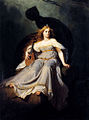
PARACELSUS

•July 23, 2012 • Leave a Comment

PROPHECY – PARACELSUS

Image


‘Therefore should you also know that the perfect Imagination coming from the Astral, issues from the Soul, wherein all Astra lie occult, and the Soul, Faith and Imagination, are three things to count, for the names are different, but they have equal force and strength, for one comes from the other, and I cannot compare it otherwise than with the Divine Trinity. For through the Soul we come to God, through Faith to Christ and through the Imagination to the Divine Spirit. Therefore also is to these three, even as to the Divine Trinity, nothing impossible.’


Image


Why should the Future not be known to us as the Past?

The Soul knows all things, the Soul being the Eternal Mind.

The self-inflicted eclipse of the Soul will not last for ever.

Sin is the result of Ignorance and Ignorance the cause of sin.

Where true knowledge flourishes sin dies

and man becomes a regenerate being.

Let us therefore endeavour to understand the ever – presence

of the Creator in the World and in Nature.

Wherever we rightly search Nature’s phenomena

we can infer from Manifestation to Cause,

from Cause to Thought,

from Thought to Law,

from Law to Love.

Nature, when rightly understood,

will be seen to act upon the principles of Thought that we can follow,

of Love that we can love and that loves us.

                                         By Nature we mean the creative Life in Nature.

Man should not be subject to Fate, as he now is,

but should be a Divine being guarded by Providence,

the Divine Mind.

If we could only realise that we are immortal beings,

how differently we should live!

Image

Prophecies of Paracelsus

 http://www.sacred-texts.com/pro/pop/pop03.htm


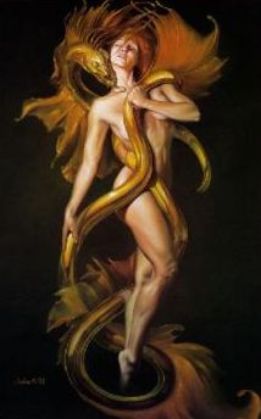
VIRGO LUCIFERA.

•July 10, 2012 • Leave a Comment

For nearly half an hour no one spoke. Then amidst a great sound the door of the dining hall swung open and thousands of lighted tapers held by invisible hands entered. These were followed by the two pages lighting the beautiful Virgo Lucifera seated on a self-moving throne. The white-and-gold-robed Virgin then rose and announced that to prevent the admission of unworthy persons to the mystical wedding a set of scales would be erected the following day upon which each guest would be weighed to determine his integrity. Those unwilling to undergo this ordeal she stated should remain in the dining hall. She then withdrew, but many of the tapers stayed to accompany the guests to their quarters for the night.
TEXT: http://www.sacred-texts.com/eso/sta/sta40.
iMAGE: htmbirthofgaia.com

Image

NEMESIS

•July 7, 2012 • Leave a Comment


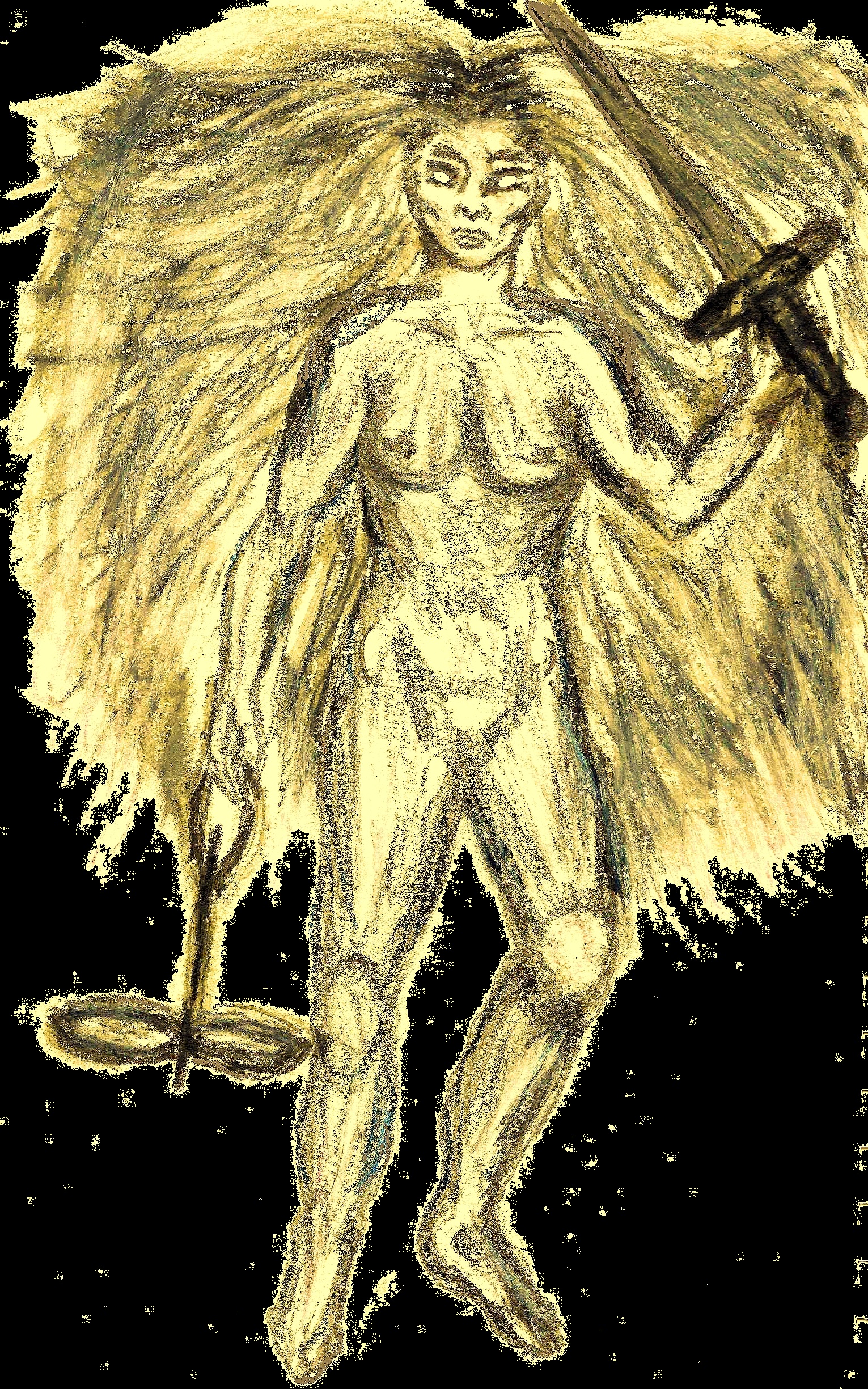
Blind Justice Sketch Copyright of Shani Oates

Nemesis was the goddess of indignation against, and retribution for, evil deeds and undeserved good fortune. She was a personification of the resentment aroused in men by those who commited crimes with apparent impunity, or who had inordinate good fortune.

Nemesis directed human affairs in such a way as to maintain equilibrium. Her name means she who distributes or deals out. Happiness and unhappiness were measured out by her, care being taken that happiness was not too frequent or too excessive. If this happened, Nemesis could bring about losses and suffering. As one who checked extravagant favours byTykhe (Fortune), Nemesis was regarded as an avenging or punishing divinity.

In myth Nemesis was particularly concerned with matters of love. She appears as an avenging agent in the stories of Narkissos and Nikaia, whose callous actions brought about the death of their wooers. In some versions of the Trojan War, she was the mother of Helene, and is shown in scenes of her seduction by Paris pointing an accusing finger at the girl.

Nemesis was often sometimes depicted as a winged goddess. Her attributes were apple-branch, rein, lash, sword, or balance. Her name was derived from the Greek wordsnemêsis and nemô, meaning “dispenser of dues.” The Romans usually used the Greek name of the goddess, but sometimes also called her Invidia (Jealousy) and Rivalitas (Jealous Rivalry).

http://www.theoi.com/Daimon/Nemesis.html

Nemesis was the goddess of righteous indignation who punished boasts of hubris.

Hesiod, Works and Days 175 ff (trans. Evelyn-White) (Greek epic C8th or C7th B.C.) :
“Would that I were not among the men of the fifth age, but either had died before or been born afterwards. For now truly is a race of iron, and men never rest from labour (kamatos) and sorrow (oizys) by day, and from perishing by night; and the gods shall lay sore trouble upon them. But, notwithstanding, even these shall have some good mingled with their evils.

And Zeus will destroy this race of mortal men also when they come to have grey hair on the temples at their birth. The father will not agree with his children, nor the children with their father, nor guest with his host, nor comrade with comrade; nor will brother be dear to brother as aforetime. Men will dishonour their parents as they grow quickly old, and will carp at them, chiding them with bitter words, hard-hearted they, not knowing the fear of the gods. They will not repay their aged parents the cost their nurture, for might shall be their right: and one man will sack another’s city.

There will be no favour (kharis) for the man who keeps his oath or for the just (dikaios) or for the good (agathos); but rather men will praise the evil-doer (kakos) and his violent dealing (hybris). Strength will be right (dike) and reverence (aidos) will cease to be; and the wicked will hurt the worthy man, speaking false words against him, and will swear an oath upon them. Envy (zelos), foul-mouthed, delighting in evil, with scowling face, will go along with wretched men one and all.

And then Aidos (Shame) and Nemesis (Indignation), with their sweet forms wrapped in white robes, will go from the wide-pathed earth and forsake mankind to join the company of the deathless gods: and bitter sorrows (lugra algea) will be left for mortal men, and there will be no help against evil.”

http://www.theoi.com/Daimon/Nemesis.html

Hymn to Nemesis
 (1st Century C.E.)

(for Voice, Lyra, Psithyra)

“Nemesis, winged one that tips the scales of life,
dark-eyed goddess, daughter of Justice,
you restrain the futile pride of mortals with your unyielding bridle and,
hating hurtful vanity, destroy black envy: below your wheel, always
moving but leaving no trace, the fortune of man turns.
Unseen, you come at once to defeat arrogance;
by your hand you gauge the span of life, and, frowning,
you scrutinize the thoughts of men, you always hold the balance.
Be merciful, hallowed judge, winged Nemesis, life’s force.
We honor you, Nemesis, immortal goddess,
victory incarnate with wings unfurled, faultless,
sharing the throne of Justice; you resent human vanity and banish
men to Tartarus below”

Hymn to Nemesis

Nemesis I call,
Almighty Queen
whose piercing sight sees all the deeds of mortals,
Eternal and much revered.
who alone judges the deeds of mortals.

Wise counselor,
who changes the course of the human heart,
forever transforming,
working without rest.

Every mortal knows Your influence,
men groan beneath the weight of Your righteous chains.

You know the thoughts in every mind,
and the soul ruled by lawless lust,
unwilling to obey reason, is judged by You.

Divine Equity,
Yours is the power to see and hear and rule.

Come, Holy Goddess, and listen to my prayer,
and take these mystics under Your protection.

Far avert form us,
Oh Nemesis,
dire and hostile impious counsels, arrogant and base.

And give us beneficent aid in our hour of need,
And abundant strength lend to our powers of reason.

http://www.sibyllineorder.org/sacred_texts/oh_nemesis.htm

The Longobards: King Sheave

•July 2, 2012 • Leave a Comment


King Sheave


Their need he healed,

 and laws renewed long forsaken.

 Words he taught them wise and lovely –

 their tongue ripened in the time of Sheave

 to song and music.

Secrets he opened runes revealing.

Riches he gave them,

 reward of labour, wealth and comfort

 from the earth calling, acres ploughing,

 sowing in season seed of plenty,

 hoarding in garner golden harvest

 for the help of men.

 The hoar forests

 in his days drew back to

the dark mountains;

 the shadow receded, and shining corn,

 white ears of wheat, whispered in the breezes

 where waste had been.


The woods trembled.

 Halls and houses hewn of timber,

strong towers of stone steep and lofty,

 golden-gabled, in his guarded city

 they raised and roofed.

In his royal dwelling

 of wood well-carven

the walls were wrought;

 fair-hued figures filled with silver,

 gold and scarlet, gleaming hung there,

 stories boding of strange countries,

 were one wise in wit the woven legends

 to thread with thought.


At his throne men found

 counsel and comfort and care’s healing,

 justice in judgement. Generous-handed

 his gifts he gave. Glory was uplifted.

 Far sprang his fame over fallow water,

 through Northern lands the renown echoed

 of the shining king, Sheave the mighty.


J. R. R. Tolkien treated Sceaf in a poem “King Sheave” which was published after his death in “The Lost Road” in The Lost Road and Other Writings and very slightly revised. In Tolkien’s treatment, a ship drifts to the land of the Longobards in the north.

It beaches itself and the folk of that country enter and found a young and handsome boy with dark hair asleep with a “sheaf of corn” as his pillow and a harp beside him.

The boy awoke the following day and sang a song in an unknown tongue which drove away all terror from the hearts of those who heard.

They made the boy their king, crowning him with a garland of golden wheat. Tolkien’s Sheave fathers seven sons from whence came the Danes, Goths, Swedes, Northmen, Franks, Frisians, Swordmen (Brongdingas), Saxons, Swabes, English, and the Langobards.


http://en.wikipedia.org/wiki/Sceafa

all photo images:copyright of shani oates

The Vigil

•June 27, 2012 • Leave a Comment


Image

In my world of shadows, the day draws long;

Silence echoes across the chambers of my soul.

Hesper rages in plumes of violet and crimson;

Tis all too beautiful, too painful to hold.

Whom is that yet fleeting, darts o’er the skies;

Twas only the silver’ed moon in Time..

Pale is Her cast upon me as I stand;

Dark is Her mood within me told.

Torrents engulf the ion streamed air;

Infusion, breath, exhalation;

Life is cold without the beloved.

Icy needles indent my skin;

Shards of light refracting another.

In this simulacra, I am redeemed;

Ignis reigns supreme.

Inward dancing, leaping high;

Fly, fly, fly……………….

Summer Solstice

•June 19, 2012 • Leave a Comment

Summer Solstice

This ancient solar fire festival of the Sun celebrates the longest day, the zenith of the Sun’s powers, and paradoxically its decline. It is a celebration of the solar logos, of light, energy and magick, for a double paradox exists in the Sun’s entry into Cancer, a water sign, ushering in the cooling, healing empathic energy of this feminine element. Fire and water, an alchemical marriage of the spirit, not a harmony, but a fusion of polar opposites. Prometheus brought us wisdom in the form of fire; Ra, the Phoenix, re-births us in his celestial fire. Horus is the Egyptian form of the rising Sun; Seth, the Lord of the dying Sun. Many of his other names and forms are known to us throughout the eclectic mythologies of the world, here is to name but a few: Shamash, Ba-al, Belanus, Apollo, Ahura Mazda, Mithras, Azazel, Shemzazza, and of course Lucifer……………all shining beings of light, the Lux Mundi, light of the World.
Many Kings and Heroes adopted solar attributes as sympathetic magick and by dedication to their deity. Examples of these are Lugh, Llew, and Marduk; interestingly, the Anglo-Saxons did not worship a solar deity, which to them was feminine, but preferred instead to elevate their Gods of war to prominence. The solar wheel, the spinning disk, traversing the heavens, represented almost all of these. This symbol evolved into the simple equal armed cross within a circle, immortalised in stone as the ‘Saxon Cross’, which itself became surmounted upon the phallic upright Godstones, to provide the final form we now see as the pillared monoliths, union of the symbols of Sun and Phallus.

To our own ancestors, fire too has played a most important role; as hereditary priest kings, the dragon [serpent] lords of smith-craft of all Smith-Craft, we are therefore called upon to hallow these symbols of his power and to celebrate all their aspects that have shaped our craft over generations and millennia.

For thousands of years mankind has worshipped the Sun, its mysteries were practised by many ancient cultures and priesthoods: the Egyptians, Phoenicians, Hindus, Chinese, Japanese, Canaanites, Moabites, Persians, Hittites, Assyrians, Babylonians, Syrians, Greeks, many North and Central Native American Tribes, Vogul and Siberian Shamans, and of course, Druids. Interestingly many of these correlated the generative power of the Sun with that of the serpent, becoming synonymous over millennia. Thus, Helel-ben Shahar, ‘Sun’ of the Morning star manifests the sexual potency within the megalithic orthostats that scatter the landscape of the entire earth.

Everywhere, examples of these phallic sunstones, the erotic energy of the cosmos ranging in size from the tiniest of several mm [worn as amulets and talismans] to several metres, monuments and objects of worship and reverence. These single standing stones, often called Herm posts or Godstones, worshipped as phallic images are emblematic of the solar life-force. Maintaining an earlier ancient connection to the stars as the ‘Axis Mundi’, centre of the world and our ladder to the Stars, flaming torches/wands were waved high into the air, tracing out secret symbols by the priests as they invoked these stellar powers. These were perceived as guardians of the thresholds between heaven and earth, that later became replaced by solar and lunar cults, absorbing and retaining these original functions.
In Sumerian mythology, Mammu, the original mother Goddess of the primal deep [the apsu] births heaven [Enlil] and earth [Enki], but she bequeaths her own watery powers to Enki, the god of wisdom, sorcery, magick and seduction…………primal power, emotional empathy and re-generative fertility………..No small wonder that our ancestors worshipped him as the ‘Lord of this World, of sweet waters, wisdom and magic.’
In Vedic mythology, the Sun is also perceived as the creator, redeemer and preserver of mankind, the Lord and Saviour. Fire is the active, male generative spirit force, water is the passive female principle within creation……….however, these are curiously worshipped with a baptismal rite [the force of water] upon the linghams, the phallic ‘Godstones’ of Shiva. Moreover, the trident of Shiva, a phallic symbol of creativity endorses a rite that equates with that of Priapus in Greece. Circle dances, fire rites and orgiastic dancing prevail within this joyous celebration activating many levels of consciousness, through sexual, emotional, physical and spiritual synthesis. In Greece, a similar rite was performed, where water was poured upon a stone phallus of Pan.
Superficially, these may be seen as simple acts of fertility, but they do conceal a deeper meaning. Many Gnostic sects [including early Christianity], performed rites of baptism, of anointing the body with water, during high summer in emulation of these ancient rites. John the Baptist, a noted Essene, [select Gnostic priesthood], viewed by many, including the Templars, to be a solar deity, has a birthday around the Solstice. It is noteworthy that within Enochian Freemasonry, the inheritors of much Templar lore, both the Summer and Winter Solstices are the two most important tides of the year.

So to summarize, the themes are regeneration, baptismal, healing, and most importantly………..joyous. It is probably the ‘lightest’ within the ritual year [pun intended], and should of course be held, if possible sometime between sunrise and noon, being very much a daytime rite. Even better, is to truly set the scene by travelling to one of the many ancient sites around the county that has a ‘Godstone’, in situ. This can be combined with a picnic and a light-hearted paddle/water fight [weather permitting].

Thus we celebrate all that is good in life…….

‘The Tree of Forgiveness’

•June 18, 2012 • Leave a Comment

Cloths of Heaven – William Butler Yeats

Had I the heavens’ embroidered cloths,
Enwrought with golden and silver light,
The blue and the dim and the dark cloths
Of night and light and the half light,
I would spread the cloths under your feet:
But I, being poor, have only my dreams;
I have spread my dreams under your feet;
Tread softly because you tread on my dreams.


Image

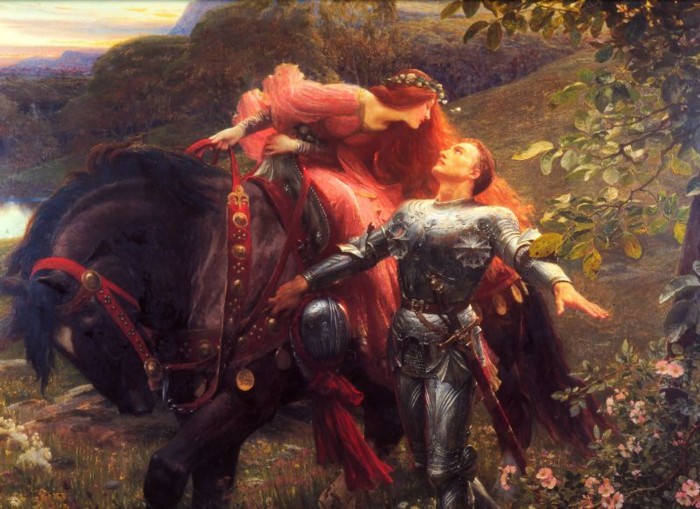
La Belle Dame Sans Merci

(image by E. C. Burne Jones)

Jeanne d’arc

•June 10, 2012 • Leave a Comment

Jeanne d'arc

14 JOAN of ARC
” A blessed spot ! oh, How my soul enjoy’d
Its holy quietness, with what delight,
Escaping humankind, I hastened there
To solitude and freedom ! Thitherward
On a spring eve I had betaken me,
And there I sat, and mark’d the deep red clouds
Gather before the wind, the rising wind,
Whose sudden gusts, each wilder than the last,
Seem’d as they rock’d my senses. Soon the niglit
Darken’d around, and the large rain-drops fell
Heavy; anon with tempest rage the storm
Howl’d o’er the wood. Methought the heavy rain
Fell with a grateful coolness on my head,
And the hoarse dash of waters, and the rush
Of winds that mingled with the loadest roar.
Made a wild music. On a rock I sat.
The glory of the tempest fill’d my soul.
And when the thunders peal’d, and the long flash
Hung durable in heaven, and to mine eye
Spread the grey forest, all remembrance left
My mind, annihilate was every thought,
A most full quietness of strange delight;
Suspended all my powers; I seem’d as though.
Dissolved into the scene.
33 ” The forms of worship in mine earlier years
Waked my young mind to artificial awe,
And made me fear my God. Warm with the glow
Of health and exercise, whene’er I pass’d
The threshold of the house of prayer, I felt
A cold damp chill me; I beheld the flame
That with a pale and feeble glimmering
Dimmed the Moonlight ; I heard the solemn mass.
And with strange feelings and mysterious dread
Telling my beads, gave to the mystic prayers
Devoutest meaning. Often when I saw
The pictured flames writhe round a penanced soul,
Have I retired, and knelt before the cross
And wept for grace, and trembled and believed
A God of Terrors. But in riper years,
When as my soul grew strong in solitude,
I saw the eternal energy pervade
The boundless range of nature, with the sun
Pour life and radiance from his flamy path,
And on the lowliest flower, a violet of the field
The kindly dew-drops shed. And then I felt
That He who form’d this goodly frame of things
Must needs be good, and with a Father’s name
I call’d on Him, and from my burthen’d heart
Pour’d out the yearnings of unmingled love.
Methinks it is not strange, then, that I fled
The house of prayer, and made the lonely grove
My temple, at the foot of some old oak
Watching the little tribes that had their world
Within its mossy bark; or laid me down
Beside the rivulet, whose murmuring
Was silence to my soul, and mark’d the swarm
Whose light-edged shadows on the bedded sand
Mirror’d their mazy sports ; the insect hum,
The flow of waters, and the song of birds
Making most holy music to mine ear:
Ob! was it strange, if for such scenes as these,
Such deep devoutness, such intense delight
Of quiet adoration, I forsook
The house of worship ?

http://archive.org/stream/joanofarcballads00sout/joanofarcballads00sout_djvu.txt

A solitary image for contemplation

•June 1, 2012 • 2 Comments

The Four Winds

•May 29, 2012 • Leave a Comment

THE FOUR WINDS, CHARIOT-STEEDS OF ZEUS

The setting of the Pleiades in November marked the beginning of the stormy season. Zeus, Olympian storm god, was often depicted within his chariot drawn by the four enigmatic and much stylised horse-shaped winds.

ASTRAEUS Titanic father of the stars, the planets and the four seasonal winds by EOS Winged goddess of the Dawn who heralds the rising of the sun with her rosy beauty.

AEOLUS  Ruler of the winds appointed by Zeus guards the storm winds Anemoi Thuellai and Aellai .  Securely locked away inside the floating island of Aeolia, released only at the bequest of the gods to wreak havoc upon the seas and on land. Aeolus is ‘King’ of the Castle there. Since the Winds were often conceived of as horse-shaped spirits, Aiolos was titled Hippotades, “the reiner of horses,” from the Greek hippos(horse) and tadên (reined in tightly).

AETHER Aither The primeval god of the shining light of the blue sky. He was conceived of as the substance of light, a layer of bright mist which lay between the dome of heaven and the lower air which surrounded the earth.

ANEMOI  Anemoi/aetes : The gods of the four directional winds and the heralds of the four seasons.

  • Boreas, the North Wind, the Thrall of Winter.
  •  Zephyros, the West Wind, the Herald of Spring.
  •  *Euros, the East Wind, the Descent of Autumn.
  • Notos, the South Wind, Flame of Summer.

Closely aligned with the Seasons, Boreas gripped the land with the icy breath of Winter; Zephyros ushered in fresh spring breezes and Notos showered the fecund earth with Summer rain-storms. *Eurus, the East Wind had not originally been associated with any of the three primary Greek Seasons and is therefore not mentioned in Hesiod’s Theogony or in the Orphic Hymns.

Represented through mythologized forms, the Wind-Gods often appeared as either winged, man-shaped gods or horse-like divinities that grazed the shores of the river Okeanos. The latter were stabled in the caverns of Aiolos Hippotades, the Horse-Reiner and Ruler of the Winds.

Homer and Hesiod distinguish the freedoms of the Seasonal Anemoi from the Anemoi Thuellai of Storms and Hurricane incarcerated within the caverns of Aiolos or the pit of Tartaros  guarded vigilantly by the Hekatonkheires. Later authors, however, blurred this vital distinction between them.

According to Hesiod (Theog. 378, &c., 869, &c.) Notus, Boreas, Argestes, and Zephyrus as the sons of Astraeus and Eos were beneficial winds; the wild and destructive winds such as Typhon borne of Typhoeus were clearly not. Philosophical writers frequently endeavoured to define the winds more accurately according to their place upon the Compass.

“When in combat with the mighty Zeus, He [Typhoeus] suffered the fourfold compulsion of the four Winds. For if he turned flickering eyes to the sunrise [the East], he received the fiery battle of neighbouring Euros. If he gazed towards the stormy clime of the Arkadian Bear [the North], he was beaten by the chilly frost of wintry whirlwinds. If he shunned the cold blast of snow-beaten Boreas, he was shaken by the volleys of wet and hot together. If he looked to the sunset [the West], opposite to the dawn of the grim east, he shivered before Enyo and her western tempests when he heard the noise of Zephyros cracking his spring-time lash; and Notos [in the South], that hot wind, round about the southern foot of Aigokeros [Capricorn] flogged the aerial vaults, leading against Typhon a glowing blaze with steamy heat.”

ANEMOI THUELLAI: The Daemones Spirits of whirlwinds, hurricanes and all violent storm-winds. These pneumatic offspring of the monster Typhoeus were locked away inside Tartarus or the floating island of Aeolus to be released only at the express command of the gods. Their female counterparts were the Aellai, Thuellai or Harpyiai(Harpies). Known as the hounds of Zeus, they were blamed for the disappearance of people without a trace. Mating with these they sired swift, immortal horses.

KHAOS  Primeval goddess of the atmosphere, the region between heaven and earth. She was the air which men breathed. Below Her lay the Earth, and above Her shone the mists of the Protogenos Aether. Khaos Mothered the Darkness, Night and of all Birds.

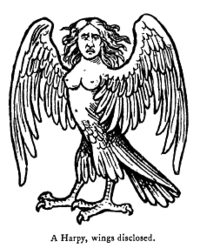
HARPYIAE (Harpyiai) Sisters of Iris and daughters of Thaumas and Electra.

In Greek mythology, a Harpy (snatcher) was any one of the mainly winged death-spirits best known for constantly stealing all food from Phineas. The literal meaning of the word is rooted in the ancient Greek word harpazein: “to snatch“.

Conversely, the Harpy could also bring life. A Harpy mothered the horses of Achilles (Iliad xvi. 150) as sired by the West Wind Zephyros. In this context Jane Harrison adduced the notion in Virgil‘s Georgics that mares became ‘gravid’ by the Wind alone. This suggests immediately the violent sexuality attributed to these phenomenon (iii.274).

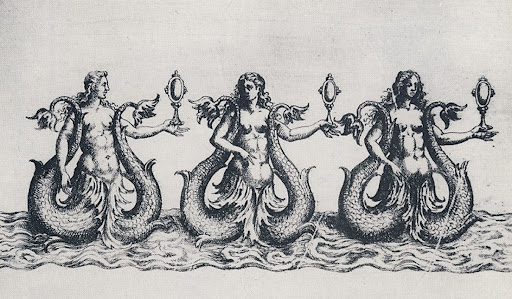
In Hesiod’s Theogony, they are named as two ‘lovely-haired’ creatures of great beauty. This revision is built upon an earlier perception of them as terrifying monsters, which parallels the cognate transformation of the Siren. Yet another sensual female Zoomorph much maligned albeit one later redeemed as the mournful death angel. A vase in the Berlin Museum depicts a Harpy whose head is recognizably that of a Gorgon, complete with rolling eyes, protruding tongue and tusks, grasping a small figure of a hero in each clawed foot.

In this form they were the agents of punishment who abducted and tortured those hapless souls on their way to Tartarus. They were vicious, cruel and violent. Their domain was the Strophades where they personified the destructive nature of tempestuous storm. Traditionally, the Harpies formed a triad of three sisters: Aello (storm swift), Celaeno (the dark), also known as Podarge (fleet-foot) and Ocypete (the swift wing).

  •  

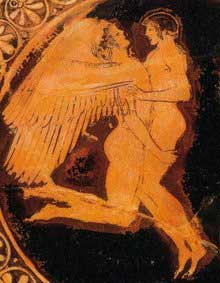
Boreas : Greek god of the cold North Wind and  harbinger of winter. His name meant “North Wind” or “Devouring One”. Boreas is depicted as being very strong, with a violent temper to match. He was frequently shown as a winged old man with shaggy hair and beard, holding a conch shell and wearing a billowing cloak. Pausaniaswrote that Boreas had snakes instead of feet, though in art he was usually depicted with winged human feet.

Boreas, closely associated with horses was said to have fathered twelve ethereal colts after taking the form of a stallion upon the mares of Erichthonius, king of Troy. The Greeks believed that his home was in Thrace. Herodotus and Pliny both describe a northern land known as Hyperborea(Beyond the North Wind), where people enjoyed longevity and peace.

Zephyrus/ Zephyr Latin Favonius, the West Wind. The gentlest of the winds, Zephyrus is known as the fructifying wind, the messenger of spring. It was thought that Zephyrus lived in a cave in Thrace.

Zephyrus was the amorous husband to several wives. He was said to be the husband of his sister Iris, the goddess of the rainbow. He abducted another of his sisters, the goddess Chloris, and gave her the domain of flowers. With Chloris, he fathered Carpus (fruit). He is said to have vied for Chloris’s love with his brother Boreas, eventually winning her devotion. Additionally, with yet another sister and lover, the Harpy Podarge (also known as Celaeno), Zephyrus was said to be the father of Balius and Xanthus, Achilles‘ horses.

One of the surviving myths in which Zephyrus features most prominently is that of Hyacinth. Hyacinth was a very handsome and athletic Spartan prince. Zephyrus fell in love with him and courted him, as did Apollo. The two competed for the boy’s love who chose Apollo, driving Zephyrus mad with jealousy. Later, catching Apollo and Hyacinth throwing a discus, Zephyrus blew a gust of wind at them, striking the boy in the head with the falling discus. When Hyacinth died, Apollo created the hyacinth flowerfrom his blood.

In the story of Cupid and Psyche, Zephyrus served Cupid by transporting Psyche to his cave.

Roman deities equivalent to the Anemoi were known as the Venti (winds). Despite different names they were otherwise very similar to their Greek counterparts, borrowing their attributes and being frequently conflated with them.

Aquilo

The Roman equivalent of Boreas was Aquilo, or Aquilon. An alternative and  less common name used for the northern wind was Septentrio. Derived from septem triones (seven oxen) it refers to the seven prominent stars in the northern constellation Ursa Major. Septentrio is also the source of the obscure word septentrional, a synonym for borealmeaning northern.

Notus the south wind associated with the desiccating hot wind of the rise of Sirius after midsummer, and was thought to bring the storms of late summer and autumn, and was feared as a destroyer of crops.

Auster

Notus’ equivalent in Roman mythology was Auster, the embodiment of the sirocco wind, who brought heavy cloud cover and fog or humidity. Austeris also the name of a defunct British aircraft manufacturer from the 1940s–1950s.

Eurus represents the unlucky east wind. He was thought to bring warmth and rain, and his symbol was an inverted vase, spilling water.

Vulturnus

His Roman counterpart was Vulturnus, not to be confused with Volturnus, a tribal river-god who later became a Roman deity of the River Tiber.

Favonius

Zephyrus’ Roman equivalent was Favonius, who held dominion over plants and flowers. The name Favonius, which meant “favorable”, was also a common Roman name.

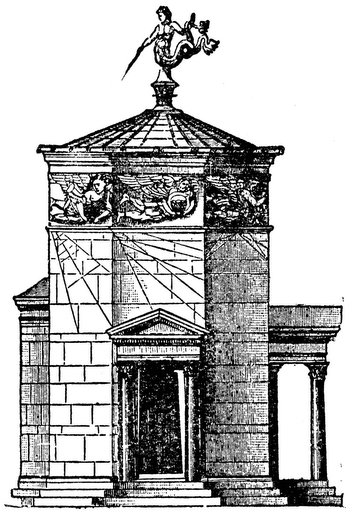
Tower of the Winds in Athens

Additionally, four lesser Anemoi were sometimes referenced, representing the northeast, southeast, northwest, and southwest winds totalling eight winds in all.

Eight winds: Zephyros, Boreas, Notos, Euros, Kaikias, Apeliotes, Skiron and Lips.

Four lesser wind deities appear in a few ancient sources, such as at the Tower of the Windsin Athens. Originally, as attested in Hesiod and Homer, these four minor Anemoi were the Anemoi Thuellai(Άνεμοι θύελλαι; Greek: “Tempest-Winds”), wicked and violent daemons(spirits) created by the monster Typhon, and male counterparts to the harpies, who were also called thuellai. These were the winds held in Aeolus‘s stables; the other four, “heavenly” Anemoi were not kept locked up. However, later writers confused and conflated the two groups of Anemoi, and the distinction was largely forgotten.

Kaikias was the Greek deity of the northeast wind. He is shown as a bearded man with a shield full of hail-stones, and his name derives from the Ancient Greek kakía (κακία), “badness” or “evil”. Kakia is also the name of a spiritof vice, the sister of Arete(“virtue”). The Roman deity equivalent to Kaikias was Caecius.

Apeliotes, sometimes known to the Romans as Apeliotus, was the Greek deity of the southeastwind. As this wind was thought to cause a refreshing rain particularly beneficial to farmers, he is often depicted wearing gumboots and carrying fruit, draped in a light cloth concealing some flowers or grain. He is cleanshaven, with curly hair and a friendly expression. Because Apeliotes was a minor god, he was often synthesized with Eurus, the east wind. Subsolanus, Apeliotes’ Roman counterpart, was also sometimes considered the east wind, in Vulturnus’ place.

Skiron, or Skeiron, was the Greek god of the northwestwind. His name is related to Skirophorion, the last of the three months of spring in the Attic festival calendar. He is depicted as a bearded man tilting a cauldron, representing the onset of winter. His Roman counterpart is Caurus, or Corus. Corus was also one of the oldest Roman wind-deities, and numbered among the di indigetes (“indigenous gods”), a group of abstract and largely minor numinous entities.

Livas, was the Greek deity of the southwestwind, often depicted holding the stern of a ship. His Roman equivalent was Afer ventus (“African wind”), or Africus, due to Africabeing to the southwest of Italy. This name is thought to be derived from the name of a fanciful North African tribe, the Afri. However, Africus was, like Corus, one of the few native Roman deities, or di indigetes, to endure in later Roman mythology. The di indigetes (“indigenous gods”) were a group of Roman gods, goddesses and spirits not adopted from other mythologies, as opposed to the di novensides (“newcomer gods”) in Georg Wissowa’s terminology. This goes some way toward ruling out any tribal name as the basis for the Roman wind god Africus.

NAMES OF ANEMOI
Eight Wind-Gods were depicted on the Tower of the Winds in Athens dating from the C1st B.C. They were:–
BOREAS The god of the North-Wind is depicted with shaggy hair and beard, with a billowing cloak and a conch shell in his hands.
KAIKIAS The god of the North-East Wind is represented as a bearded man with a shield full of hail-stones.
APELIOTES The god of the East Wind appears as a clean-shaven man, holding a cloak full of fruit and grain.
EUROS The god of the South-East Wind who is sculpted as a bearded man holding a heavy cloak.
NOTOS The god of the South Wind pours water from a vase.
LIPS The God of the South-West Wind is represented holding the stern of a ship.
ZEPHYROS God of the West-Wind is depicted as a beardless youth scattering flowers from his mantle.
SKIRON The god of the North-West is a bearded man tilting a cauldron, signifying the onset of winter. The cloud collecting and rain-fraught [Corus – Roman] (north-west gale).

Orphic Hymn 80 to Boreas (trans. Taylor) (Greek hymns C3rd B.C. to 2nd A.D.) :
“To Boreas (North-Wind), Fumigation from Frankincense. Boreas, whose wintry blasts, terrific, tear the bosom of the deep surrounding air; cold icy power, approach, and favouring blow, and Thrake awhile desert, exposed to snow: the air’s all-misty darkening state dissolve, with pregnant clouds whose frames in showers resolve. Serenely temper all within the sky, and wipe from moisture aither’s splendid eye.”

Orphic Hymn 81 to Zephyrus :
“To Zephyros (West-Wind), Fumigation from Frankincense. Sea-born, aerial, blowing from the west, sweet Breezes (Aurai), who give to wearied labour rest. Vernal and grassy, and of murmuring sound, to ships delightful through the sea profound; for these, impelled by you with gentle force, pursue with prosperous fate their destined course. With blameless gales regard my suppliant prayer, Zephyros unseen, light-winged, and formed from air.”

Orphic Hymn 82 to Notus :
“To Notos (South-Wind), Fumigation from Frankincense. Wide-coursing gales, whose lightly leaping feet with rapid wings the air’s wet bosom beat, approach, benevolent, swift-whirling powers, with humid clouds the principles of showers; for showery clouds are portioned to your care, to send on earth from all-surrounding air. Hear, blessed power, these holy rites attend, and fruitful rains on earth all-parent send.”

“In Titane there is also a sanctuary of Athena, into which they bring up the image of Koronis [mother of Asklepios] . . . The sanctuary is built upon a hill, at the bottom of which is an Altar of the Anemoi (Winds), and on it the priest sacrifices to the Anemoi (Winds) one night in every year. He also performs other secret rites [of Hekate] at four pits, taming the fierceness of the blasts [of the winds], and he is said to chant as well the charms of Medea.”
Virgil, Aeneid 3. 209 ff (trans. Day-Lewis) (Roman epic C1st B.C.) :
“Bird-bodied, girl-faced things they [the Harpyiai] are; abominable their droppings, their hands are talons, their faces haggard with hunger insatiable.”

NYX  The primeval goddess of night. In the evening Nyx drew her curtain of dark mists across the sky, cloaking the light of her son Aether, the shining blue sky. In the morn, her daughter Hemera (the goddess Day) lifted the dark mantle.

OCEANIDES  (Okeanides)The daughters of the earth-encircling river Oceanus. Some of these were nymphs of clouds (Nephelae) and moistening breezes (Aurae).

References

The Anemoi[From Wikipedia, the free encyclopedia]
wikicommons images

{
 
Picnic in Akeldama

Cooking... And something like cooking...

Tales From The Under Gardener's Lodge

Home, hearth and life immeasurable

Of Axe and Plough

Anglo-Saxon Heathenry and Roman Polytheism

My search for magic

Looking for magic in the modern world

Man of Goda

People of Goda, Clan of Tubal Cain

The Elder Tree

Life as a Witch.

Sorcerous Transmutations

Meanderings of the Muse:honouring the sacred muse in word and vision

Across the Abyss

Meanderings of the Muse:honouring the sacred muse in word and vision

Clan of the Entangled Thicket 1734

Meanderings of the Muse:honouring the sacred muse in word and vision

Daniel Bran Griffith - The Chattering Magpie

Meanderings of the Muse:honouring the sacred muse in word and vision

The Cunning Apostle

Cunning Man, Mystic, Eccentric & Outcast